

During the recent $14.2 billion multi-week contraction in stablecoin supply—the largest liquidity pullback seen since the 2022 market fallout—the dynamic between Tether (USDT) and Circle (USDC) has split into two key trends: supply share (market cap) versus transactional share (on-chain settlement).
1. Market Cap Dominance: USDT Proves Stickier in Retrenchment
While both stablecoins logged multi-billion-dollar supply contractions, USDT’s dominance expanded relative to the broader market, while USDC experienced a larger proportional drawdown.
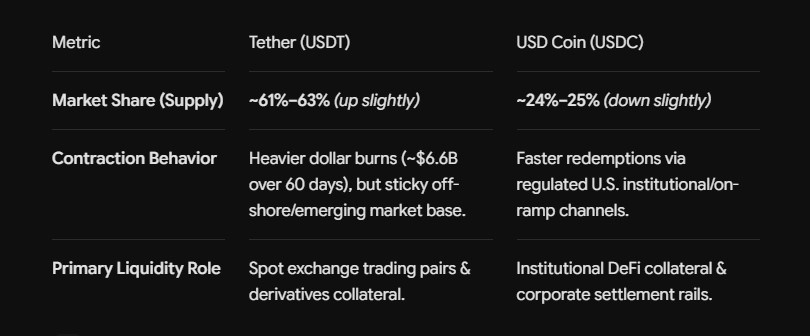
Why USDT's dominance held firm: Tether serves as the foundational reserve currency across offshore centralized exchanges (CEXs) and emerging market payment corridors. Because traders use USDT as primary trading quote pairs, capital converted to cash often stays inside USDT on-chain unless funds exit the crypto system altogether.
Why USDC contracted faster by percentage: USDC is tightly linked to U.S. institutional access, regulated entities, and decentralized finance (DeFi) protocols. As institutions de-risk or seek high risk-free returns in short-term U.S. Treasuries, USDC is more easily redeemed directly into fiat bank accounts.
2. The Divergence: Volume Dominance vs. Supply Dominance
Despite USDT holding over double the market cap of USDC, the underlying utility metrics tell a more nuanced story:
Centralized Trading Volume: USDT continues to dominate centralized exchange order books, accounting for over 70% of CEX trading volume.
On-Chain Settlement Volume: USDC has maintained a strong lead over USDT in net annualized transaction volume across networks like Ethereum, Solana, and Base, driven by B2B cross-border payments, programatic smart contracts, and institutional clearing.
Key Takeaway for Market Liquidity
When market liquidity drops sharply, USDT acts as the safer "parking harbor" for active crypto traders, causing its supply dominance percentage to rise even during aggregate burns. Conversely, USDC acts as the primary fiat off-ramp for institutional capital, making its balance sheet more sensitive to traditional macro yield competition and regulatory de-risking cycles.

