

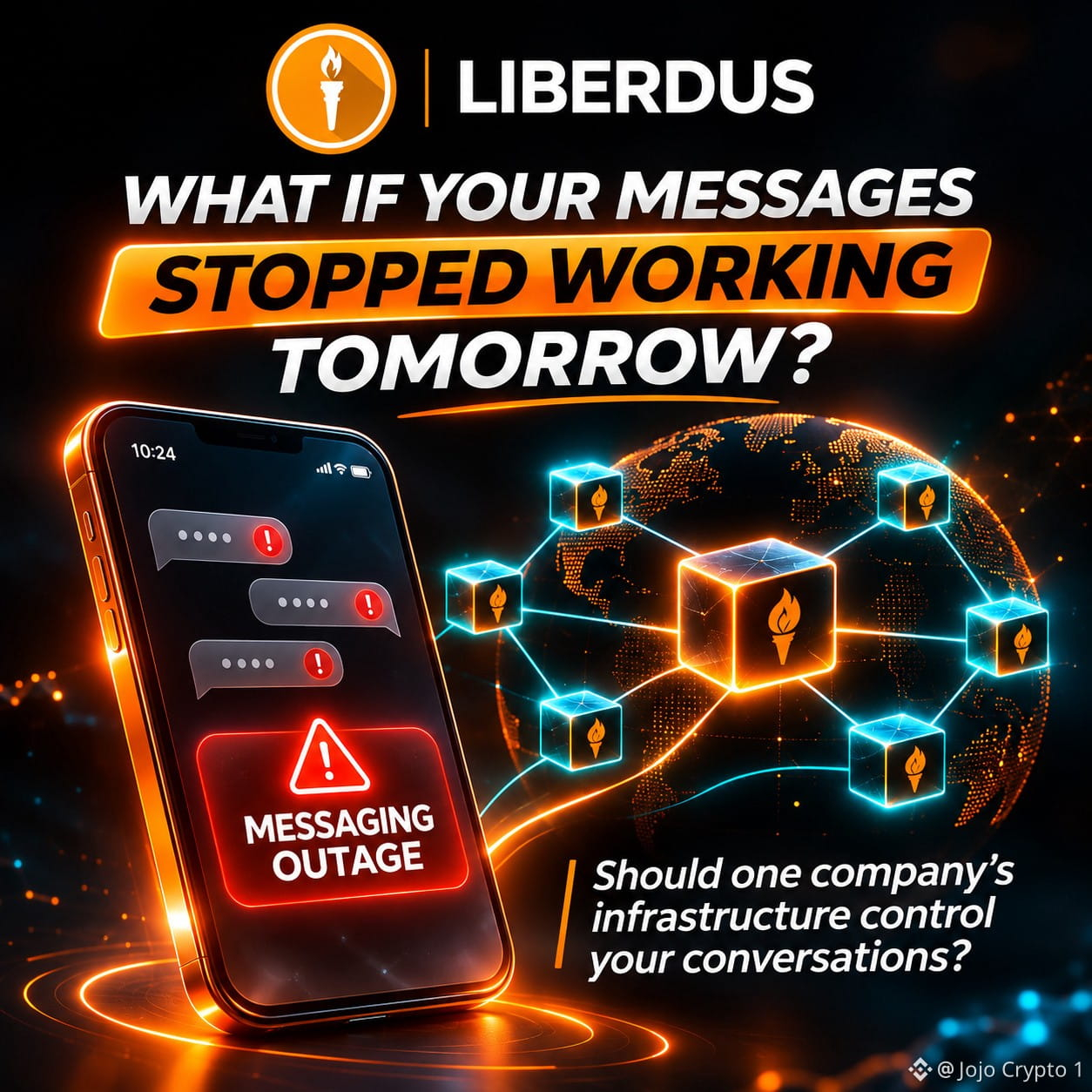
What happens when the app connecting millions of people suddenly stops working? Imagine a messaging platform going offline for an entire day. Businesses lose contact with customers. Families struggle to reach each other. Teams can't coordinate their work, and important conversations are interrupted. It's easy to forget how much of our daily communication depends on infrastructure we don't control. In crypto, we've spent years discussing decentralization, self-custody and reducing our dependence on intermediaries. $BTC challenged the idea that transferring value must depend on a central authority. But communication raises a similar question. Why should millions of conversations depend on infrastructure controlled by a single company? That's one reason liberdus caught my attention. The discussion around decentralized messaging goes beyond privacy. It also raises important questions about how communication networks are designed and who controls their infrastructure. Of course, decentralization doesn't eliminate every risk. Distributed networks can still experience connectivity issues, technical failures and service interruptions. The real challenge is building systems that remain useful and accessible even when individual components fail. Because digital independence isn't just about controlling your assets. It's also about reducing unnecessary dependencies in the tools we use every day. **If your primary messaging app disappeared for 24 hours, what would be the biggest consequence for you?** #BTC #Bitcoin #Macro Insights#
انضم إلى مُستخدمي العملات الرقمية حول العالم على Binance Square
⚡️ احصل على أحدث المعلومات المفيدة عن العملات الرقمية.
💬 موثوقة من قبل أكبر منصّة لتداول العملات الرقمية في العالم.
👍 اكتشف الرؤى الحقيقية من صنّاع المُحتوى الموثوقين.
البريد الإلكتروني / رقم الهاتف