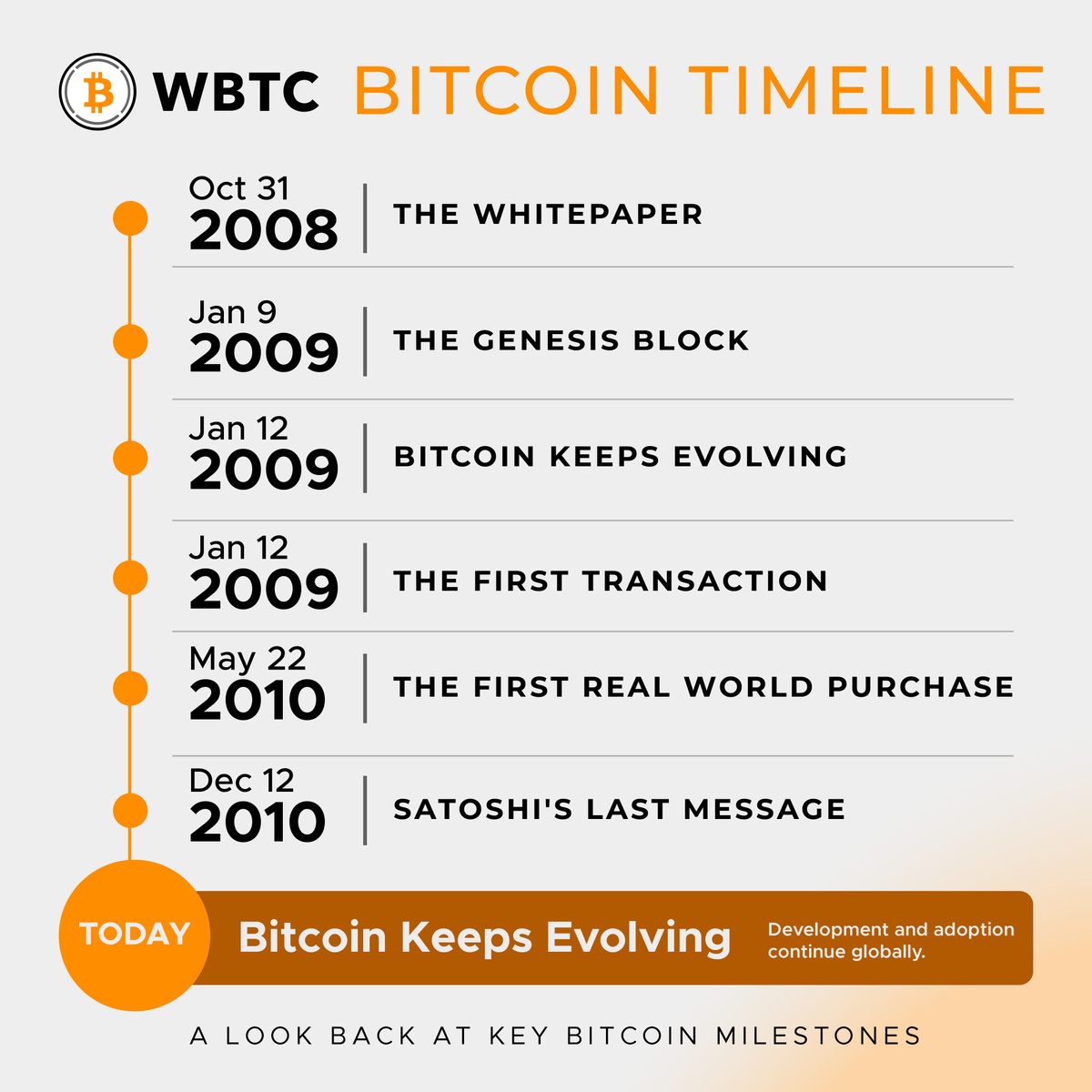
WBTC's historical overview traces Bitcoin from its earliest milestones to its role in contemporary financial markets.
The source identifies January 3, 2009, as the date of Bitcoin's first block and initial issuance, January 12, 2009, as the first transaction milestone, and May 22, 2010, as an early commercial-use milestone.
It also references Satoshi Nakamoto's disappearance from public participation in December 2010.
These dates help illustrate how Bitcoin developed from an experimental payment network into a widely recognized digital asset.
The initial design focused on value transfer
Bitcoin introduced a mechanism for recording and validating transactions without relying on a conventional central ledger operator.
Its architecture combines cryptographic signatures, distributed verification, and consensus rules.
The system's primary function was not to provide a general-purpose environment for complex financial applications.
Market development expanded Bitcoin's role
As infrastructure matured, exchanges, custody services, and financial products emerged around BTC.
These developments created new ways to access and manage Bitcoin exposure.
However, market infrastructure should be distinguished from changes to Bitcoin's underlying protocol.
Wrapped Bitcoin represents another stage
WBTC allows BTC-linked value to operate on compatible smart-contract networks.
This extends Bitcoin's financial reach without requiring the Bitcoin base layer itself to execute those applications.
The trade-off is the introduction of custody and tokenization dependencies.
Historical continuity does not imply identical risks
Native BTC, exchange-held BTC, and WBTC represent different operational arrangements.
Even when they track the same underlying asset, users may encounter different custody, counterparty, and technical risks.
A historical clarification
The source's December 12, 2010 reference is best understood as part of the period when Satoshi withdrew from public involvement, rather than a precisely established final disappearance date.
The broader historical point remains that Bitcoin continued developing without its creator's ongoing public leadership.
The analytical conclusion
Bitcoin's evolution demonstrates how a relatively focused monetary protocol can support an expanding financial ecosystem.
WBTC belongs to that evolution as an interoperability instrument.
Its value lies in extending Bitcoin-linked financial functionality while making the additional trust and infrastructure requirements explicit.