
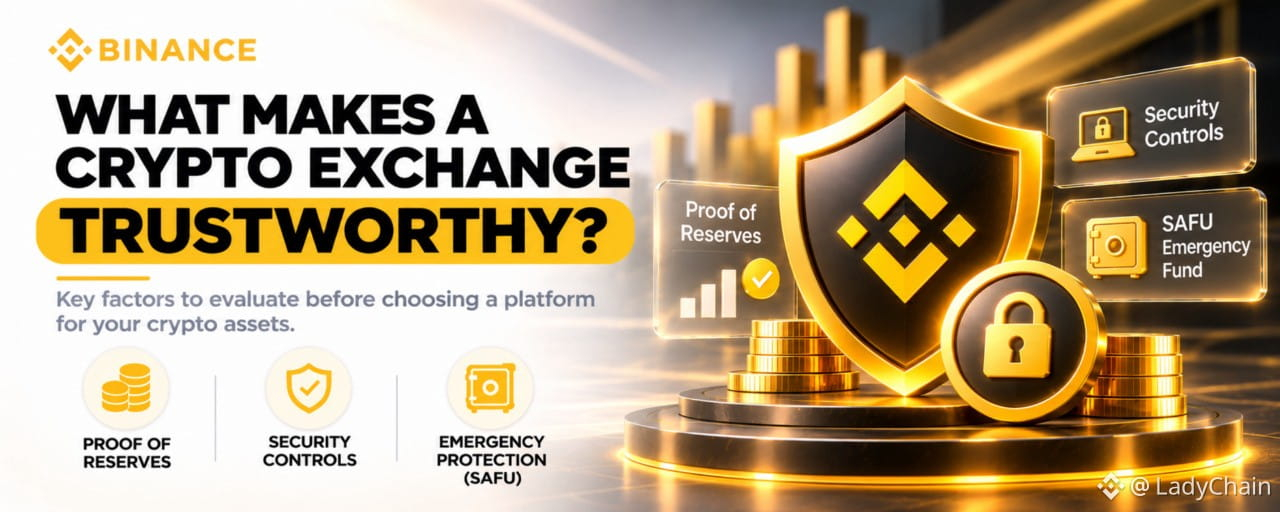

Choosing a crypto exchange is not simply about finding the lowest trading fees, the largest number of listed assets, or the most recognizable brand.
A trustworthy exchange should be able to demonstrate how it protects customer assets, verifies its financial position, complies with applicable regulations, and responds when something goes wrong.
But there is an important distinction: trust should be based on verifiable evidence, not promises made in marketing materials.
Here are the key factors to examine before choosing a crypto exchange, with examples of how users can evaluate Binance's publicly documented safeguards and incident-response actions.
1. Can You Verify the Exchange's Reserves and Your Account Balance?
Financial transparency is one of the first things worth examining.
A crypto exchange should provide clear information about the assets it holds and how customers can verify their reported balances.
One mechanism used by exchanges is Proof of Reserves (PoR).
Binance's PoR system uses two cryptographic technologies:
Merkle Trees: Organize account balance information so users can check whether their balances are included in a published snapshot.
zk-SNARKs: Provide cryptographic verification that helps demonstrate the reported balances are included in the calculation without publicly exposing individual account information.
Users can visit the Binance Proof of Reserves dashboard and follow the verification process to check their own account balances.
Official resource: https://www.binance.com/en/proof-of-reserves
What should you look for?
When reviewing an exchange's reserve disclosures, ask:
Are reserve reports publicly accessible?
How frequently are snapshots published?
Can individual users independently verify their balances?
Which assets are included?
Does the exchange explain the verification method and its limitations?
Does Proof of Reserves prove an exchange is financially healthy?
Not entirely.
PoR provides evidence about reported reserve assets and the inclusion of user balances in a particular verification. However, it is not a complete financial audit.
It does not independently establish that every liability has been disclosed, prove long-term solvency, or guarantee that withdrawals will always be available.
For a more complete assessment, users should examine reserve information alongside financial disclosures, withdrawal conditions, custody arrangements, and incident history.
2. What Security Controls and Independent Assessments Does It Have?
An exchange should explain how it protects customer assets against unauthorized access, compromised credentials, insider threats, and attacks on its infrastructure.
Some security controls worth examining include:
Asset custody
Cold storage arrangements for assets held offline.
Multi-signature authorization for sensitive wallet transactions.
Clear explanations of how customer assets are stored and managed.
Account protection
Two-factor authentication (2FA).
Passkeys and phishing-resistant authentication.
Anti-phishing codes.
Withdrawal address allowlisting.
Suspicious-activity monitoring and security notifications.
Infrastructure and security assessments
Regular vulnerability assessments and penetration testing.
Independent cybersecurity reviews.
Documented incident-response procedures.
Public explanations of completed security improvements.
Binance provides several account-security features and publishes information about its security practices through its official resources.
Official resource: https://www.binance.com/en/security
However, the presence of security features alone does not prove that an exchange is immune to attacks.
Users should also examine whether an exchange provides credible evidence of security assessments. Pay attention to who conducted an assessment, what systems were covered, when it took place, and whether the findings or remediation steps were disclosed.
A useful distinction is that Proof of Reserves and cybersecurity assessments answer different questions. One concerns reported asset backing; the other examines the security of systems and infrastructure.
3. How Does It Protect Users When Something Goes Wrong?
A platform's response during a serious incident can reveal more about its accountability than its marketing claims.
Before choosing an exchange, investigate:
Whether it has a documented incident-response process.
How it communicates with affected users.
Whether it explains who is responsible for eligible losses.
Whether compensation arrangements have clearly defined conditions.
How it restores services and addresses the underlying problem.
Understanding Binance's SAFU Fund
The Secure Asset Fund for Users (SAFU) was established by Binance in 2018 as an emergency reserve intended to provide an additional layer of protection in extreme situations.
It is important to understand that SAFU is not equivalent to government-backed deposit insurance.
Compensation depends on the applicable terms and Binance's determination of eligible incidents and losses. It should not be interpreted as a promise to reimburse every scam, trading loss, or compromised account.
Users can review the official SAFU documentation here:
https://www.binance.com/en/support/faq/detail/028799e730294ae4a9b382d60d350116
Why the October 2026 Binance security incident matters
A recent example shows why users should evaluate actual incident responses, not just advertised safeguards.
On October 29, 2026, Binance experienced a major security incident involving unauthorized withdrawals from its hot-wallet infrastructure.
According to Binance's published updates, approximately US$6.34 billion in digital assets were affected. The company said it would absorb the financial impact rather than pass the losses on to users.
The subsequent response included several documented actions:
Rebuilding affected wallet systems in a new environment.
Replacing affected devices and revoking associated credentials.
Strengthening wallet-service risk controls and AI-based behavioral anomaly detection.
Working with law enforcement and industry partners to trace and freeze affected assets.
Engaging independent cybersecurity experts to review the incident and recommend further improvements.
Binance reported that approximately 98% of affected assets had been replenished by November 4, 2026. It also published an expanded Proof of Reserves snapshot covering 44 tokens.
These figures and commitments are reported by Binance and should be understood as company disclosures, not independently verified conclusions about the incident's full impact.
Official references:
Initial incident findings and response: https://www.binance.com/en/blog/community/3229153443759566763
Recovery and expanded PoR update: https://www.binance.com/en/support/announcement/detail/c6ba9aa726974fc6b9332a2c8f63b405
The important lesson is not that an exchange can avoid every security incident. It is that users should examine the evidence: what happened, what was affected, what the company committed to, which actions were taken, and whether progress was communicated transparently.
4. How Transparently Does It Communicate During Security Incidents?
Even a platform with extensive security infrastructure can experience operational disruptions.
What matters next is how clearly it communicates with customers.
A responsible exchange should provide updates that explain:
What happened: A clear description of the confirmed incident and its known scope.
Which services were affected: Information about deposits, withdrawals, trading, or other impacted services.
What actions are being taken: Details about containment, investigation, and recovery.
What has been restored: Specific information about service availability and remaining restrictions.
What will change: Documented improvements intended to reduce the likelihood of similar incidents.
Binance's October–November 2026 recovery announcements provide an example of phased communication. Following the incident, withdrawal services were reopened progressively as security and readiness checks were completed.
This is an important detail: a general announcement that withdrawals have resumed does not necessarily mean every asset and network is available immediately. Users should check the relevant withdrawal page and network status before initiating a transfer.
A useful way to assess transparency is to compare announcements over time. Do they provide measurable progress? Are earlier statements updated when new information becomes available? Are unresolved issues clearly acknowledged?
A trustworthy communication process should make it possible for customers to distinguish confirmed facts from preliminary findings and future commitments.
5. Does Regulatory Compliance Matter?
Yes. An exchange's regulatory status is another important part of evaluating its credibility.
However, licensing is jurisdiction-specific. Authorization in one country does not automatically mean that a platform is authorized to provide every service in another.
For Indonesian users, the relevant authority is the Otoritas Jasa Keuangan (OJK).
OJK publishes a whitelist of licensed or registered digital financial asset and crypto trading providers. Consumers are advised to use the listed entities and their official applications, websites, and channels.
Before using a platform, check:
Whether the legal entity appears on the relevant official list.
Whether the platform's name and website match the published information.
Whether the specific service you intend to use is covered.
Whether you are accessing an official application or website.
Do not assume that an exchange's global security measures automatically provide local regulatory authorization or protections in Indonesia.
6. What Other Signs Should You Examine?
Beyond reserves, security, incident response, and regulation, several practical details can help you evaluate an exchange.
Withdrawal reliability
Check whether withdrawal procedures, fees, limits, supported networks, and service interruptions are clearly communicated.
Transparent fees
Review trading fees, deposit and withdrawal charges, spreads, and conversion costs. A platform advertising zero trading fees may still have other costs.
Customer support
Look for accessible support channels, clear complaint procedures, and a way to follow up on unresolved issues.
Operating history
Review how long the exchange has operated, whether it has experienced major incidents, and how it communicated and responded to them.
Clear company accountability
Find out which legal entity operates the service and whether the platform explains its responsibilities to customers.
No single factor is enough to establish trustworthiness. The overall picture matters.
Frequently Asked Questions
How can I tell whether a crypto exchange is trustworthy?
Start by checking its regulatory status in your jurisdiction. Then examine its Proof of Reserves or other financial disclosures, custody arrangements, security controls, withdrawal procedures, fees, customer support, and incident-response history.
Look for information that can be independently verified rather than relying solely on marketing statements or social media recommendations.
Does Proof of Reserves guarantee safety?
No. Proof of Reserves helps users verify reported reserve coverage and whether their balances are included in a published snapshot. It does not constitute a complete financial audit or guarantee long-term solvency, uninterrupted withdrawals, or protection against every security incident.
It should be considered alongside other financial, operational, regulatory, and security information.
Final Verdict: Trust Should Be Built on Evidence
A trustworthy crypto exchange should be able to demonstrate more than popularity, trading volume, or attractive fees.
The strongest signs are:
Verifiable financial disclosures and reserve information.
Clear asset custody and account-security practices.
Appropriate regulatory authorization for the relevant jurisdiction.
Reliable withdrawal procedures and transparent fees.
Accessible customer support and clear accountability.
Documented incident responses and measurable improvements.
Binance's Proof of Reserves, SAFU, security controls, and published response to the October 2026 incident offer concrete examples users can examine. They should be evaluated alongside the limitations and risks described above.
My recommendation: Before depositing funds, ask one question: Can this exchange show verifiable evidence of how it protects customer assets—and explain what happens when those protections fail?
Trust is not established by a promise. It is built through evidence, accountability, and consistent actions.
What do you check first when evaluating a crypto exchange: regulatory status, Proof of Reserves, security measures, or its history of handling incidents?