
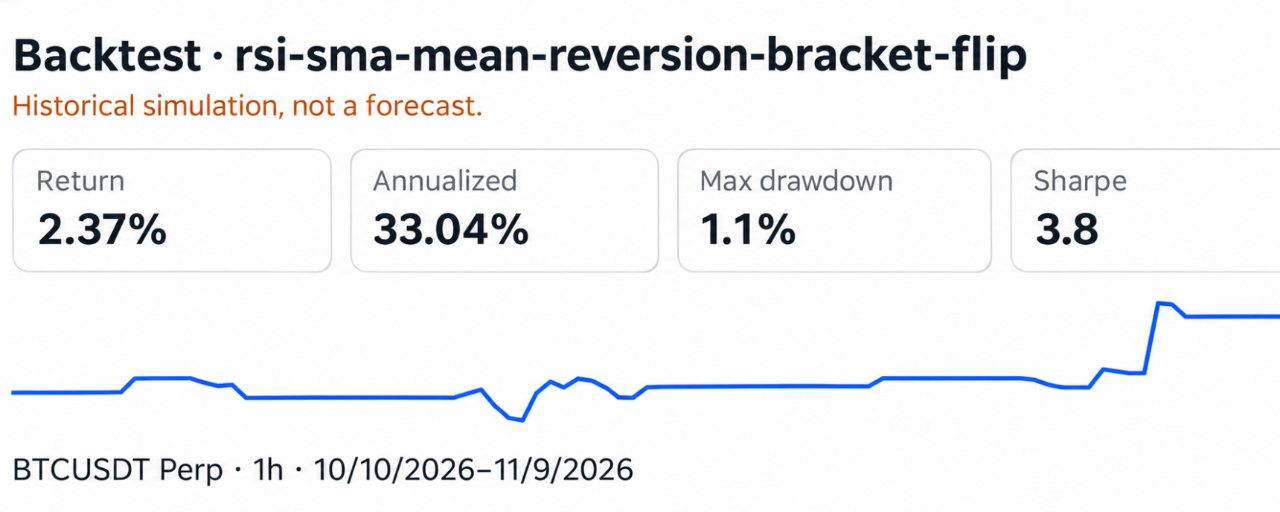

A backtest result is only useful when someone else can inspect the assumptions behind it. I ran a small BTCUSDT perpetual experiment and wrote down the configuration, the result, and the tests that still need to be done.
The strategy:
The rule set combines RSI and a simple moving average:
- Market: Binance BTCUSDT perpetual
- Bars: 1 hour
- Test window: October 10–November 9, 2026
- Starting capital: 100,000 USDT
- Leverage: 1×
- Position sizing: about 30% of capital per position
- RSI: 14 periods, with 30/70 thresholds
- SMA: 60 periods
- Fees: 0.02% maker and 0.05% taker
- Funding payments: not modeled
- Additional slippage: not modeled
The idea is intentionally simple: look for short-term RSI extremes, but use the SMA as a basic regime filter rather than treating every oversold or overbought reading the same way.
What the run produced
The 30-day window returned 2.37%, with 2,372.39 USDT in realized P&L. Maximum drawdown was 1.10%. The run recorded a 50% win rate, a 3.63 profit factor, a 3.80 Sharpe ratio, 14 closed positions, and 28 orders.
Those numbers are observations from one short historical simulation—not evidence that the strategy is robust. Fourteen closed positions are too few to support a strong conclusion, and the unusually high Sharpe ratio should be treated as a prompt for more testing.
What I would test next
1. Extend the window across trending, ranging, and high-volatility regimes.
2. Add funding and a realistic slippage model.
3. Run out-of-sample and walk-forward tests.
4. Sweep RSI thresholds and SMA lengths to identify parameter cliffs.
5. Compare results on adjacent liquid markets rather than optimizing only BTCUSDT.
6. Inspect every fill and exit to verify that the implementation matches the intended rules.
Why this workflow is useful
The main value is not the headline return. It is the ability to move from an idea to an inspectable experiment inside an AI coding workspace, then challenge the result with explicit follow-up tests.
I’m part of the team building AlgoRover.ai, which I used to run and inspect this test. AlgoRover can be installed in Codex, Cursor, or Claude Code to run and review the same kind of backtest.
Disclosure: this is a historical simulation, not a forecast or investment recommendation.