
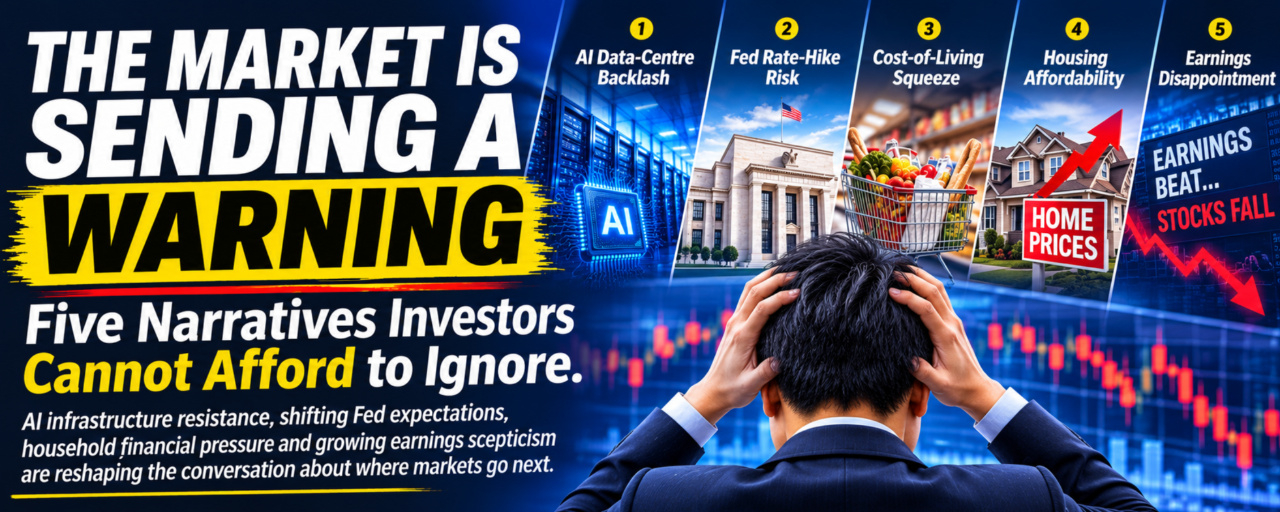

From the AI infrastructure boom to the cost-of-living crisis, public sentiment is revealing a changing relationship between economic growth, corporate valuations and investor confidence.
Markets rarely change direction without warning. Sometimes the earliest indications do not come from earnings statements, central bank announcements or economic forecasts. They emerge in public conversations, where investors, consumers, analysts and ordinary people begin questioning assumptions that financial markets have taken for granted.
Over the past week, November 1–8, 2026, conversations on X have revealed an increasingly cautious market mood. Five narratives have been gaining momentum, each reflecting a different source of economic anxiety. Some concern the sustainability of corporate growth, others point to monetary tightening, declining affordability and growing scepticism about the returns being generated by massive corporate investments.
What makes these narratives particularly interesting is their interconnectedness. The debate surrounding artificial intelligence, for example, is no longer exclusively about technological innovation. It is increasingly about infrastructure costs, electricity demand, political resistance, capital expenditure and the ability of technology companies to generate returns from their investments.
For investors, these conversations deserve attention.
1. The AI Infrastructure Boom Meets Political Reality
The dominant emotion: Fear and uncertainty.
Perhaps the most striking narrative gaining momentum this week is the growing political and regulatory resistance to AI data centres in the United States.
For several years, the artificial intelligence investment thesis has been built around an assumption that demand for computing capacity will continue expanding almost without interruption. Technology companies have committed enormous amounts of capital to data centres, semiconductor infrastructure, energy supply and cloud computing capacity in anticipation of a future increasingly powered by #AI .
But the conversation is changing.
Following the November 3–6 US electoral developments, discussions on X increasingly focused on local opposition to data centre developments, electricity consumption, water requirements, land use and the political implications of expanding AI infrastructure.
One widely circulated post by @jennystojkovic questioned whether the midterm developments had effectively punctured the AI bubble, linking the debate to a reported $2.5 trillion loss in technology market value during a major market selloff.
Another post by @MarvellousDev framed the developments more directly: data centres had lost political support, with local ballot outcomes potentially threatening planned infrastructure capacity.
The investment implications are significant, although the precise scale of the reported ballot outcomes and their effect on planned capacity require independent verification.
The important point is not that AI is suddenly becoming irrelevant. It is that the economics of building AI infrastructure may become more complicated.
Data centres require land, electricity, water, grid connections, regulatory approvals and substantial financing. Even where demand exists, the ability to build infrastructure profitably depends on securing these resources at an acceptable cost.
Investors should therefore begin distinguishing between companies that benefit from AI adoption and those whose valuations depend heavily on uninterrupted infrastructure expansion.
Semiconductor manufacturers, cloud providers, utilities, energy infrastructure companies and data centre operators may all experience different consequences.
The next phase of the AI investment story may be determined less by who has the most ambitious technology and more by who can deliver computing capacity economically, secure the necessary infrastructure and generate measurable returns.
The question investors should be asking is no longer simply how big AI can become, but how much it will cost to build the future everyone is betting on.
2. The Federal Reserve Is Becoming a Source of Market Anxiety Again
The dominant emotion: Anxiety.
Another rapidly climbing narrative concerns the changing expectations surrounding US monetary policy.
Markets that had previously anticipated interest rate cuts are now confronting the possibility that monetary easing could be delayed, or that interest rates may need to remain elevated for longer.
The discussion intensified following stronger-than-expected US employment figures, reportedly showing 165,000 additional jobs and an unemployment rate of 4.1%.
A post by @xiaojie8386 highlighted how the probability of a December Federal Reserve rate cut had fallen to approximately 27% on #Kalshi following the employment figures.
Other market commentary went further, suggesting that expectations were shifting towards a possible rate increase.
These probabilities should be treated as snapshots of market expectations rather than established forecasts. A stronger employment report alone does not determine the Federal Reserve's next decision.
Nevertheless, the broader implication is important.
Interest rates influence almost every major investment decision. They determine borrowing costs, affect the attractiveness of bonds relative to equities, influence corporate financing and help establish the discount rates investors use when valuing future earnings.
When markets anticipate lower interest rates, growth-oriented companies often benefit because their expected future earnings become more valuable in present-day terms.
When those expectations reverse, highly valued technology companies, leveraged businesses and speculative assets can become particularly vulnerable.
The implications also extend beyond Wall Street. Higher borrowing costs can affect housing, consumer credit, business expansion and government financing.
For investors, the critical development is the possibility that the anticipated relief from monetary tightening may not arrive as quickly as previously expected.
This creates an environment where companies must demonstrate stronger earnings resilience rather than relying on favourable financial conditions to support their valuations.
3. The Cost-of-Living Crisis Is Becoming an Investment Signal
The dominant emotion: Outrage and anxiety.
One of the most persistent narratives on X is also among the most revealing: ordinary people increasingly feel that full-time employment is no longer sufficient to guarantee a comfortable standard of living.
A post by @milesclips_ described working 40 hours in a week while facing grocery expenses of approximately $230, rent of $1,680 and rising insurance costs.
The central question was simple: when did working full-time stop being enough to afford a normal life?
This sentiment is particularly important because it moves the economic discussion beyond headline inflation figures.
An economy can report moderating inflation while households continue experiencing significant financial pressure. Prices do not necessarily return to previous levels simply because the rate at which they increase has slowed.
Housing, groceries, insurance, utilities, transportation and fuel all compete for household income. When these expenses rise faster than wages, disposable income contracts.
That has consequences for businesses.
Consumers under financial pressure may reduce discretionary spending, postpone purchases, trade down to cheaper alternatives and become more sensitive to price increases.
For investors, this creates an important distinction between companies selling essential products and those dependent on consumers having sufficient disposable income.
Retailers, consumer goods manufacturers, insurers, hospitality businesses and consumer credit providers may experience different pressures depending on their pricing power, customer base and exposure to household borrowing.
There is also an energy dimension. Geopolitical tensions and fuel-market uncertainty can increase transportation, manufacturing and agricultural input costs, potentially feeding into food prices and broader consumer inflation.
The opportunity for investors is to identify businesses capable of maintaining demand and protecting margins even when household purchasing power weakens.
The warning, however, is that strong nominal revenue growth does not necessarily indicate a healthy consumer market. Sometimes it simply reflects higher prices being paid for the same goods.
4. Housing Affordability Is Becoming a Structural Economic Problem
The dominant emotion: Anxiety.
The housing market continues to generate considerable frustration, particularly among younger households and prospective first-time buyers.
A widely circulated post by @BillWiIdin compared the increase in home prices since 2020 with the rise in mortgage interest rates and the much slower growth in median worker salaries.
The broader argument was that housing affordability has deteriorated because the cost of purchasing a home has moved significantly further away from what ordinary incomes can support.
This is an important distinction for investors.
A decline in house prices does not automatically make housing affordable. If mortgage interest rates remain elevated, monthly repayments can remain prohibitively expensive even when property values soften.
The housing market is therefore caught between two opposing pressures: households need lower prices and cheaper financing, while property owners, developers and lenders must contend with financing costs and market demand.
The consequences extend across the financial system.
Mortgage lenders face changes in borrowing demand and credit risk. Property developers must manage construction costs, financing expenses and slower sales. Real estate investment trusts may face pressure from higher financing costs and changing property valuations.
At the same time, rental demand may remain resilient where home ownership becomes increasingly inaccessible.
This creates opportunities and risks across residential property, construction materials, mortgage finance and rental markets.
Investors should pay particular attention to the relationship between household income, mortgage affordability, housing supply and financing costs rather than relying exclusively on headline property price movements.
Housing is not simply another investment asset. It is one of the largest components of household financial security, and prolonged unaffordability can eventually influence consumption, labour mobility and broader economic growth.
5. Strong Earnings Are No Longer Enough: Investors Want Proof of Returns
The dominant emotion: Disappointment and scepticism.
The fifth narrative concerns an increasingly uncomfortable development for equity investors: companies can report earnings above expectations and still see their share prices fall.
Discussion on X has increasingly focused on the difference between earnings performance and market reaction.
A post by @ChartLibraryio noted that approximately 78% of companies had beaten earnings estimates during the reporting season, yet the market reaction to those earnings surprises had been relatively muted.
The underlying message was that beating expectations is no longer sufficient. Investors want to understand what happens next.
This is particularly relevant to technology companies and those making substantial investments in artificial intelligence.
The market has already rewarded many businesses for their AI ambitions. But as capital expenditure expands, investors are becoming more interested in the financial returns generated by that spending.
How much revenue is AI actually generating? How much does it cost to operate? Is adoption translating into improved productivity? Are companies generating higher margins, or simply spending more to remain competitive?
These questions are becoming increasingly important.
A company can report impressive revenue growth while simultaneously committing enormous sums to infrastructure, research, computing capacity and acquisitions.
If those investments fail to generate sufficient returns, the business may eventually face valuation pressure despite continuing to grow.
This is where forward guidance becomes critical.
Investors are increasingly examining management's expectations for future revenue, margins, capital expenditure and profitability rather than celebrating historical earnings surprises.
The implications extend beyond the technology sector. Across the market, capital is likely to become more selective, favouring companies with demonstrable cash flows, disciplined investment strategies and credible growth prospects.
The era in which simply attaching an AI strategy to a corporate presentation could support investor enthusiasm may be giving way to a more demanding investment environment.
The Bigger Picture: Five Narratives, One Changing Market Psychology
Individually, these five narratives describe different economic developments. Together, they reveal a more important shift in investor psychology.
The AI infrastructure debate questions whether capital expenditure can generate adequate returns.
The Federal Reserve debate questions whether financial conditions will become more supportive or remain restrictive.
The cost-of-living crisis questions whether consumers can sustain existing levels of spending.
The housing affordability debate exposes structural pressure on household finances.
The earnings debate questions whether corporate growth is translating into genuine shareholder value.
There is a common thread running through all five: the market is becoming less willing to accept growth without examining its underlying economics.
This does not necessarily mean that a prolonged bear market is approaching. Markets can remain resilient even when public sentiment becomes pessimistic. Equally, negative sentiment can create opportunities when asset prices fall below their underlying economic value.
But it does suggest that investors should pay closer attention to the quality of growth, the cost of capital, consumer resilience and the sustainability of corporate investment.
What Investors Should Watch Next
The coming weeks could provide important clues about whether these narratives intensify or begin to fade.
For AI infrastructure, watch regulatory developments, local data centre approvals, electricity availability, hyperscaler capital expenditure and evidence of monetisation.
For monetary policy, watch inflation releases, employment data, Federal Reserve communications and changes in bond yields and interest-rate expectations.
For consumer resilience, watch retail sales, household credit delinquencies, wage growth and corporate commentary on consumer spending.
For housing, monitor mortgage rates, transaction volumes, inventory, affordability measures and rental demand.
For corporate earnings, pay particular attention to forward guidance, free cash flow, return on invested capital and whether AI-related spending is producing measurable productivity and revenue gains.
These indicators will help establish whether the current pessimism represents a temporary sentiment adjustment or the beginning of a more fundamental reassessment of market valuations.
Conclusion: Sentiment Is Not a Forecast, But It Is a Signal
X has become an important arena for observing how market participants interpret economic developments in real time.
Its value is not that every post is accurate. Many are exaggerated, politically motivated, speculative or based on incomplete information. Viral claims about market losses, election outcomes and interest-rate probabilities must always be independently verified.
Its value lies in identifying which concerns are gaining traction, how quickly they are spreading and which assumptions investors are beginning to question.
This week's five fastest-climbing narratives suggest that market participants are increasingly concerned about the relationship between economic growth and its actual cost.
For investors, that distinction matters.
The next winners may not necessarily be the companies promising the biggest technological breakthroughs, spending the most on infrastructure or reporting the strongest historical revenue growth.
They may be the businesses that can demonstrate sustainable demand, control their costs, allocate capital efficiently and convert innovation into durable cash flows.
In a market increasingly questioning the price of growth, the most valuable investment signal may be the ability to distinguish between what people are excited about and what businesses can actually deliver.