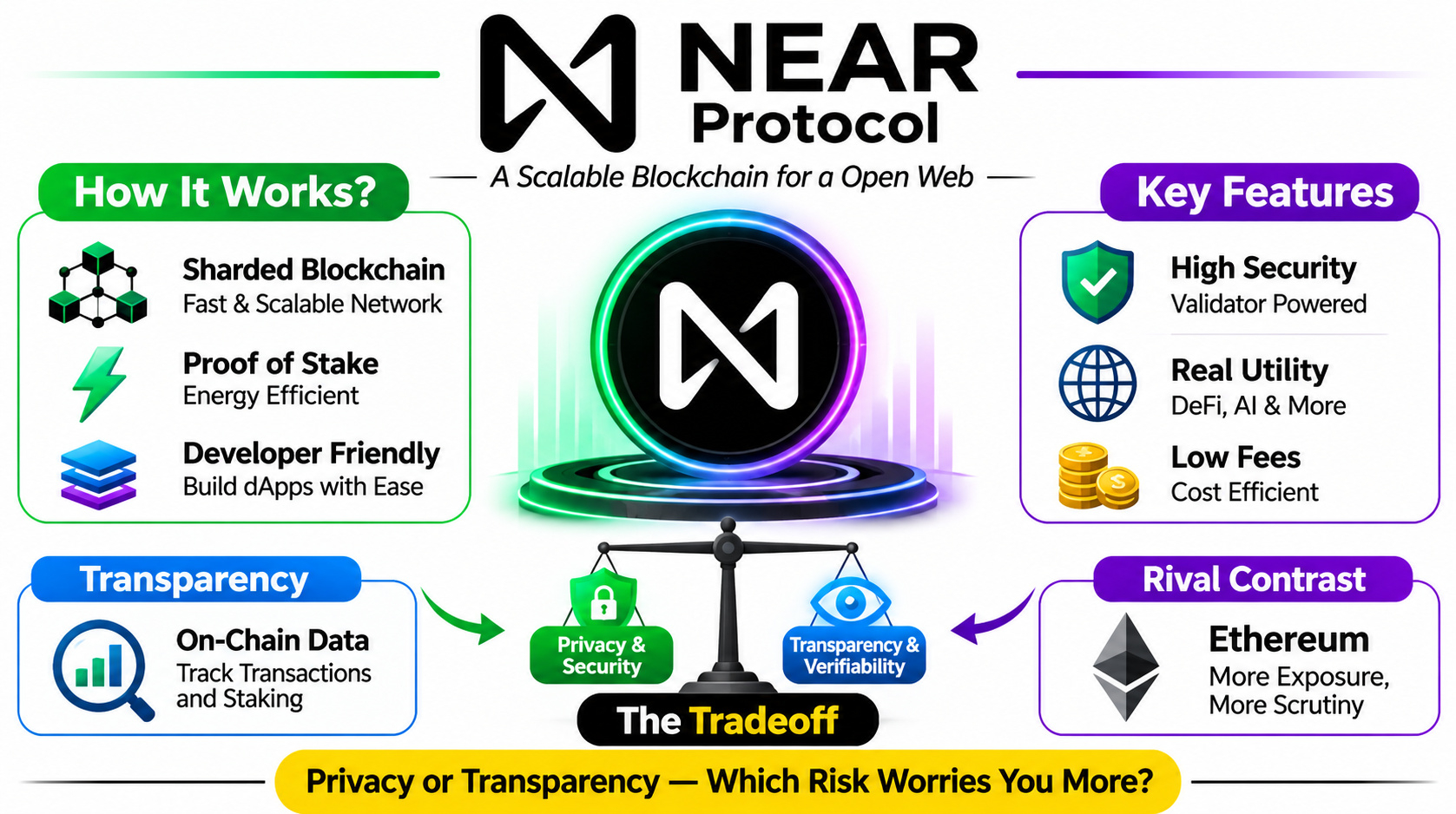

NEAR is a public Proof-of-Stake blockchain, not a reserve-backed token. Its transactions, staking activity, validator participation, and token supply are publicly inspectable. But that transparency has a boundary. That's not an oversight. It's a different trust model.
NEAR does not rely on publishing monthly reserve attestations because holders are not claiming ownership of an off-chain asset. Instead, security depends on distributed validators and protocol rules. The tradeoff is that on-chain visibility cannot independently prove every validator's operational security or eliminate governance and infrastructure risks.
Holders can check wallet balances, transactions, validator stakes, and network activity through public explorers such as NearBlocks. They can also track issuance and fee burns. NEAR's updated tokenomics target 2.5% annual issuance, with 70% of transaction fees burned. There is no recurring reserve attestation from an accounting firm. On-chain records update continuously, but they are not a continuous independent security audit. NEAR +2
Ethereum offers a useful contrast. Its public staking system exposes validator deposits, balances, and withdrawal records, giving outsiders another level of verifiable detail. More exposure, in exchange for greater public scrutiny. ethereum.org +1
Neither approach removes counterparty risk. NEAR relies on validator distribution and protocol execution. Ethereum relies on its own validator network and consensus rules.
Which risk worries you more — hidden operational dependencies, or publicly exposed validator