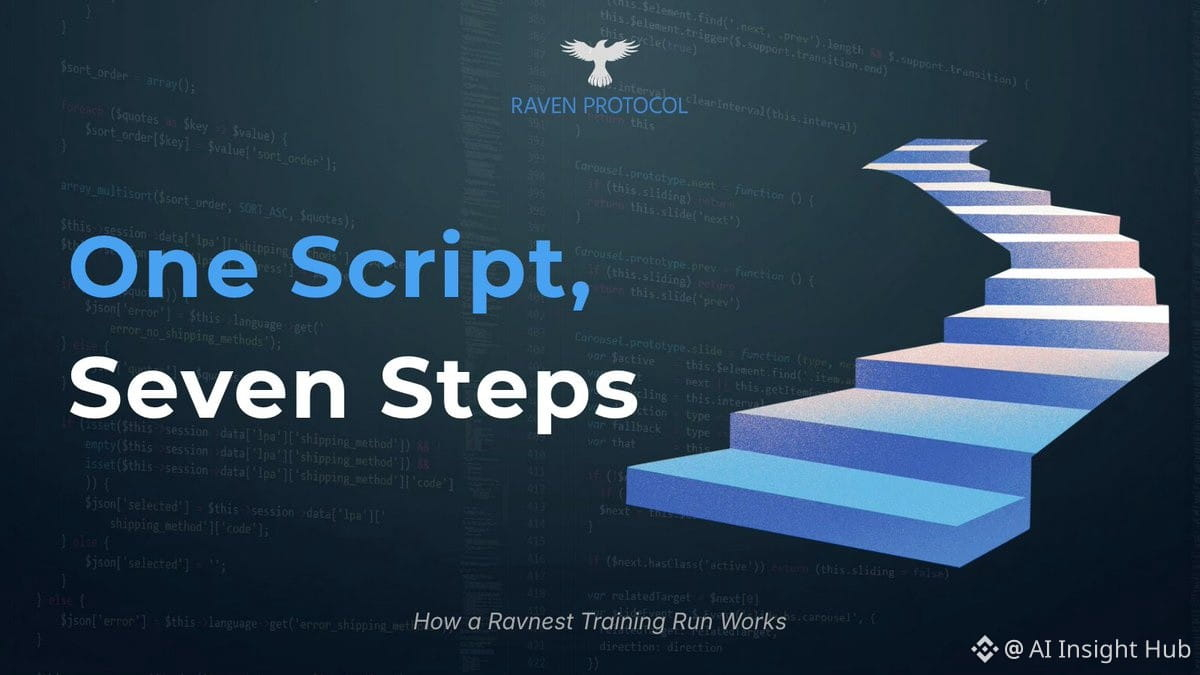
Distributed training demystified: what actually happens when you spin up a Ravnest training run across heterogeneous hardware.
Every node (gaming PC, workstation, whatever) runs identical scripts. The framework orchestrates everything in 7 steps:
1. Node discovery & handshake - machines find each other and establish communication channels
2. Capability assessment - each node reports GPU specs, memory, bandwidth
3. Work partitioning - framework splits model layers/batches based on actual hardware capabilities
4. Gradient synchronization setup - establishes ring-allreduce or parameter server topology
5. Training loop coordination - manages forward/backward passes across nodes
6. Checkpoint aggregation - merges model states from distributed workers
7. Failure recovery - handles node drops without killing the entire run
The key insight: you don't need identical hardware. The framework dynamically load-balances based on what each machine can actually handle. A 4090 might process 3x the batch size of a 3060, but both contribute useful gradients.
This matters because most distributed training frameworks assume datacenter uniformity. Ravnest is built for the real world where people train on whatever GPUs they can access.
Every node (gaming PC, workstation, whatever) runs identical scripts. The framework orchestrates everything in 7 steps:
1. Node discovery & handshake - machines find each other and establish communication channels
2. Capability assessment - each node reports GPU specs, memory, bandwidth
3. Work partitioning - framework splits model layers/batches based on actual hardware capabilities
4. Gradient synchronization setup - establishes ring-allreduce or parameter server topology
5. Training loop coordination - manages forward/backward passes across nodes
6. Checkpoint aggregation - merges model states from distributed workers
7. Failure recovery - handles node drops without killing the entire run
The key insight: you don't need identical hardware. The framework dynamically load-balances based on what each machine can actually handle. A 4090 might process 3x the batch size of a 3060, but both contribute useful gradients.
This matters because most distributed training frameworks assume datacenter uniformity. Ravnest is built for the real world where people train on whatever GPUs they can access.