

Adaptive CCI Thresholds as a Stateful Mean-Reversion Model
Strategy hypothesis
A fixed CCI threshold assumes that the same negative reading has the same meaning in every recent market regime. This strategy tests a different idea: use the recent distribution of CCI to decide which entry threshold is active, then treat the current CCI reading as a separate trigger.
The example configuration is long-only and uses one-hour SOLUSDT perpetual bars. It is an implementation study, not a claim about expected returns.
Indicator and data assumptions
The Commodity Channel Index measures how far the current input is from its rolling mean relative to the mean absolute deviation:
CCI = (current input - rolling mean) / (0.015 × mean absolute deviation)
The documented configuration uses a 10-bar CCI. Public strategy material describes the input as closing prices, although the managed implementation is not fully exposed, so the exact input field should be confirmed before reproducing the model in LEAN.
CCI has no fixed 0-to-100 range. A very negative value describes a large downward deviation from the recent center; it does not establish that a reversal has begun.
Selecting the active threshold
The strategy begins with an initial threshold of -203 and evaluates these lookback/threshold pairs in order:
40 bars / -90
50 bars / -70
60 bars / -50
90 bars / -4
120 bars / 0
140 bars / 25
160 bars / 50
180 bars / 70
For each pair, it asks whether the minimum CCI inside that lookback window is strictly greater than the candidate threshold. If the test passes, that candidate replaces the previously active threshold. The last qualifying candidate therefore becomes the effective entry line for the bar.
Entry is a second comparison: the current CCI must be strictly below the effective threshold. Qualification and entry point in opposite directions, so they should not be collapsed into one condition.
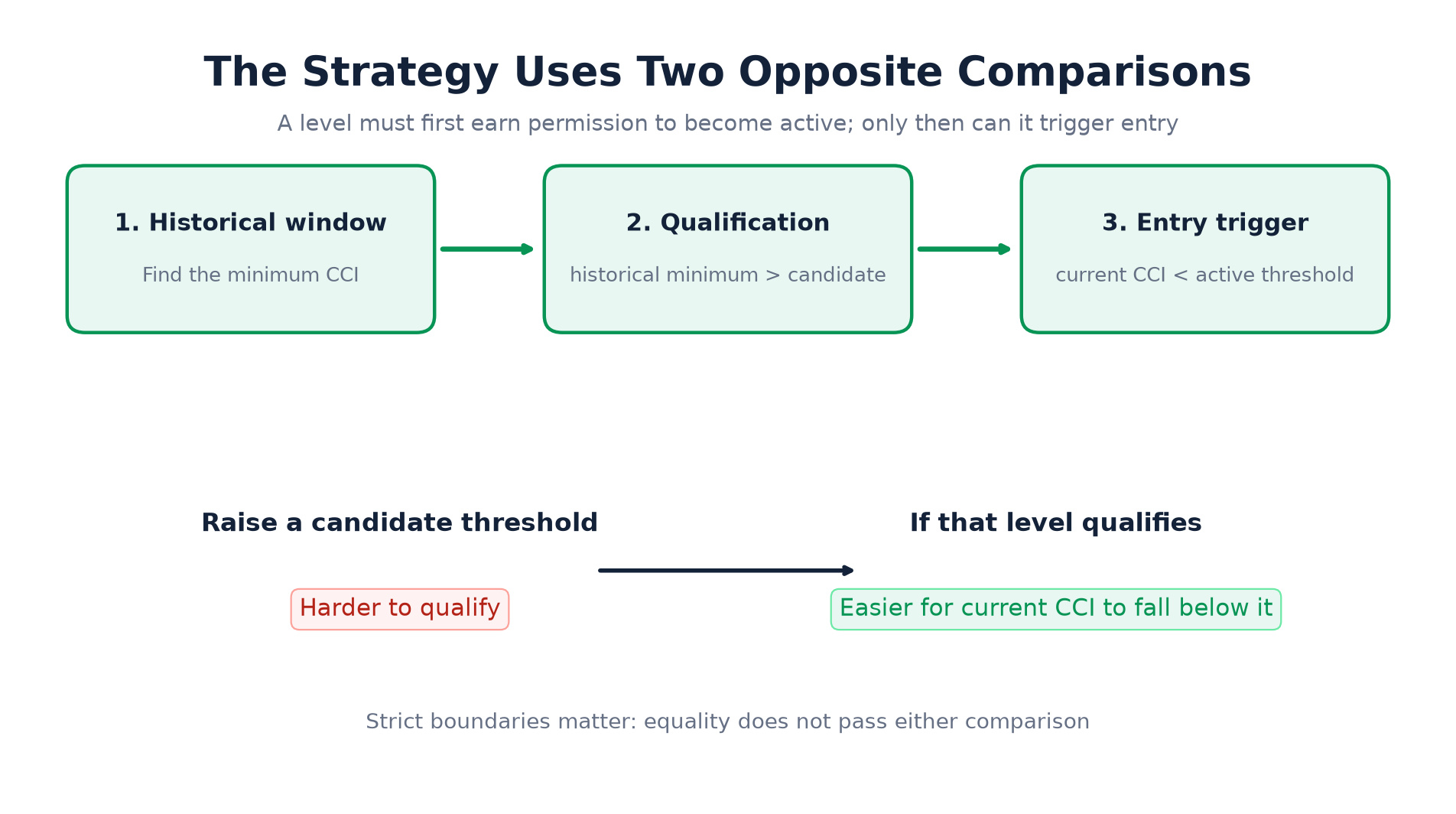
Figure 1: Historical qualification and current-bar entry are separate, opposite comparisons.
For example, if the 40-bar minimum is -80, the -90 candidate qualifies. If the 50-bar minimum is -75, the -70 candidate fails. At that stage, the current CCI must be below -90 to create a long intent.
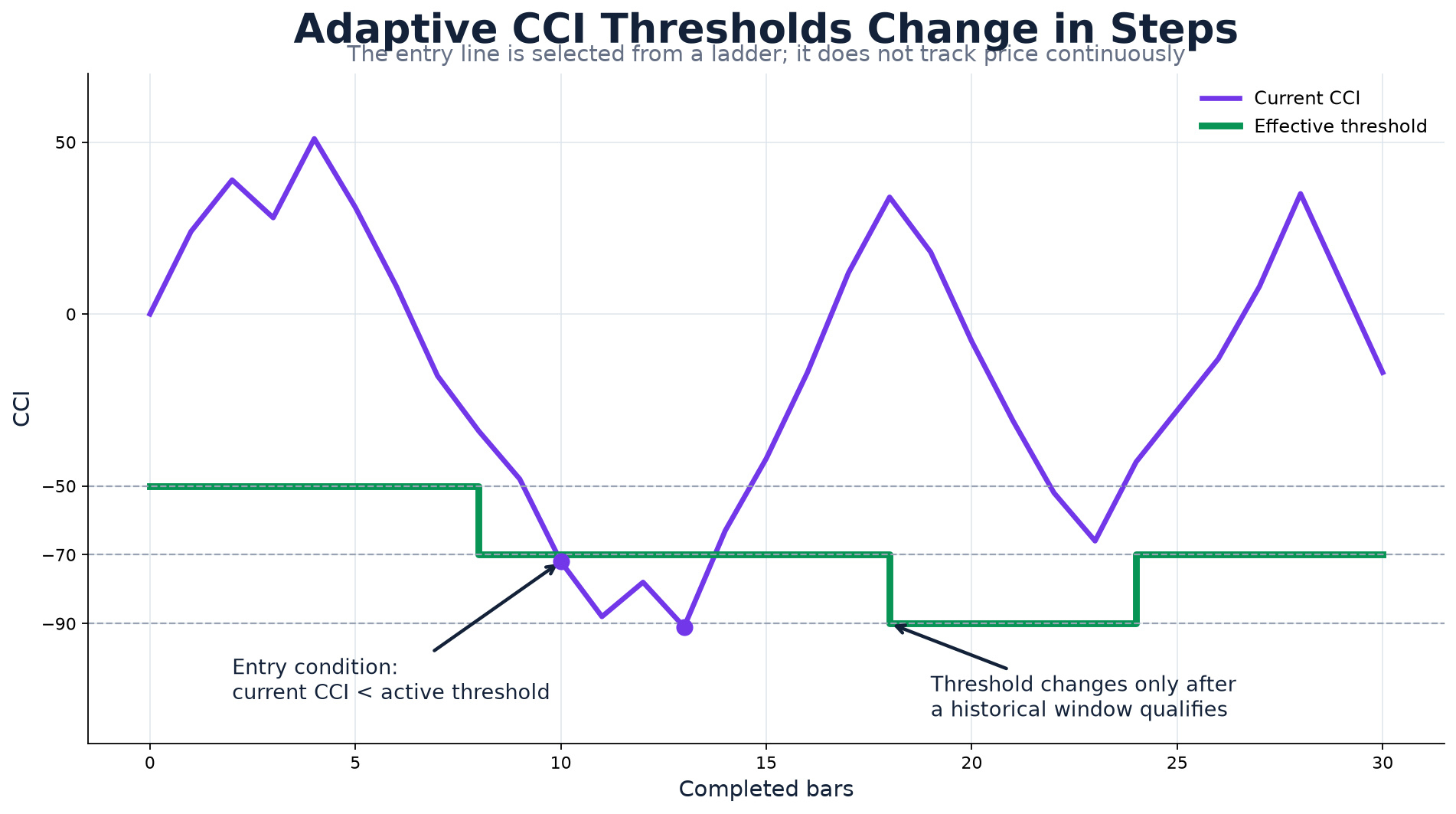
Figure 2: The effective CCI threshold changes in discrete steps rather than following price continuously.
Algorithm state and event order
A platform implementation needs to retain at least:
a rolling CCI window long enough for the 180-bar test;
the current effective threshold;
whether a long position or an outstanding entry order exists;
the highest observed price after entry;
the number of completed bars in the position.
The per-bar order is:
Update CCI from the completed bar.
Wait until the indicator and maximum lookback are ready.
Evaluate the threshold levels from shortest to longest lookback.
If flat and the current CCI is below the final threshold, emit a long intent.
While invested, update the post-entry peak.
Exit when the trailing condition or the 168-bar maximum holding period is reached.
Do not immediately re-enter on the same bar as the time exit.
The current metadata exposes a trailing parameter of 0.01, but its displayed unit is not sufficiently documented to assume whether the interface means 1% or 0.01%. A LEAN port should define that unit explicitly instead of silently copying the number.
LEAN implementation sketch
In LEAN, the indicator and rolling history can be updated in OnData, but signal state and order state should remain separate. A minimal structure would calculate the final threshold only after all required history is available, then generate an order intent. An order ticket or portfolio holding confirms what the execution layer actually accepted.
The same separation applies to exits. A low price touching a trailing boundary is a signal condition; it does not guarantee the fill price. Contract specifications, spread, slippage, order type, and partial fills remain execution concerns.
Parameters to isolate during research
The CCI length changes the entire indicator series. A lookback length changes which historical extremes enter a qualification test. A candidate threshold changes both the difficulty of qualification and, once qualified, the ease of current-bar entry. The trailing distance and 168-bar limit govern different exit paths.
Because these parameters affect different layers, changing them together makes it difficult to identify why behavior changed. A useful implementation test changes one group at a time and checks readiness, threshold selection, signal count, state transitions, and exit timing—not profitability.
Takeaway
The defining feature is not simply “buy a low CCI.” The model first asks which threshold the recent CCI distribution allows, then asks whether the current reading crosses below that threshold. Keeping those two comparisons and the execution layer separate is the key to reproducing the strategy faithfully.
Disclosure: This article explains a public strategy rule set for technical education. The rules can be reproduced and backtested on AlgoRover.ai. It is not individualized investment advice.