
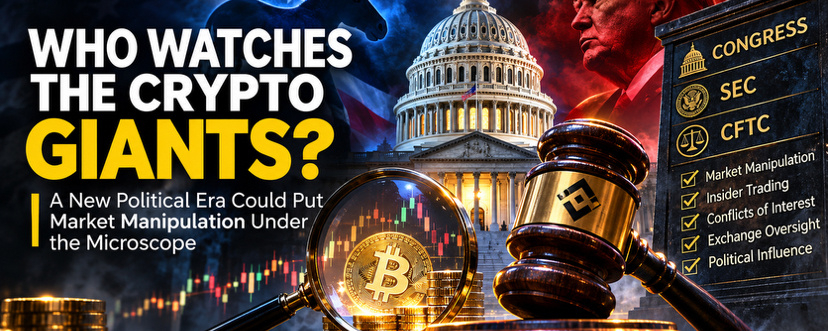

Let’s talk about something that could become very important for the crypto market.
For years, ordinary traders have watched Bitcoin move thousands of dollars in minutes. We’ve seen sudden liquidations, massive candles, unexpected crashes, and recoveries that seem to come out of nowhere.
And every time something like this happens, the same question comes up:
Are we really trading in a free market, or are the biggest players simply playing a game that ordinary traders cannot see?
Now, with the political landscape in Washington changing after the November 2026 midterm elections, this question becomes even more interesting.
Could the next chapter of crypto be about investigating the people and institutions that have the greatest influence over the market?
Let’s look at it.
1. Washington could become a lot more interested in crypto
Congress has the power to investigate financial markets, request documents, hold hearings, and question powerful institutions.
If Democrats gain control of both chambers, we could see a different approach to crypto oversight.
People like Elizabeth Warren have been vocal about their concerns regarding crypto regulation, consumer protection, and the risks of financial misconduct.
Committees dealing with banking, financial services, and commodities could become important players in this debate.
But here’s something worth remembering:
Congress can investigate. Regulators can enforce the law. Courts determine legal responsibility.
And none of these processes should be driven by political revenge.
The real question is whether the same rules will apply to everyone.
2. What about the SEC and CFTC?
These two agencies are especially important to crypto traders.
The SEC deals with securities markets, while the CFTC oversees commodity derivatives and has authority over certain forms of fraud and manipulation.
Depending on the asset and the type of trading, their jurisdictions can overlap or differ.
Imagine an investigation into suspicious trading activity involving a major exchange, a market maker, or a group of institutional investors.
The important questions would be:
Was confidential information used to gain an unfair advantage?
Was trading activity designed to manipulate prices?
Were investors misled about market conditions?
Were conflicts of interest properly disclosed?
These are serious questions.
And if there is real evidence of misconduct, the size of the institution should not matter.
3. The big players are not ordinary traders
Let’s be honest.
A retail trader with $500 is not operating on the same level as a major market maker moving hundreds of millions of dollars.
Large institutions have access to sophisticated trading systems, deep liquidity, advanced analytics, and information networks that most retail traders can only dream about.
That doesn’t automatically mean they are manipulating the market.
But it does mean that transparency matters.
When a market becomes so large that its movements can affect millions of people, the public deserves to know whether its rules are being respected.
The crypto industry cannot keep asking for institutional adoption while ignoring the need for accountability.
4. Political connections and crypto businesses
Another interesting area is the relationship between politics and cryptocurrency.
Crypto has become deeply connected to political fundraising, lobbying, investment, and regulation.
That creates an important question:
What happens when people who influence financial regulations also have financial interests in the industries being regulated?
This is not an accusation against any particular person.
It is a question of transparency.
Whether we are talking about Trump-linked crypto ventures, major exchanges, institutional investors, or political donors, the principle should be the same.
Financial interests should be disclosed. Conflicts should be examined. And potential wrongdoing should be investigated based on evidence.
Nobody should be above the law.
5. What does all this mean for Bitcoin?
Now, let’s bring this back to the market.
Could stronger oversight be bullish for Bitcoin?
Possibly, in the long term.
A more transparent market could attract investors who have been hesitant to enter crypto because of concerns about manipulation, fraud, or weak investor protection.
But in the short term, political uncertainty can create volatility.
Markets may react to:
Regulatory announcements.
Congressional hearings.
SEC and CFTC investigations.
New crypto legislation.
Changes in institutional investment.
Concerns about exchange security and market integrity.
And remember, a regulatory headline does not automatically mean Bitcoin will go up or down.
The market may price in expectations long before anything actually happens.
My personal take
What bothers me most about crypto is not volatility.
Volatility is part of the game. We know that when we enter the market.
What bothers me is the possibility that some participants could have advantages that ordinary traders cannot even see.
We spend hours analyzing charts, studying RSI, MACD, liquidity, and macroeconomic data. We manage our risk and try to survive another trading day.
Meanwhile, the biggest players have resources that are beyond our reach.
If the market is fair, let it be proven.
If manipulation exists, investigate it.
And if someone has broken the law, hold them accountable.
It doesn’t matter whether they are a retail trader, a billionaire, a major exchange, or a politically connected institution.
A market cannot call itself free if accountability only applies to the small players.
What do you think?
Could the new political balance in Washington finally bring more transparency to crypto, or will the biggest players continue to operate beyond the reach of ordinary investors?
#Bitcoin #BTC #Crypto #BinanceSquare #MarketManipulation #SEC #CFTC #CryptoRegulation #Trading