
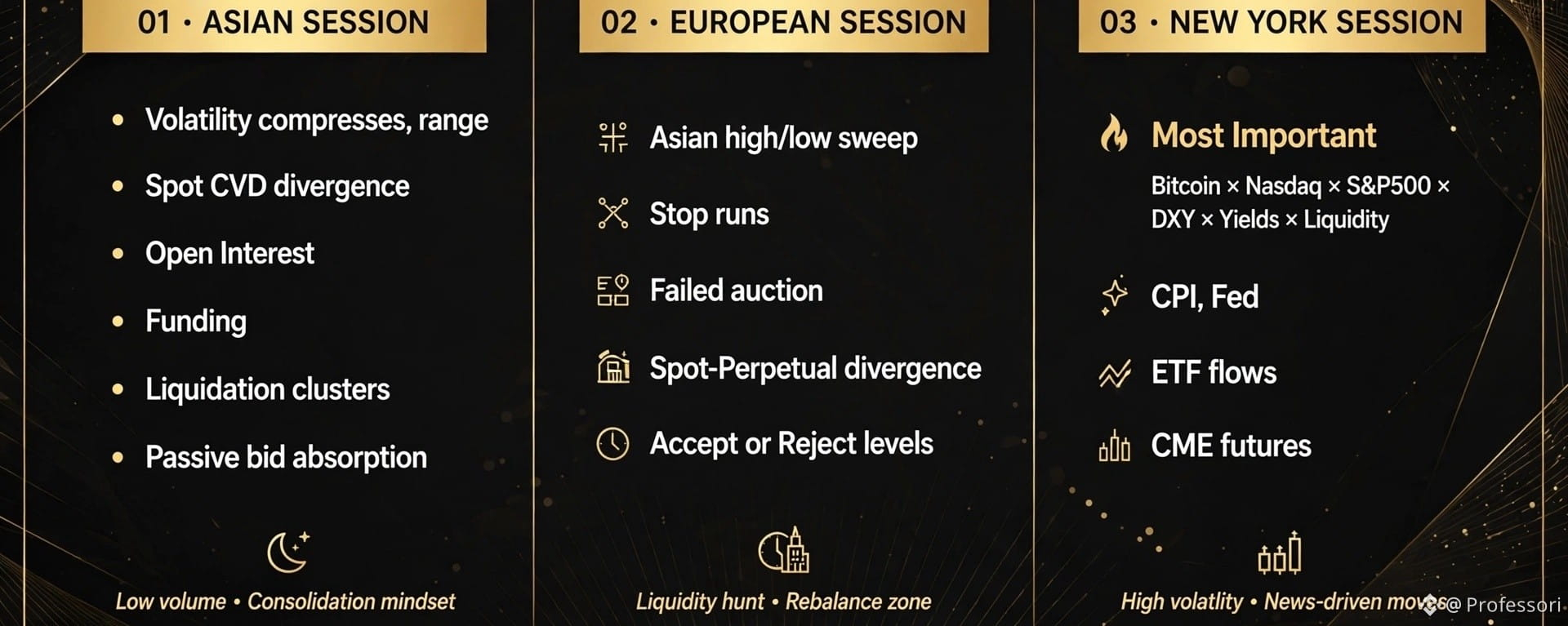

We have three kill zones : Asian, Europeans and Nyse.
1. ASIAN SESSION
Now During the Asian session, volatility often compresses, liquidity becomes fragmented, and price trades within relatively defined ranges.
This is where we study:
•Passive bid absorption and sell-side exhaustion.
•Order-book depth, liquidity replenishment and iceberg orders.
•Spot CVD divergence against price action.
•Open interest expansion versus genuine spot accumulation.
•Funding rates, basis spreads and liquidation clusters.
The objective isn’t simply to buy a dip.
It’s to identify whether aggressive selling is being absorbed by persistent passive demand.
2. EUROPEAN SESSION
European participation can challenge the Asian range, sweep resting stops, and establish a new intraday directional bias.
We monitor:
•Asian session high/low liquidity sweeps.
•Stop runs and failed auction structures.
•Aggressive market orders versus resting limit liquidity.
•Spot-perpetual divergence and basis repricing.
Whether price accepts or rejects levels after a liquidity sweep.
A breakout without sustained participation is often just a liquidity event.
A breakout supported by spot demand, positive order-flow imbalance and expanding volume has a stronger foundation
3. NEW YORK SESSION
This is our most important window.
Not because Bitcoin belongs to America, but because US capital markets, dollar liquidity and macroeconomic expectations have enormous influence over global risk assets.
Look at the institutional landscape.
The US government holds substantial Bitcoin assets, although government holdings should not automatically be treated as a strategic reserve.
Strategy, formerly MicroStrategy, is one of the largest corporate Bitcoin holders.
US-listed spot Bitcoin ETFs connect traditional investment capital directly to Bitcoin exposure.
Public companies, institutional funds, asset managers and derivatives desks increasingly influence BTC positioning.
And then comes the most important correlation framework:
Bitcoin × Nasdaq × S&P 500 × DXY × US Treasury Yields × Global Liquidity.
We monitor the US equity cash open, particularly the NYSE and Nasdaq, alongside CME futures, ETF flows and macroeconomic releases.
Why?
Because Bitcoin doesn’t trade in isolation.
A shift in US real yields can reprice risk assets.
A surprise CPI print can change the expected Federal Reserve policy path.
A change in dollar liquidity can influence leverage, funding and institutional risk appetite.
And a sudden repricing of US equities can transmit directly into crypto through cross-asset positioning.
This is where macro meets microstructure.
But always understand
We don’t trade a fixed session narrative.
We trade the relationship between liquidity, positioning, execution and macro catalysts.
The real edge is understanding the difference between what the market expects and what actually happens.
Sometimes bullish news produces a sell-off because the outcome was already priced in.
Sometimes bearish news triggers a rally because positioning was excessively defensive.
Markets don’t simply trade good or bad news.
Markets trade surprises, expectations and liquidity.
And remember:
A liquidity sweep doesn’t guarantee a reversal.
A short squeeze without sustained spot demand can become exit liquidity.
Rising open interest doesn’t automatically mean new longs.
And a large resting order doesn’t necessarily represent genuine buying interest.
Execution matters.
Confirmation matters.
Risk management matters.