


Since 28 September 2026 there is no hryvnia balance on Binance, no USDT/UAH order book and no direct UAH deposit or withdrawal through Fiat Trade UAH. P2P in hryvnia was not part of that announcement and still runs every day, so for most people in Ukraine it is now the main way to move between UAH and crypto on Binance.
👉 Open a Binance account with code GETREWARD
The questions below are the ones people asked most in the weeks after the change: what exactly closed, where leftover hryvnia went, how a P2P trade works without the old gateway, how Ukrainian bank limits fit in, and what the legal position is. Menus and limits differ by account and change over time, so check your own app before acting on any detail here.
What exactly closed on 28 September?
Binance announced the change on 22 September 2026. It covered two products and one automatic step, nothing more.
Fiat Trade UAH: Deposits and withdrawals of hryvnia through this service stopped at 09:00 UTC+2 on 28 September, which was 10:00 in Kyiv because Ukraine was still on summer time.
The USDT/UAH spot pair: Trading on the pair ended at the same minute. Any open orders on it were removed automatically.
Leftover hryvnia: Eligible UAH balances still sitting in accounts were converted to USDT by 18:00 UTC+2 on 30 September at a fixed rate of 46.5 UAH per USDT.
The notice gave no reason for the decision and said nothing about closing accounts, crypto trading or P2P. Ukrainian outlets such as ThePublic and dev.ua read it the same way: the gateway and the pair are gone, the rest of the account works as before.
Where did the hryvnia left in my account go?
If you had UAH on the balance after the deadline and it met the conversion conditions, it now shows as USDT. The math is a single division. 4,650 UAH ÷ 46.5 = 100 USDT. A balance of 1,200 UAH became about 25.81 USDT.
To find the entry, look through the wallet history around 30 September rather than your order history, because the conversion was done by Binance and not by an order you placed. If you still see a hryvnia amount, or the USDT figure looks wrong, open a support chat from the app and quote the date and the amount. Do not answer anyone who contacts you first offering to recover a missing conversion. Those messages are a common trick after any delisting.
Is hryvnia P2P still running?
Yes. Binance did not list P2P among the closed services, and UAH ads stayed live through October. A count published by the Ukrainian site InsidePC on 20 October 2026 found between 185 and 327 ads to buy USDT for hryvnia and between 377 and 740 ads to sell, depending on the amount entered. Those numbers move daily, but the market is clearly active.
Keep in mind what P2P is. You are dealing with another user, not with Binance. The platform locks the seller's coins in escrow while the order is open, which protects the crypto side, while the hryvnia side moves through your own bank. If you have never used P2P before, this longer guide to buying and selling crypto safely on P2P covers advertiser checks and appeals in more detail.
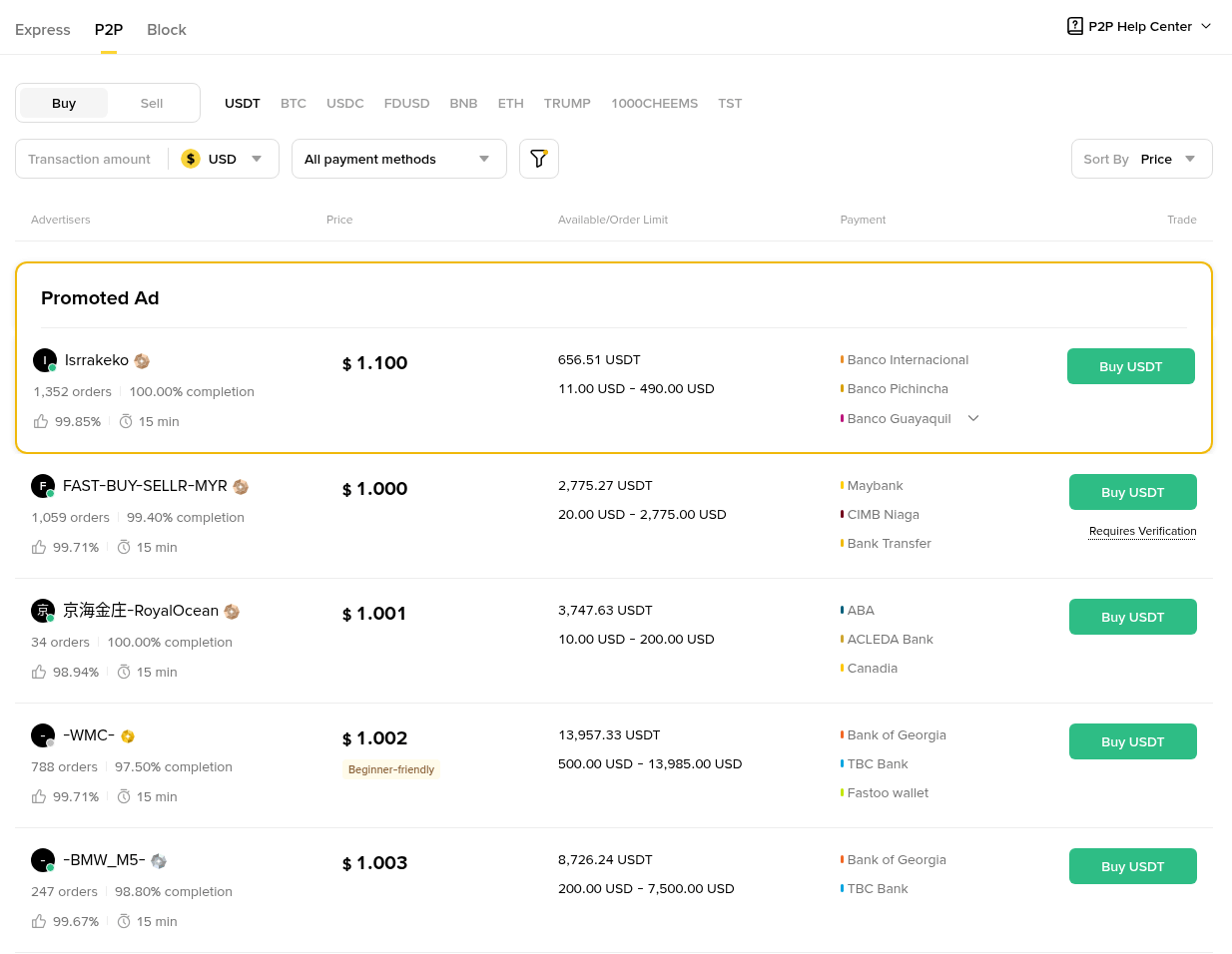
The market looks like the screen below. The capture was taken with USD selected; with UAH chosen the columns are the same, and the bank list shows Ukrainian banks.
How does a hryvnia buy work now, step by step?
Finish identity verification and turn on your P2P profile. Add a card or IBAN that is in your own name.
Open P2P, choose Buy, select USDT and set the currency to UAH.
Enter the amount in hryvnia and filter by your bank. Ads on 20 October listed Monobank, PrivatBank, PUMB, A-Bank, Oschadbank, Raiffeisen, OTP and Sense among others, both by card number and by IBAN.
Pick an advertiser by record first and price second: number of orders, completion rate, time limit and the minimum and maximum order size.
Open the order. The seller's USDT is now locked and a timer starts, usually 15 minutes.
Send the exact amount from your own account to the details shown inside the order, then mark the order as transferred.
When the seller confirms, the USDT lands in your Funding wallet.
Run the first order with a small sum. A slow interbank transfer or a typo in the card number then costs you a little time and nothing else.
Do Ukrainian bank limits apply to P2P transfers?
Yes, and they come from your bank, not from Binance. Under the memorandum on transparency in the market for transfers that Ukrainian banks signed with the support of the National Bank of Ukraine, outgoing person-to-person transfers have a monthly cap for clients without confirmed income.
Standard cap: Since 1 June 2025 it is 100,000 UAH a month for low and medium risk clients and 50,000 UAH for clients the bank rates as high risk.
What counts: Transfers by card number, phone number and IBAN to other people all add up toward the same cap. Moves between your own accounts do not.
Raising it: Banks set individual limits for people who confirm a higher income. The Association of Ukrainian Banks has pointed to the OK-5 and OK-7 income certificates in the Diia app as the usual way to do this.
Two practical effects follow. If you plan a large purchase, split it over time or confirm your income with the bank first. And expect questions: a run of transfers to different people that looks like crypto trading can trigger a source-of-funds request or a temporary card block. Answer honestly, and have your Binance order history ready to show where the money went.
Where do the coins arrive after a P2P buy?
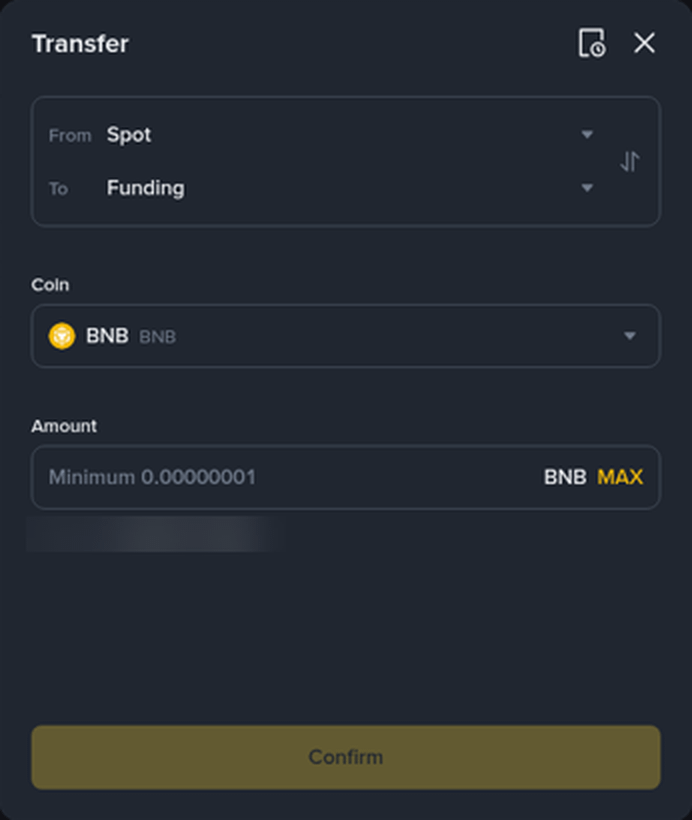
In the Funding wallet. To trade them on Spot, open Transfer, set Funding as the source and Spot as the target, pick USDT and confirm. When you sell later, do the reverse first, since P2P sells only from Funding. The dialog looks like this:
How do I sell USDT for hryvnia without the old withdrawal?
The sale is now the cash-out route, and the release step is where people lose money.
Prepare the coins: Make sure the USDT sits in Funding. An empty amount field usually means it is still in Spot.
Choose the buyer: Open P2P, tap Sell, pick USDT and UAH, add your bank in the filter and read the buyer's record before the price.
Open the order: Your USDT goes into escrow. It stays there until you release it or the order is cancelled.
Check your bank app: Wait until the full hryvnia amount is credited, from an account in the buyer's verified name. Screenshots, forwarded SMS messages and "it's on the way" chat messages prove nothing.
Release: Only then tap Release and confirm with your two-factor code. A released order cannot be pulled back by the platform.
Incoming transfers count toward your bank's risk checks too, even though the monthly cap above is about outgoing transfers. Selling often to many strangers is the pattern banks look at most closely.
What other ways in and out are left?
Besides P2P, the simplest route is moving crypto you already hold elsewhere. Deposits of crypto to Binance have no Binance fee; you cover only the network fee on the sending side. The step that goes wrong is the network choice. The sending wallet and the Binance deposit page must use the same network, so a TRC20 transfer has to land on a TRC20 address. This explainer on picking between TRC20, BEP20 and ERC20 walks through the differences in cost and speed.
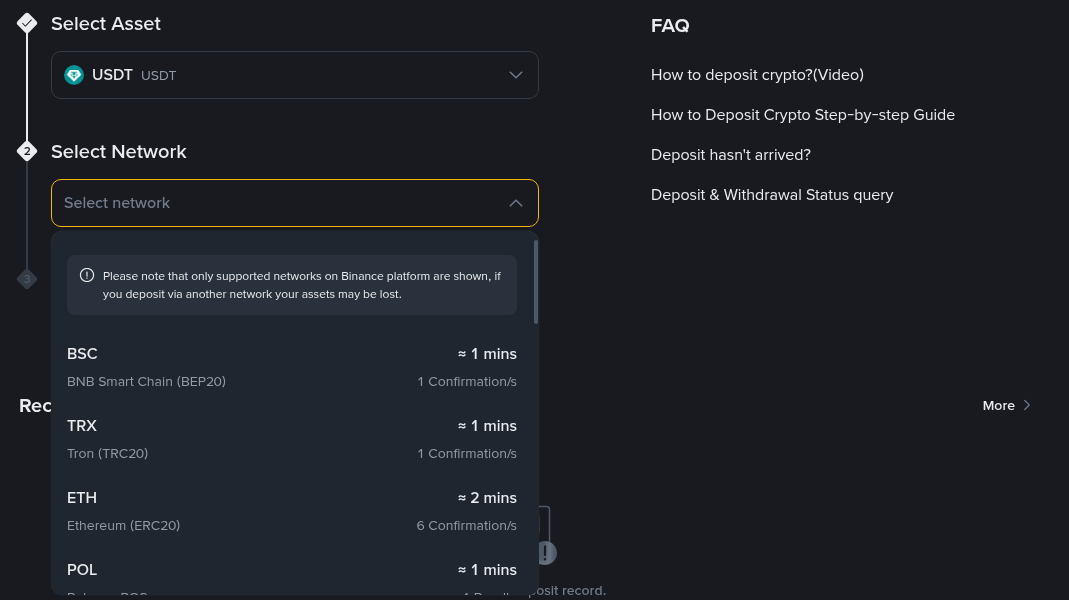
Some accounts also show other fiat options on the Deposit page. Which ones appear depends on your account and region, so look there instead of relying on a forum post written before September. The network list on the crypto deposit page looks like this:
How much does P2P cost compared with the official rate?
There is usually no separate fee for a taker. The cost sits inside the advertiser's price. On 20 October InsidePC measured P2P buy prices at 2.4 to 3.4% above the National Bank of Ukraine rate.
The figures below are made up to show the method, not a quote. Say the official rate is 41.50 UAH per dollar, buy ads sit at 42.70 and sell ads at 41.90.
Buying with 20,000 UAH: 20,000 ÷ 42.70 = about 468.38 USDT.
Same sum at the official rate: 20,000 ÷ 41.50 = about 481.93. The gap of roughly 13.5 USDT is the real cost of the purchase.
Selling straight back: 468.38 × 41.90 = about 19,625 UAH. A full round trip costs around 375 UAH, close to 1.9% of the starting sum, before any bank charges.
Add your bank's own tariff on top. Some banks charge for transfers to cards at other banks, so filtering ads by your own bank often saves a small fee on every order.
Is Binance regulated in Ukraine?
No exchange holds a Ukrainian crypto licence, because the licensing system does not exist yet. The Law on Virtual Assets No. 2074-IX was adopted in February 2022 but has not come into force; it starts only when matching amendments to the Tax Code take effect. Bill No. 10225-d, which would set up that regime and tax rules, was adopted at first reading on 3 September 2025 and is still being prepared for the second reading. In September 2026 the securities regulator NSSMC published proposals that would split supervision between itself and the National Bank, in line with the EU model.
For users this means P2P deals have no Ukrainian regulator behind them. Disputes go through Binance's own appeal and support process. It also means tax rules for crypto are not yet written into the Tax Code. The bill proposes 18% personal income tax plus a 5% military levy on the yearly result, but that is a draft and may change. Ask a Ukrainian tax adviser about your own case; nothing here is tax or financial advice.
Which warning signs should stop a trade?
Chat outside the order: A request to continue on Telegram or Viber, often with a better price as bait.
New bank details: A card or IBAN different from the one shown in the order.
A third party: Hryvnia arriving from someone other than the verified buyer.
Time pressure: Repeated messages asking you to release before the money shows in your bank.
Fake support: Anyone offering to restore your old UAH balance or unblock an order for a fee.
What if a P2P order goes wrong?
You sent money and the order expired: Do not send again. Open an appeal from the order page, attach the bank receipt and wait for the review.
The bank froze your card: Answer the bank's questions with the order ID and amounts. Keep trading off until it is cleared.
The buyer's money came from someone else: Do not release. Open an appeal and let the platform handle the return.
You cannot find the bought USDT: Look in Funding, not Spot.
Keep the order ID, the date, both amounts and the bank statement line for every order. Five minutes of record keeping per month answers almost any question from a bank later.
A short routine for the new setup
Verified account, two-factor on, bank account in your own name. Watch the monthly bank cap. Small first order, advertiser record before price. Send hryvnia only to the details in the order, release only after your bank shows the full sum. Save the order ID with the receipt.
Opening your first account? You can check the active Binance bonus event to see which welcome tasks currently apply to eligible new users.
Sign-up code: GETREWARD
FAQ
Can I still hold hryvnia on Binance?
No. The UAH balance was retired with Fiat Trade UAH, and eligible leftovers were converted to USDT at 46.5 UAH.
Will the USDT/UAH pair come back?
Binance has not said so. Treat P2P as the hryvnia route unless a new announcement appears.
Is the 46.5 rate used anywhere now?
No. It applied only to the automatic conversion at the end of September. P2P prices are set by each advertiser.
Do I need a separate P2P account?
No. P2P uses your verified Binance account and its Funding wallet; you only switch on the P2P profile and add a bank method.
Can I use a card in someone else's name?
No. Both sides must use accounts in their own verified names, and a mismatch is the most common reason for appeals.
Disclosure: this article includes a Binance sign-up link with the code GETREWARD. Crypto prices can fall. This is not financial or tax advice.