


1) Executive summary
What the TRON network is. TRON $TRX is a Layer-1 (L1) public blockchain that describes itself as a settlement network for the onchain economy, naming stablecoins, payments, real-world assets and AI agents as the activity it supports. Justin Sun founded the TRON network in 2017. The TRON MainNet launched in May 2018, and the network marked its Independence Day on June 25, 2018. Through its delegated proof of stake (DPoS) consensus mechanism, users who stake TRX, the native utility token of the TRON network, vote for validators of the TRON network. These elections occur every 6 hours with the top 27 vote-getters becoming Super Representatives, who produce blocks and participate in consensus. The next 100 vote-getters, positions 28-127, are known as Super Representative Partners (SRP) and they help maintain network readiness.
Why stablecoin settlement? Moving dollars across borders typically involves correspondent banking systems and working within their respective business hours. A stablecoin on a public blockchain can move at any hour and settle almost instantly for a modest network fee. These benefits make it attractive for users and large companies to conduct payments, transfers, and hold their dollar savings onchain. Stablecoins are held and transferred at scale on the TRON network.
The market and opportunity. Dollars are moving onto public blockchains as stablecoins. Across the chains Token Terminal tracks, natively issued stablecoin supply averaged $298.23B in Q3 ’26 (-2.41% QoQ, +12.13% YoY), still small next to the dollars held in the banking system. USDT, the largest stablecoin, is issued natively on 12 tracked chains, and TRON overtook Ethereum to hold the most of it in Q3 ’26.
The quarter. Q3 ’26 set records in stablecoin holdings and network usage while the fee per transaction fell slightly. Stablecoin supply, stablecoin holders and monthly active users reached all-time highs, transaction count held at a record level, and TRON overtook Ethereum as the largest USDT network in late July. Revenue fell slightly with the lower average fee. TRX gained regulated U.S. channels through Anchorage Digital, Bitnomial and a staked TRX ETF from Canary Capital, and the network enabled TVM compatibility with Ethereum’s Prague and Osaka upgrades in late August.
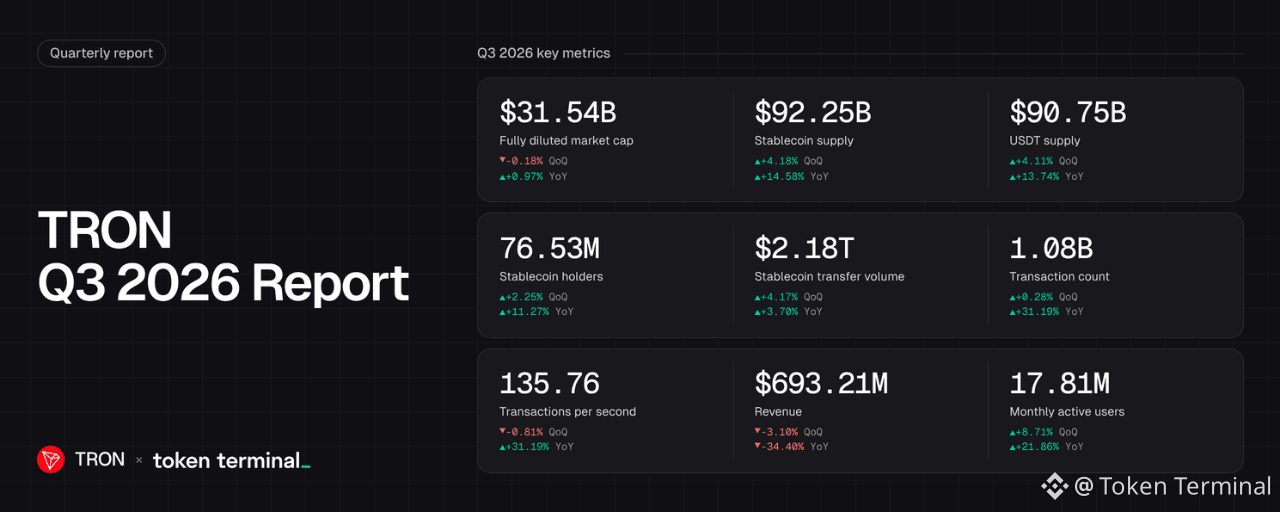
🔑 Key metrics (Q3 2026)
Fully diluted market cap: $31.54B (-0.18% QoQ, +0.97% YoY)
Stablecoin supply: $92.25B (+4.18% QoQ, +14.58% YoY)
Transaction count: 1.08B (+0.28% QoQ, +31.19% YoY)
Revenue: $693.21M (-3.10% QoQ, -34.40% YoY)
Monthly active users: 17.81M (+8.71% QoQ, +21.86% YoY)
👥 TRON DAO commentary
“The overall story of this quarter has been the continued institutional adoption of TRON and TRX, the native utility token of the TRON network. Stablecoin supply has hit records alongside monthly active users, with new institutional-friendly access points for USDT-TRC20 like Bitstamp. The launch of the Canary Staked TRX ETF marked another significant milestone, providing U.S. investors with regulated, exchange-traded exposure to TRX. Together, these developments highlight TRON’s growing role in global stablecoin settlement and the expanding integration of its ecosystem with traditional financial markets.
Looking ahead, we see significant opportunities to build on this momentum. Our focus remains on expanding access to stablecoin payments, strengthening institutional infrastructure, and supporting new use cases across real-world assets and the emerging AI economy. As more financial institutions explore blockchain-based settlement, TRON is well positioned to connect traditional financial services with the onchain economy.”
2) Fully diluted market cap
Fully diluted market cap measures the total USD value of TRX’s maximum supply at current market prices, assuming all tokens are in circulation. Fully diluted market cap averaged $31.54B in Q3 ’26 (-0.18% QoQ, +0.97% YoY), the second-highest quarterly average on record after Q2 ’26.
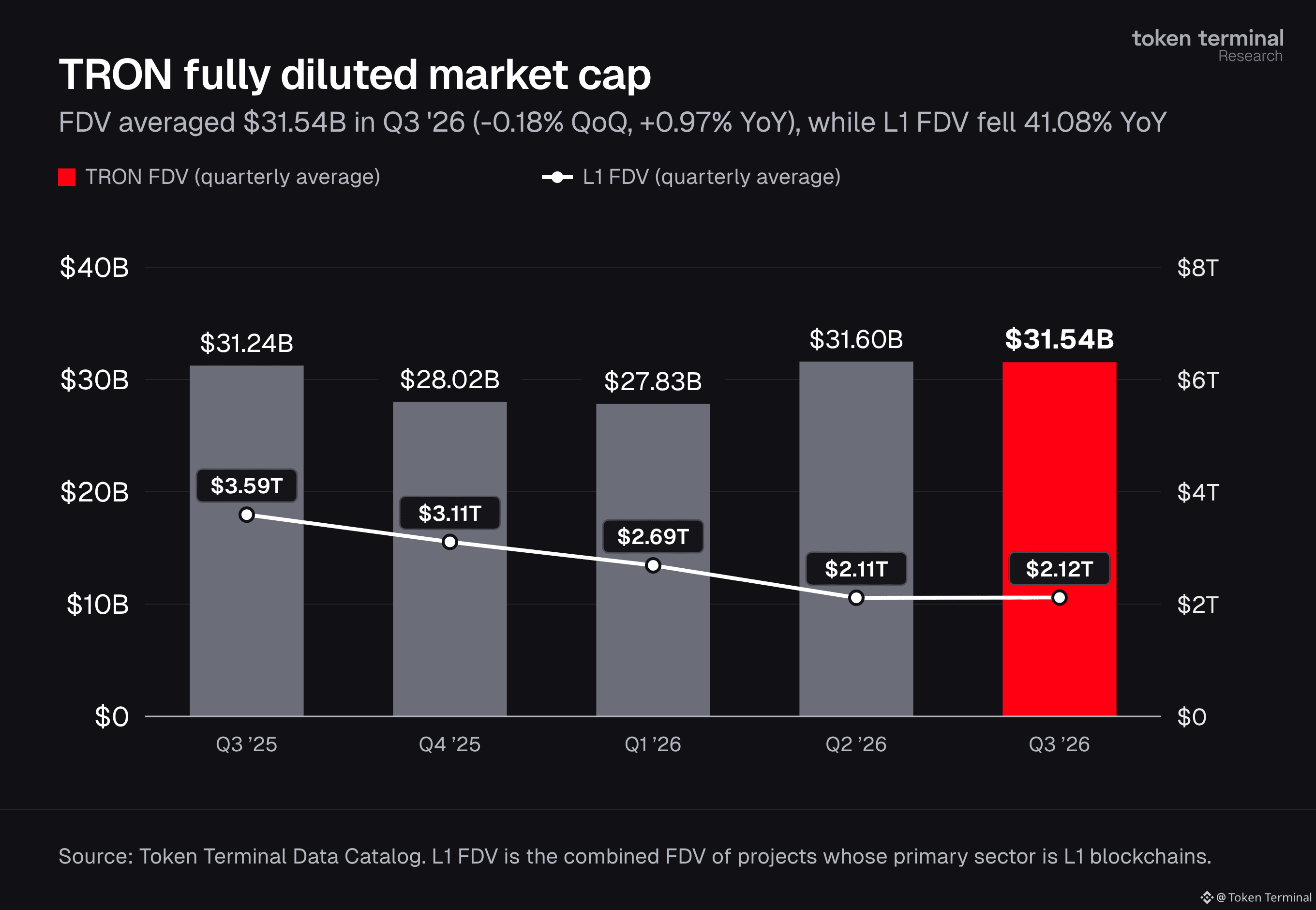
TRX held its value over a year in which L1 networks as a group lost much of theirs. Their combined fully diluted market cap was flat in the quarter but lower over the year (+0.18% QoQ, -41.08% YoY), so TRON’s share of it rose from 0.87% to 1.49%.
The quarter added regulated ways to hold TRX in the U.S. Anchorage Digital, which operates a federally chartered crypto bank, added native TRX staking for institutions on July 14. Bitnomial, a CFTC-regulated exchange, listed TRX futures on July 27. Canary Capital launched the Canary Staked TRX ETF (TRXS), which seeks to track the price of TRX and earn staking rewards, on September 9.
TRX is the token users burn to pay network fees or stake to obtain Energy and Bandwidth, which can be used to cover transaction costs. These institutional channels broaden access to TRX, the network’s native utility token. The largest pool of value on TRON, however, is its stablecoin supply.
👥 TRON DAO commentary
“TRX, the native utility token of the TRON network, remained resilient throughout Q3 despite turbulence in the broader blockchain ecosystem. TRX’s relatively stable market capitalization throughout the quarter reflects sustained network activity and growing institutional demand for stablecoin settlement.
Looking ahead, our focus remains on strengthening the fundamental drivers of network activity, expanding stablecoin adoption, and supporting new use cases across payments and real-world assets. We believe the TRON network’s established role in stablecoin settlement provides a strong foundation for continued ecosystem development and deeper integration with global financial markets.
Ultimately, we view long-term adoption by institutions and real-world utility as more meaningful indicators of the network’s progress.”
3) Stablecoin supply
Stablecoin supply measures the total USD value of stablecoins issued on the TRON network, covering natively issued stablecoins and excluding bridged stablecoins. Stablecoin supply averaged $92.25B in Q3 ’26 (+4.18% QoQ, +14.58% YoY), an all-time high, and stood at $93.88B at the end of the quarter.
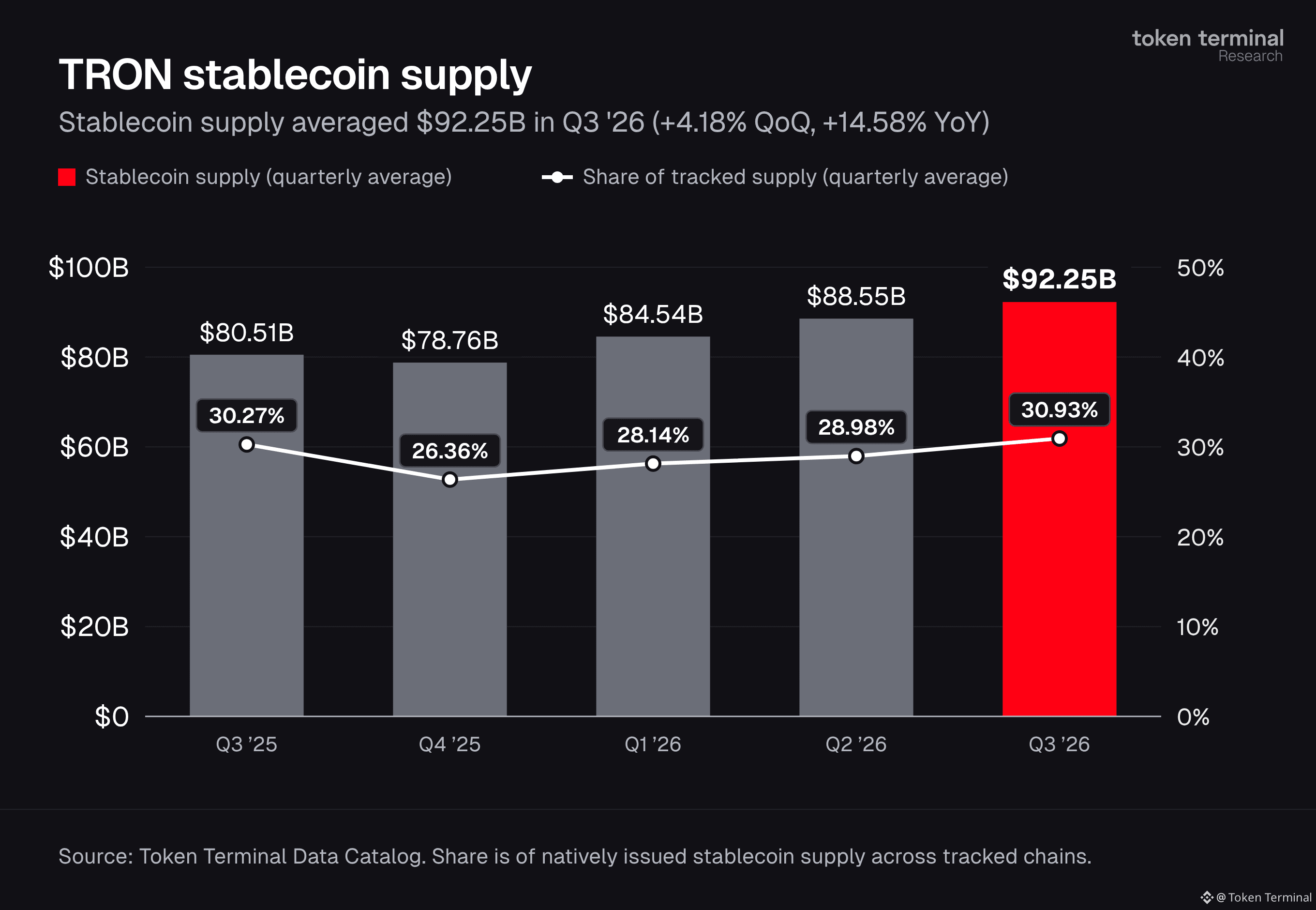
TRON added supply in a quarter when the total across all tracked chains fell 2.41% QoQ (+12.13% YoY). Its share of that total rose to 30.93% (+1.96 pp QoQ, +0.66 pp YoY), the highest since Q2 ’25. Supply has now grown for three consecutive quarters and in seven of the past eight.
USDT supply measures the total USD value of USDT issued on each network, covering natively issued USDT and excluding bridged supply. TRON overtook Ethereum as the largest USDT network in Q3 ’26, averaging $90.75B (+4.11% QoQ, +13.74% YoY) against Ethereum’s $87.73B (-7.59% QoQ, +7.67% YoY). That put TRON at 49.49% of USDT across the 12 tracked chains (+2.93 pp QoQ, +1.36 pp YoY).
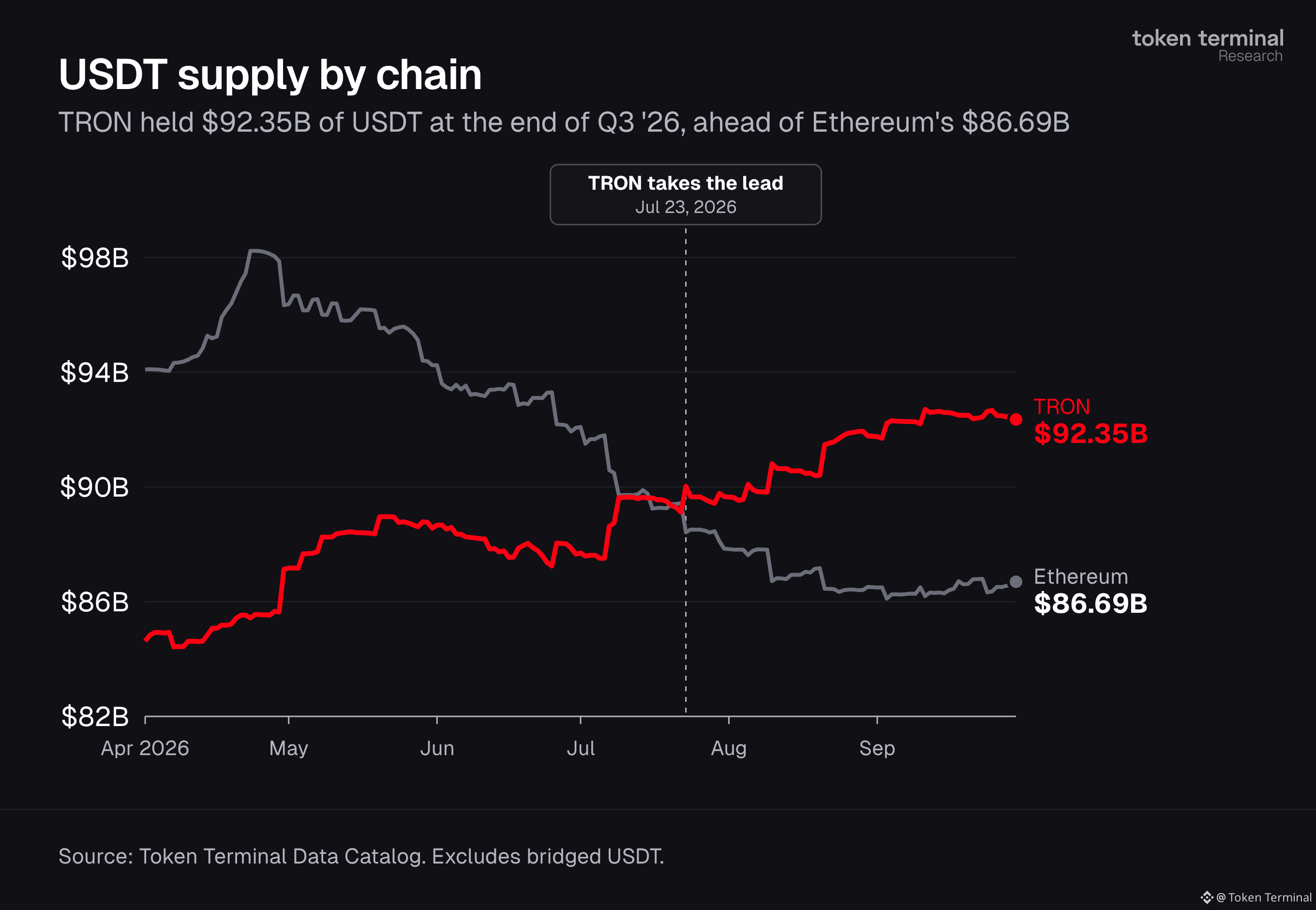
TRON first moved ahead of Ethereum on July 16, fell back for three days, and has stayed ahead since July 23. Q3 ’26 is the first quarter TRON has held more USDT than Ethereum on average since Q2 ’25, and the two networks together held 97.33% of USDT across tracked chains.
Stablecoin holders measures the number of unique addresses holding a non-zero balance of a natively issued stablecoin on TRON. Stablecoin transfer volume measures the total USD value of natively issued stablecoins transferred on TRON. Holders averaged 76.53M in Q3 ’26 (+2.25% QoQ, +11.27% YoY), an all-time high, and transfer volume totaled $2.18T (+4.17% QoQ, +3.70% YoY).
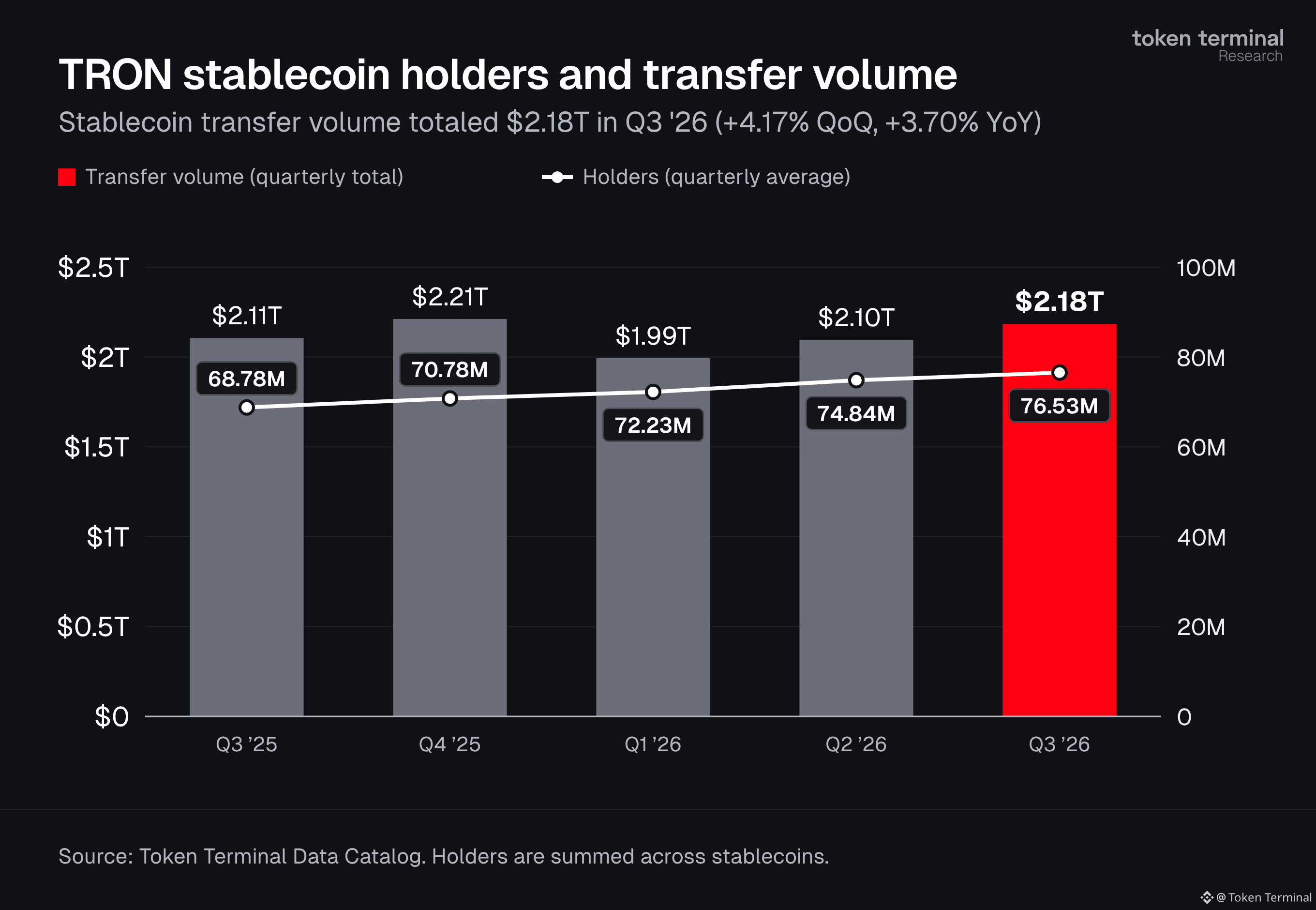
The holder count has risen in every quarter since 2019. Transfer volume was 23.67 times the quarter’s average supply, the same rate as in Q2, which means the average stablecoin dollar on TRON moved once every 3.89 days.
Supply grew and the rate at which it moved held steady, so the larger balance came with a proportionally larger flow of transfers across the network.
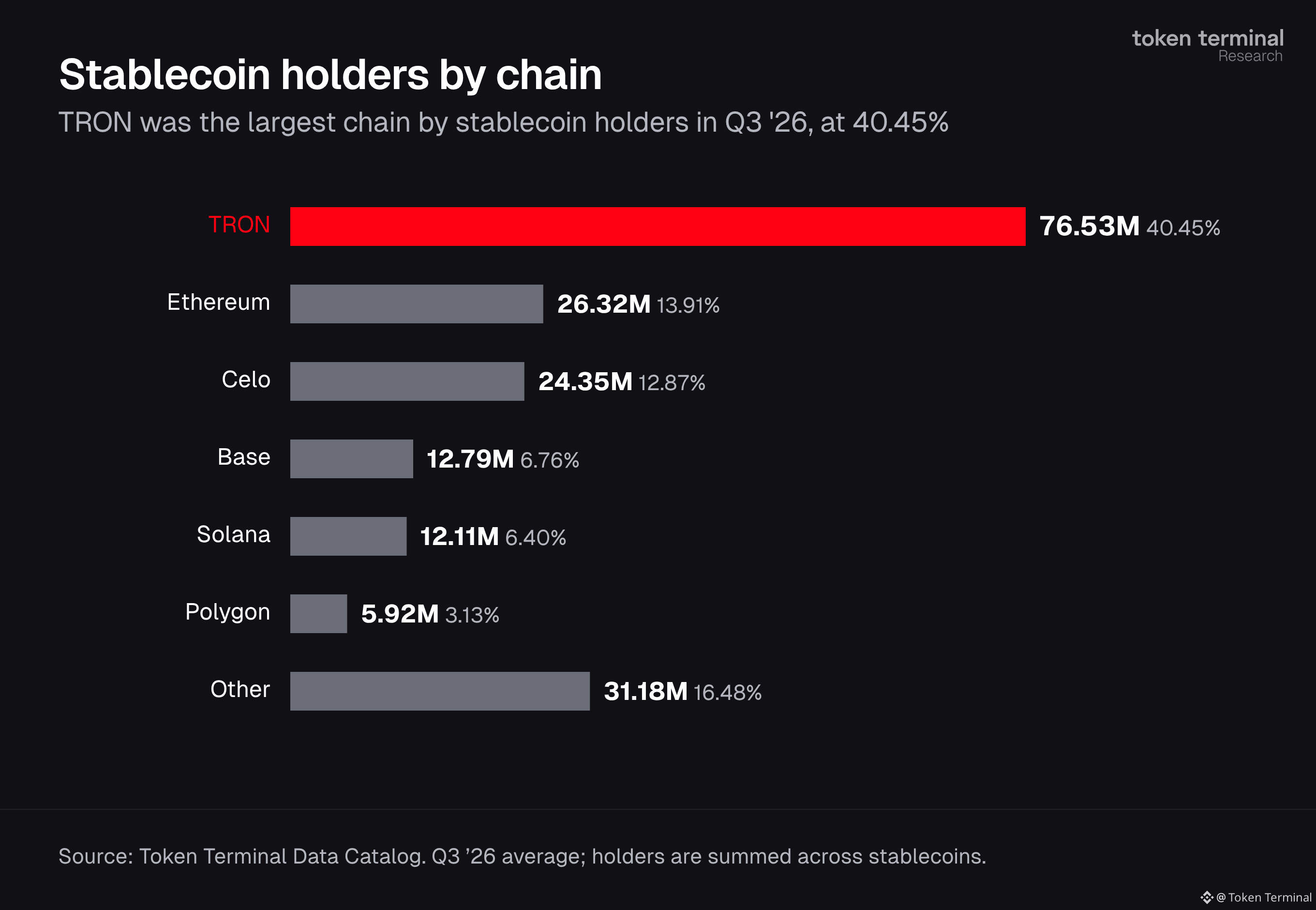
TRON was also the largest chain by stablecoin holders. Its 76.53M holders in Q3 ’26 were 40.45% of the total across the 45 chains Token Terminal tracks, 2.91 times Ethereum’s 26.32M.
👥 TRON DAO commentary
“Continued growth in stablecoin supply remains the strongest indicator of institutional adoption. TRON’s position as the largest network for USDT reflects its low transaction costs, fast settlement times, and extensive integration with exchanges, wallets, and payment providers, making it a preferred network for moving digital dollars globally.
Equally important is the growth in stablecoin holders and transfer volume, demonstrating that adoption extends beyond simply holding digital dollars to actively moving them across the network. Looking ahead, we will build on this momentum by expanding payment integrations, strengthening institutional integrations, and making stablecoins more accessible to businesses and individuals worldwide. We see significant opportunities for TRON to support the next phase of stablecoin adoption, particularly in cross-border payments and emerging markets where demand for dollar-denominated financial infrastructure remains strong.”
4) Transaction count and transactions per second
Transaction count measures the total number of transactions processed on the TRON network. Transactions per second measures the average number of transactions the TRON network processes per second. Transaction count totaled 1.08B in Q3 ’26 (+0.28% QoQ, +31.19% YoY), holding at a record level, while TPS averaged 135.76 (-0.81% QoQ, +31.19% YoY).
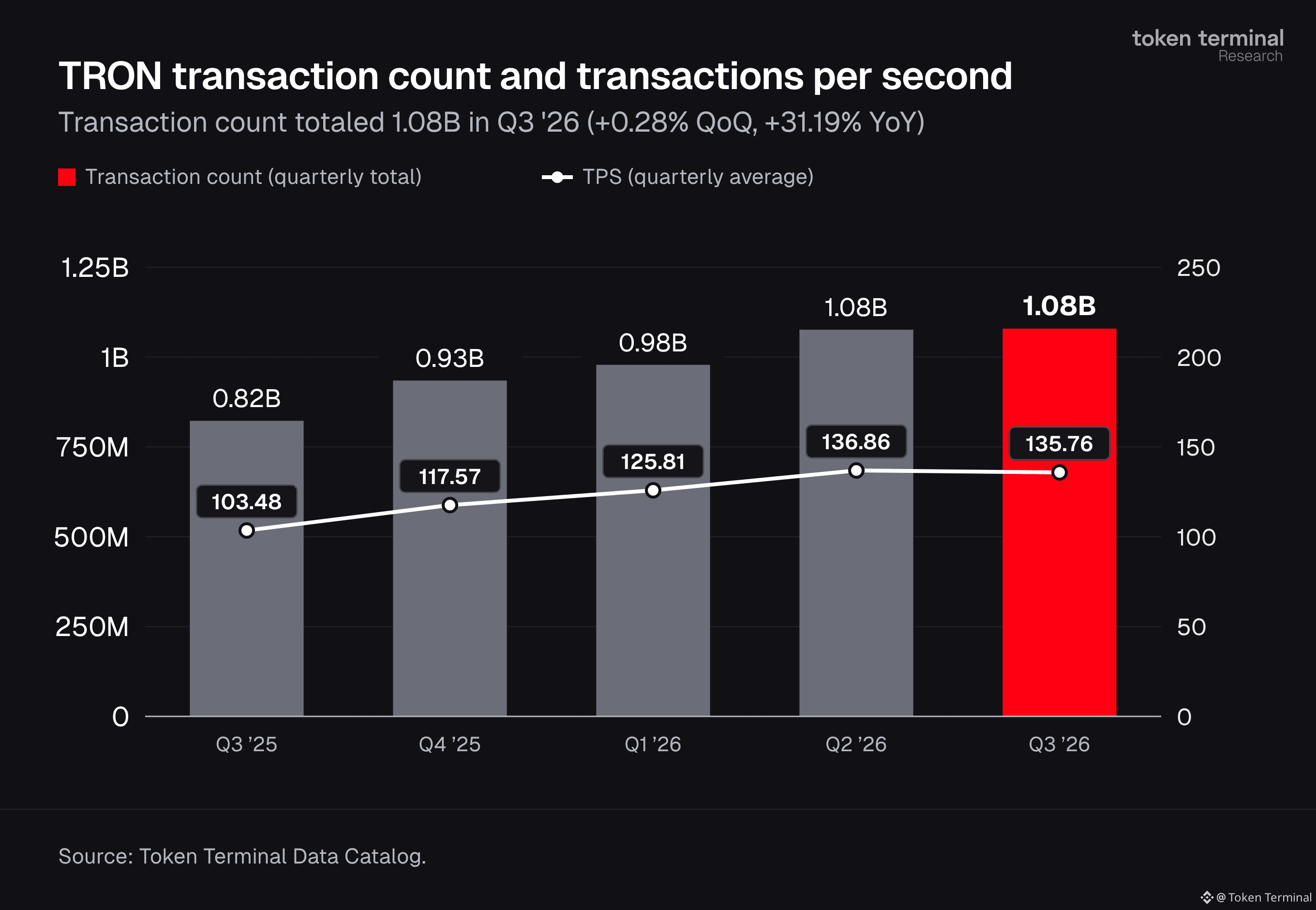
Q3 had one more day than Q2, so the quarterly total rose slightly while daily throughput was essentially flat. It was the sixth consecutive quarterly increase in transaction count.
Activity at this level sets the base for TRON’s revenue, and what it earns depends on the fee each transaction pays.
👥 TRON DAO commentary
“Transaction activity remained at record levels in Q3, with more than 1B transactions processed for the second consecutive quarter. This growth reflects TRON’s established role in stablecoin transfers and expanding ecosystem of onchain applications. Maintaining this level of activity demonstrates the network’s ability to support consistent transaction demand at scale.
Looking ahead, our focus remains on improving network efficiency, keeping transaction costs competitive, and supporting integrations that bring more users and businesses onchain. As stablecoin payments continue to be adopted by institutions around the world, we expect these use cases to remain important drivers of transaction activity across TRON.”
5) Revenue
Revenue measures the total USD value of transaction fees paid on the TRON network, whether paid by burning TRX or with Energy and Bandwidth obtained by staking TRX, all of which TRON counts as revenue. Revenue totaled $693.21M in Q3 ’26 (-3.10% QoQ, -34.40% YoY), the second-highest quarter since TRON lowered its Energy price in August 2025.
Average transaction fee measures the average USD fee paid per transaction on the TRON network. With transaction count flat, the decline came from the average transaction fee, which fell to $0.64 (-3.87% QoQ, -50.20% YoY).
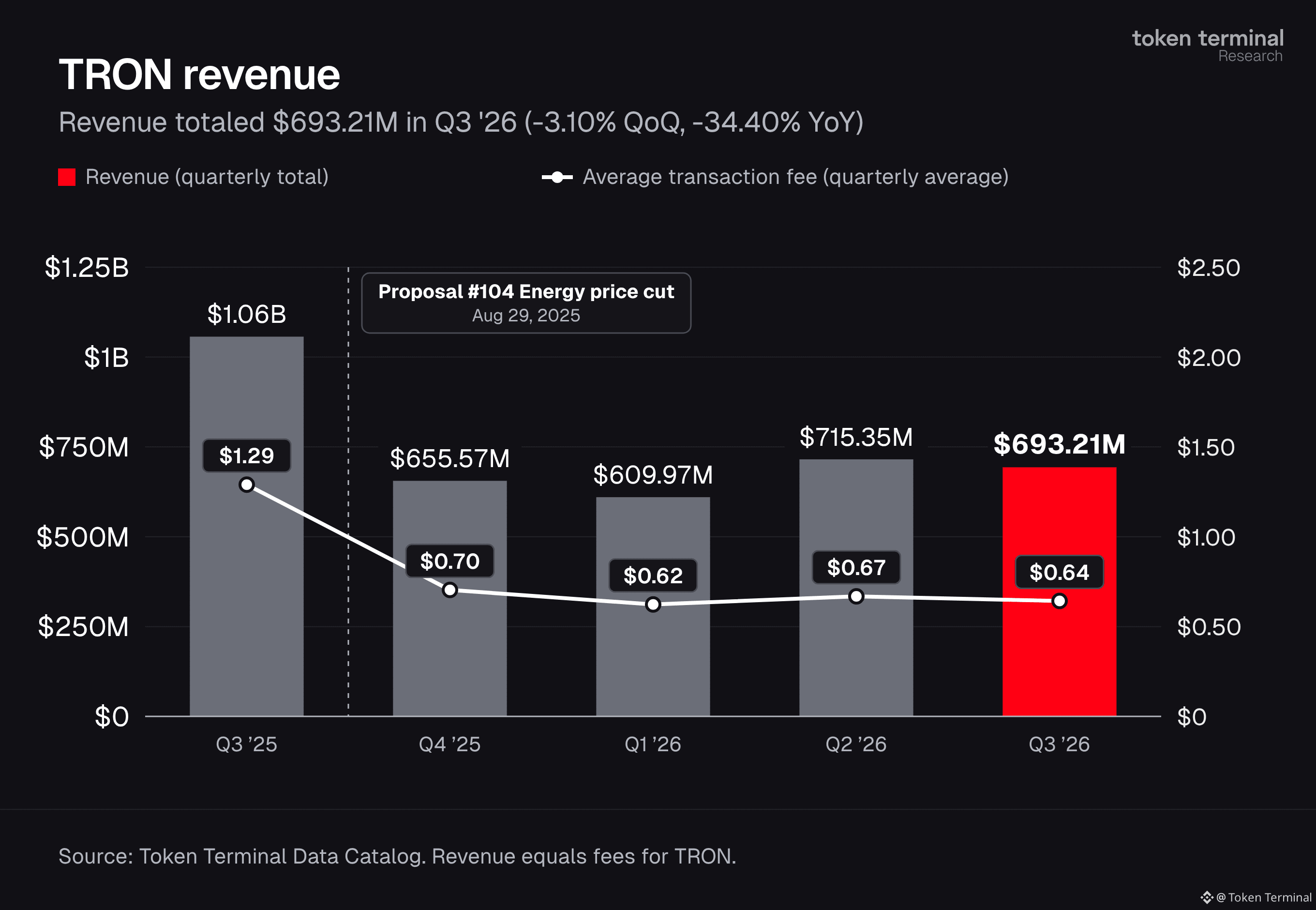
The YoY comparison spans Proposal #104, which cut the price of Energy, the resource most transactions consume, from 210 sun to 100 sun on August 29, 2025. Q3 ’25 was the last full quarter at the higher price, which is why the average fee is about half its year-earlier level while transaction count is 31.19% higher.
TRON was the largest L1 or L2 network by revenue in Q3 ’26, at 93.18% of revenue across L1 and L2 networks (-0.30 pp QoQ, +3.49 pp YoY).
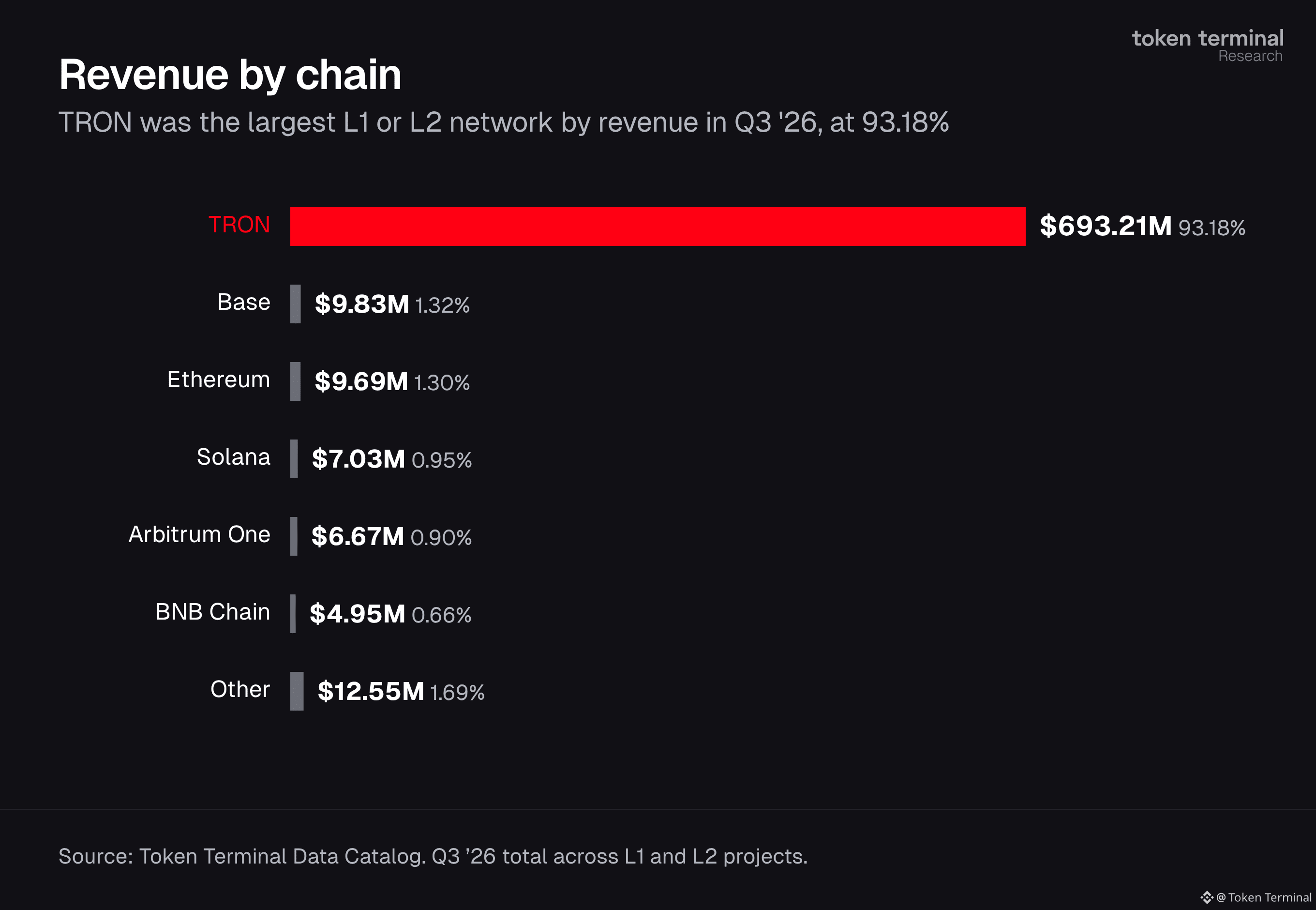
TRON’s revenue was 13.67 times the combined revenue of every other L1 and L2 network in the group.
For the business, revenue rises with activity, and the Energy price set through governance decides how much each transaction contributes. In Q3, activity held at its record level and the average fee fell slightly.
👥 TRON DAO commentary
“TRON’s Q3 revenue performance shows the strength of its underlying network activity, even as transaction fees have declined significantly over the past year. Despite lower average fees, TRON remained a leading public blockchain by network revenue, accounting for more than 93% of the total across the tracked networks. This reflects institutional demand for stablecoin transfers, and its ability to sustain substantial economic activity while reducing user costs.
The reduction in Energy prices was an important step toward making TRON more accessible and competitive for everyday transactions. Looking ahead, we remain focused on balancing affordable transaction costs with sustainable network economics, ensuring TRON can continue supporting growing demand from payment providers, financial institutions, and individual users worldwide.”
6) Monthly active users
Monthly active users measures the number of unique addresses that sent at least one transaction on the TRON network over a rolling 30-day period. Monthly active users averaged 17.81M in Q3 ’26 (+8.71% QoQ, +21.86% YoY), the highest quarterly average on record.
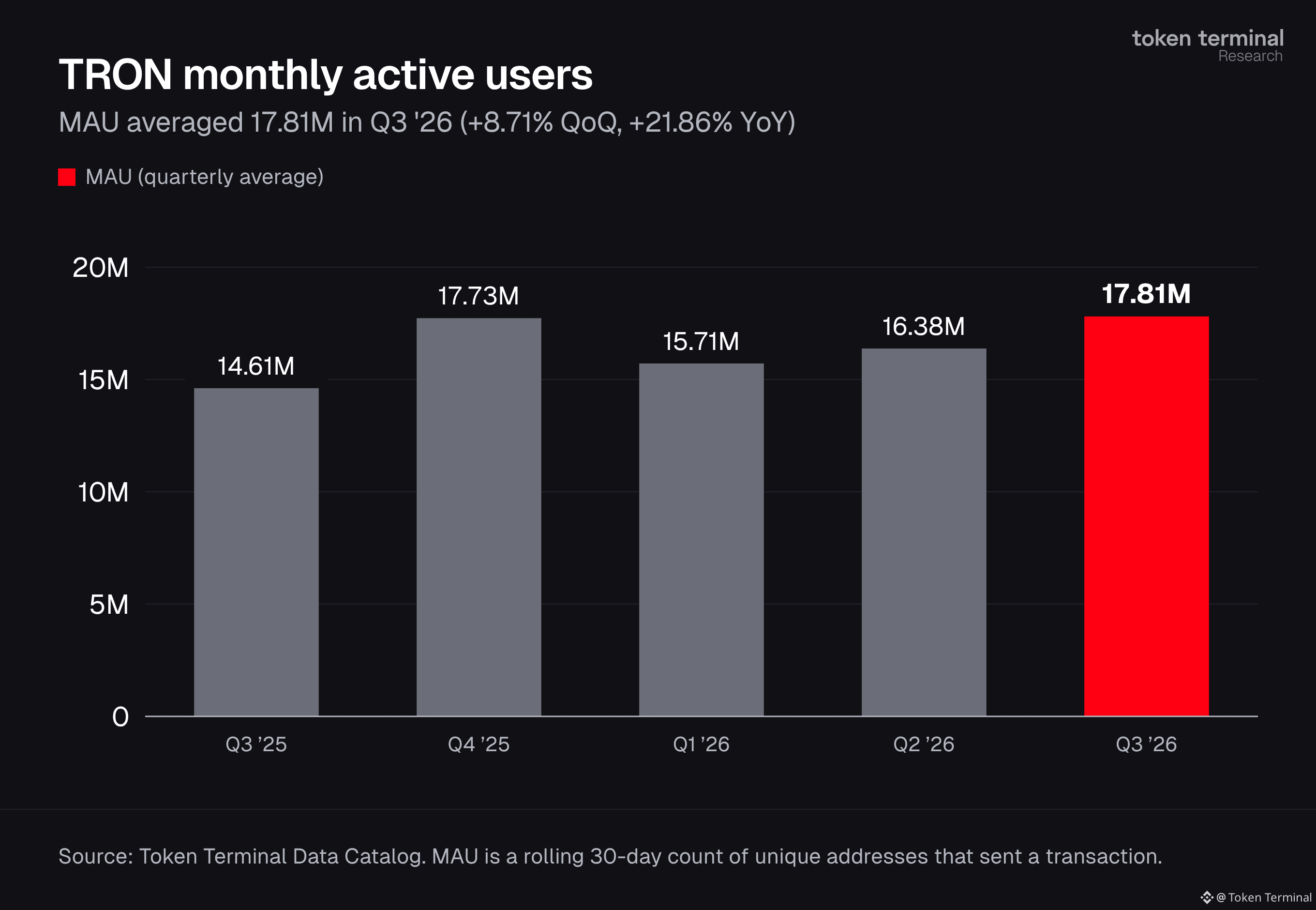
MAU entered the quarter at 20.09M on June 30 and ended it at 15.42M on September 30. Across L1 and L2 networks, summed MAU fell 16.00% QoQ, an approximate comparison since the sum counts addresses active on several networks more than once.
Over the year, transaction count grew faster than monthly active users (+31.19% versus +21.86%), so each active address sent an average of 60.60 transactions in Q3, up from 56.29 a year earlier.
For the business, growth over the year came from more active addresses and from more transactions per address, which together carried transaction count to its record level.
👥 TRON DAO commentary
“TRON’s record quarterly average of 17.81M monthly active addresses reflects continued growth in network adoption, even as activity moderated toward the end of Q3. This performance is particularly notable given the broader decline in active addresses across competing networks. More importantly, transaction growth outpaced the increase in active addresses over the past year, suggesting that TRON is not only attracting new participants but also supporting more frequent onchain activity.
Looking ahead, our priority remains expanding access to the network through wallet integrations, payment infrastructure, and institutional collaborations. As blockchain-based payments become more deeply integrated into global financial services, we see opportunities to broaden TRON’s user base while encouraging greater engagement across the ecosystem.”
7) Outlook
Q3 ’26 left TRON as the largest blockchain by circulating supply of USDT, with stablecoin supply, stablecoin holders and monthly active users at all-time highs, transaction count at a record level, and revenue slightly lower as the average fee per transaction fell. TRX also gained regulated U.S. channels. Stablecoin supply passed $94B in early October, and TRON stayed ahead of Ethereum on USDT supply every day through October 20.
Four developments to watch going into Q4:
Polygon payments stack. Polygon Labs added TRON to its Open Money Stack on October 8, giving businesses a route between U.S. bank accounts and USDT on the TRON network.
Post-quantum signatures. TRON DAO set out its post-quantum work at TOKEN2049 Singapore on October 8, with post-quantum signature support running on just the Nile Testnet.
Node access. Luganodes opened TRON RPC access with a free monthly tier on October 14, adding an infrastructure option for developers building on the network.
Institutional access. Bitstamp added support for USDT on the TRON network (TRC-20) in October 2026, expanding access to TRON-based stablecoins through an established cryptocurrency exchange.
As of late October, the Polygon integration and the Luganodes service have launched, and post-quantum signatures remain on the Nile Testnet.
8) Definitions
Metrics:
Fully diluted market cap: Fully diluted market cap measures the total USD value of TRX’s maximum supply at current market prices, assuming all tokens are in circulation.
Stablecoin supply: Stablecoin supply measures the total USD value of stablecoins issued on the TRON network, covering natively issued stablecoins and excluding bridged stablecoins.
USDT supply: USDT supply measures the total USD value of USDT issued on each network, covering natively issued USDT and excluding bridged supply.
Stablecoin holders: Stablecoin holders measures the number of unique addresses holding a non-zero balance of a natively issued stablecoin on TRON.
Stablecoin transfer volume: Stablecoin transfer volume measures the total USD value of natively issued stablecoins transferred on TRON.
Transaction count: Transaction count measures the total number of transactions processed on the TRON network.
Transactions per second: Transactions per second measures the average number of transactions the TRON network processes per second.
Revenue: Revenue measures the total USD value of transaction fees paid on the TRON network, whether paid by burning TRX or with Energy and Bandwidth obtained by staking TRX, all of which TRON counts as revenue.
Average transaction fee: Average transaction fee measures the average USD fee paid per transaction on the TRON network.
Monthly active users: Monthly active users measures the number of unique addresses that sent at least one transaction on the TRON network over a rolling 30-day period.
9) About this report
This report is published quarterly and produced leveraging Token Terminal's end-to-end onchain data infrastructure. All metrics are sourced directly from blockchain data. Charts and datasets referenced in this report can be viewed on the corresponding TRON Q3 2026 Report dashboard on Token Terminal.