$1INCH 1inch Blocks Attacker’s Address Following Binance Hack – But 1INCH Tokens Cannot Be Frozen
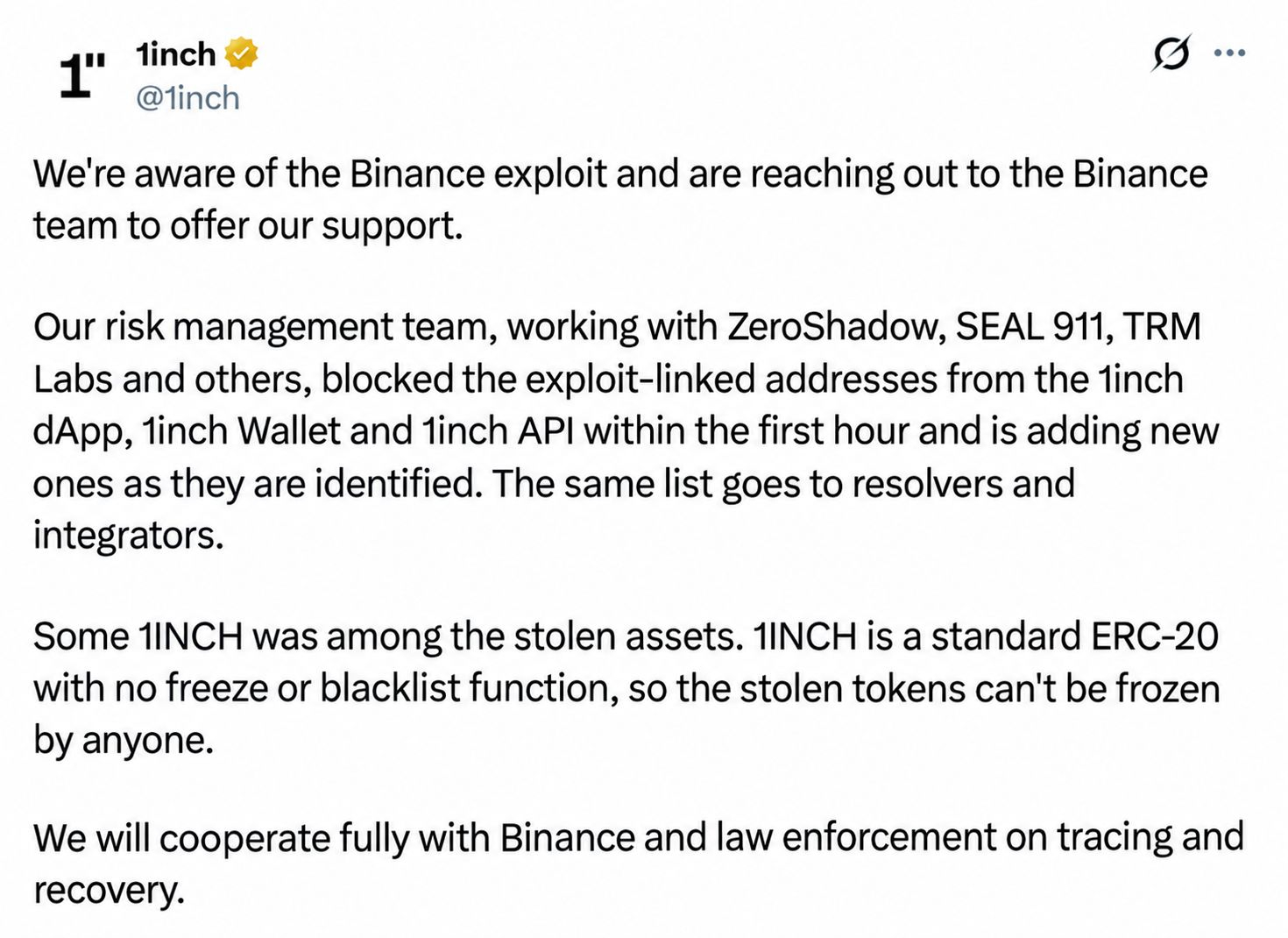
1inch has addressed the recent hack involving Binance, demonstrating a highly professional response.
Actions taken by 1inch:
Contacted the Binance team to provide assistance.
Collaborated with ZeroShadow, SEAL 911, TRM Labs, and other partners through their risk management team.
Within one hour of the incident, blocked the attacker’s address across the 1inch DApp, 1inch Wallet, and 1inch API.
Continued to add new addresses, synchronizing these updates for resolvers and integration partners.
Among the stolen assets were 1INCH tokens. However, as a standard ERC-20 token, 1INCH lacks any built-in freezing or blacklisting functionality. This means that no one not even the 1inch team can freeze the stolen tokens.
This is the flip side of decentralization. Standard ERC-20 tokens lack intervention mechanisms; while this promotes financial freedom, it becomes a nightmare in the event of a hack. The attacker can freely sell the stolen 1INCH tokens on any decentralized exchange (DEX) without the possibility of being blocked.
1inch did everything within its power blocking the address at the interface, API, and wallet levels but it could not restrict the tokens themselves at the smart contract layer. This is an inherent limitation of the design.
When choosing tokens, it is important to understand that the absence of a "freeze" function is a double-edged sword: it protects you from censorship, but it also shields thieves from having their assets frozen.
1inch blocked the address but could not freeze the tokens what are your thoughts?
News is for reference, not investment advice. Please read carefully before making a decision.
$BNB