


A Binance bonus code does one concrete thing. Enter 20LESSFEES when you create your account and you pay a flat 20% less on Spot and Futures trading fees, for as long as you trade on that account.
Everything else people say about bonus codes is a mix of half-truths and wishful thinking. Below are the eight claims new users repeat most, each checked against how the account actually works, with real fee numbers.
👉 Open a Binance account with bonus code 20LESSFEES
The welcome bonus of up to $19,800 for eligible users is a separate, task-based extra. You can join it with any code, so the fee discount is the part your choice of code really decides.
Myth 1. A bonus code drops money into your account
Fact: Nothing lands in your wallet when you register. The code changes the price you pay per trade, not your balance.
That sounds less exciting, but it is the more useful of the two. A balance top-up is a one-off. A lower fee keeps working on every order you place, month after month, with no deposit target or trading minimum attached.
What the code changes: Spot and Futures trading fees, 20% lower than your tier's standard rate.
What it leaves alone: Deposit methods, withdrawal fees, spreads and the welcome tasks.
What it costs you: Nothing. There is no fee for entering a code and no subscription behind it.
Myth 2. Some codes come with a bigger welcome bonus
Fact: The welcome bonus works the same way whichever code you sign up with. Its ceiling, its tasks and its eligibility rules come from Binance, not from the code.
So if you are comparing codes, compare what they do to fees. Some cover Spot only. The one used here covers Spot and Futures, which is the wider of the options and matters a lot if you ever open a futures position.
A page that promises a "bigger" welcome bonus for one particular code is either confused or selling something. Check the event page itself and you will see the same tiers for everyone who qualifies.
Myth 3. You can add the code later from your settings
Fact: The code has to be attached at the moment the account is created. Once you have tapped Register without it, there is normally no field to add it afterwards.
This is the mistake that costs people the discount most often. They sign up in a hurry on their phone, skip the optional field, and only notice a week later when they compare fees with a friend.
If you want a full list of the ways the discount slips through the cracks, read this checklist for making sure the 20% fee discount applies before you start.
Here is the order that works every time.
Open the sign-up page through the link above: The code field fills in by itself. If you type the address by hand, copy 20LESSFEES first.
Enter your email or phone number: It is the first box on the registration screen.
Look at the code field before anything else: On some versions of the page it is folded under a small arrow. Open it and check the spelling, with no space at the end.
Tap Register: Confirm the email or SMS code, set a strong password and finish identity verification when the app asks.
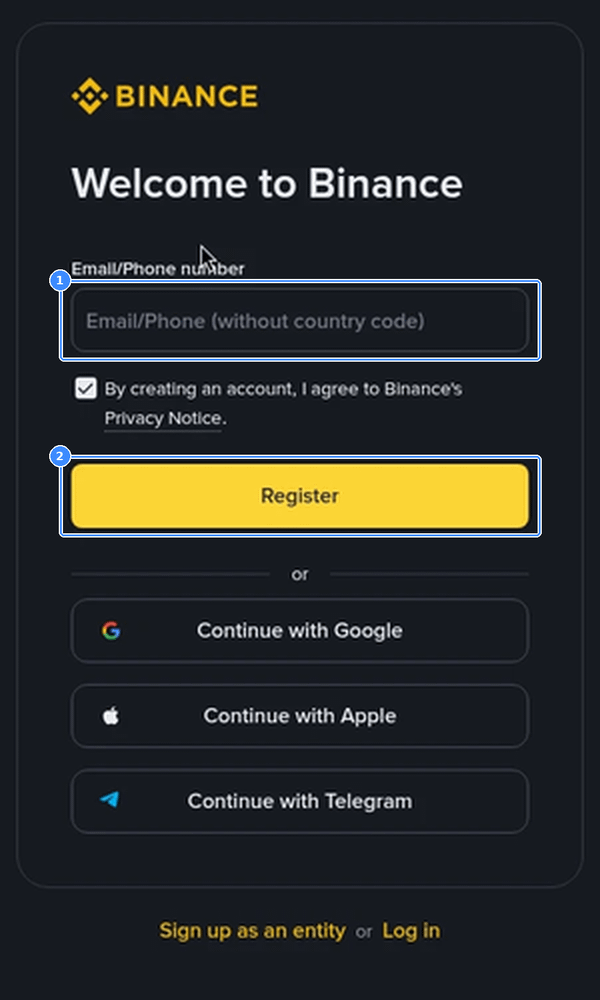
👉 Code check before you tap Register: 20LESSFEES, spelled exactly.
Myth 4. A 20% fee discount is too small to bother with
Fact: On one trade it is small. Over a year of normal trading it adds up, and on futures it adds up faster than most beginners expect.
The standard Spot fee for a Regular User is 0.100% for maker and taker orders. With the code that becomes 0.080%. Here is what that gap looks like at different activity levels.
One $1,000 market buy: $1.00 in fees at the standard rate, $0.80 with the code. You save 20 cents.
A $200 weekly buy for a year: About $10,400 of volume, so roughly $10.40 in fees against $8.32. A saving of about $2, which is honestly minor.
$20,000 of Spot trades a month: $20 a month in fees against $16. That is about $48 a year.
$100,000 a month: $100 against $80, or about $240 a year that stays in your account.
The pattern is simple. The discount is a slice of the fee, and the fee is a slice of your volume. Someone who buys once a month will barely notice it. Someone who trades every day will.
Myth 5. The headline figure is what a new user receives
Fact: "Up to $19,800" is the top of a ladder of tasks. Most people who take part complete the first one or two rungs, if any.
The table below is one version of the welcome task ladder. Each tier pairs a net deposit and a trading volume with a reward and a deadline. Tiers, amounts and periods can change, so always read the version shown to your own account.
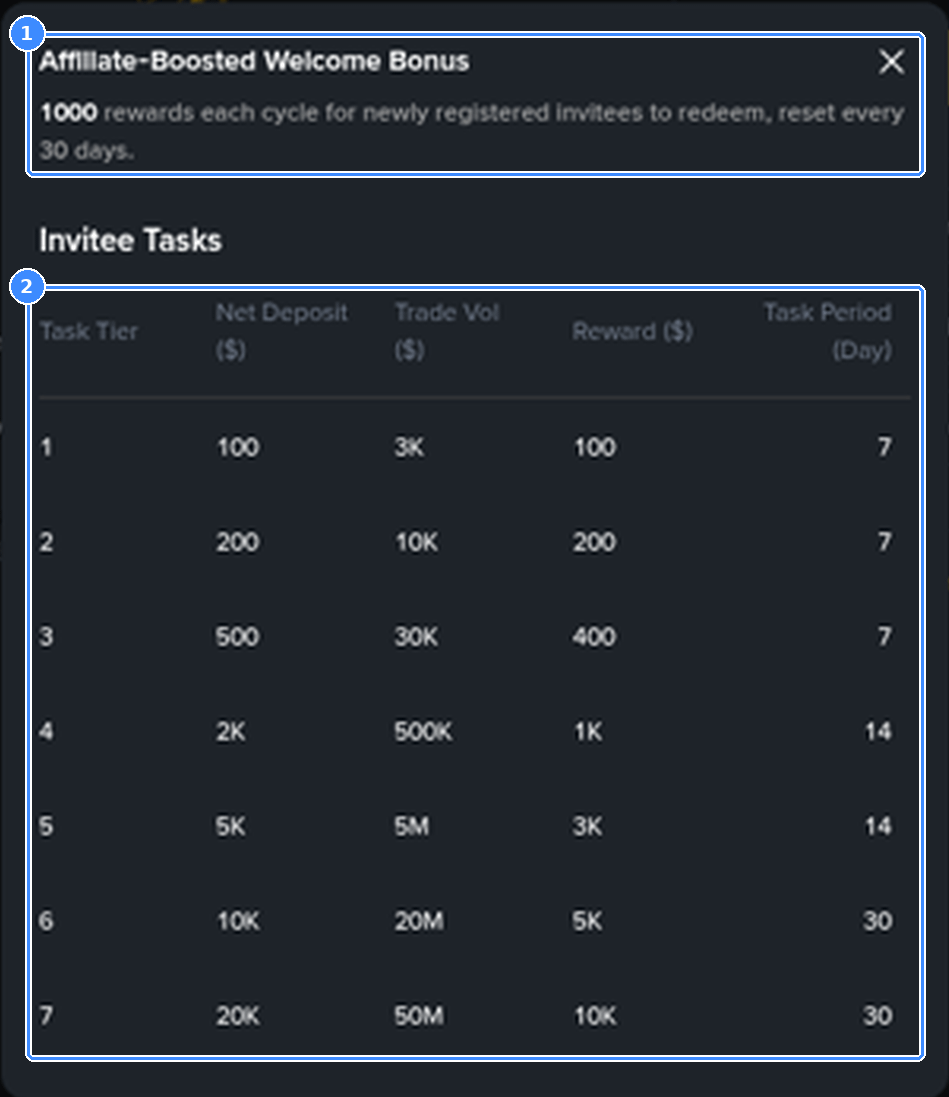
Take the first tier in that table as a worked example. It asks for a $100 net deposit and $3,000 of trading volume within 7 days.
Fees on $3,000 of Spot volume: $3.00 at the standard 0.100% rate, or $2.40 with the 20% discount.
What the volume really means: $3,000 of volume from a $100 deposit is many buys and sells of the same money. Every round trip pays a fee and a spread.
What the rule leaves out: The market can move against you while you trade. A 3% drop on a $100 position is $3, the same size as the whole fee bill.
Tier 7 asks for a $20,000 net deposit and $50 million of volume in 30 days. That is professional-desk activity, not something to aim for in your first month.
Myth 6. Chasing the volume target costs nothing
Fact: Volume is never free. You pay fees on it, you cross the spread on it, and your coins can lose value while you hold them.
A cheaper way to think about it: only take a task if the trading it needs is trading you planned to do anyway. If you would have to invent trades just to hit a number, skip that tier. Forcing volume is the classic way new users lose more in fees and price moves than the reward is worth.
This is where the code and the bonus work well together. If you do end up trading toward a task, every one of those trades costs 20% less in fees with 20LESSFEES on the account.
Myth 7. Futures fees are too tiny to care about
Fact: Futures fees look tiny because they are quoted on the full position size, not on the margin you put up. That is exactly why they add up.
A Regular User on USDⓈ-M futures pays 0.0200% maker and 0.0500% taker. Say you open a $5,000 position with $500 of margin at 10x and close it with market orders.
Standard taker fees: $2.50 to open plus $2.50 to close, so $5.00 per round trip.
With 20LESSFEES: 0.0400% taker, so $2.00 plus $2.00, or $4.00 per round trip.
Twenty round trips a month: $100 in fees against $80, which is 4% of your $500 margin either way. The code trims that cost, it doesn't remove it.
Funding payments come on top of trading fees and the code doesn't touch them. Leverage also means losses can hit your margin fast, so treat the fee saving as a cost cut and nothing more.
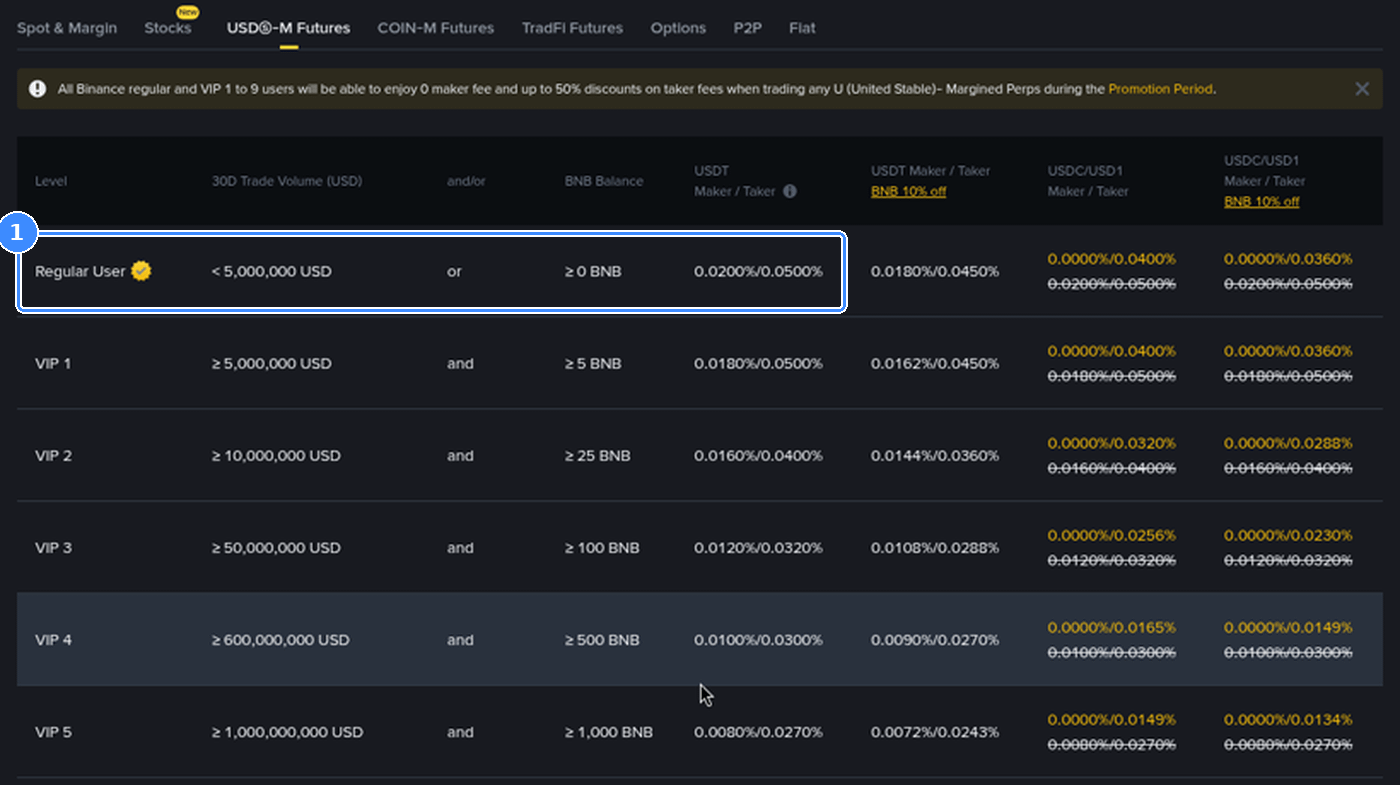
👉 Spot and Futures fees, both 20% lower: sign up with 20LESSFEES.
Myth 8. Welcome rewards are cash you can withdraw straight away
Fact: Rewards from the welcome tasks usually arrive as vouchers in the Rewards Hub. Each voucher has its own type, expiry date and rules for how it can be used.
Some vouchers cover trading fees, others need to be claimed and used within a few days. If you let one expire, it is gone. This guide to tasks and vouchers in the Binance Rewards Hub shows where to find them and what to check before the deadline passes.
Is entering a bonus code safe?
Yes. A code is a tag on a new account and nothing more. It doesn't ask for card details, it doesn't share your login, and nobody gains any access to your funds through it.
What is not safe is a site or a message that asks for your password, a 2FA code or a "verification payment" in exchange for a bonus. Binance never needs any of those for a sign-up code. Close that page and enter the code only on binance.com or in the official app.
I already have an account, so what now?
An existing account can't take a new code. Binance allows one account per person, so opening a second one to grab a discount breaks the rules and can get both accounts restricted.
What you can still do on an existing account:
Turn on BNB fee payment: Binance's own fee setting lowers the Regular User Spot fee from 0.100% to 0.075%, if you keep some BNB in your Spot wallet. BNB's price moves, so keep that amount small.
Use limit orders: Maker orders can be cheaper than taker orders on futures, and they also spare you the spread.
Trade less often: Fewer, better-planned trades cut fees more than any code.
The quick version before you register
The code decides: Your fee discount. With 20LESSFEES that is a flat 20% off Spot and Futures fees.
The code doesn't decide: The welcome bonus, which is task-based and the same for every eligible user.
Timing: The code goes in before you tap Register, never after.
Tasks: Take only the tiers that match trading you would do anyway.
If you are about to open a Binance account, attach 20LESSFEES first so every trade costs less from day one. Then, if you are eligible, open the active Binance welcome bonus event and read its tiers before you commit to any of them.
This article is about fees and account setup. It is not financial advice, crypto prices can fall, and leveraged trading can lose your margin quickly.
FAQ
What is the difference between a bonus code and the welcome bonus?
The code sets your fee discount for the life of the account. The welcome bonus is a set of time-limited tasks with rewards for eligible users, and it is the same with any code.
How do I check that the discount worked?
Place one small Spot trade and open your trade history. A 100 USDT market order on the Regular User tier should show a fee worth about 0.08 USDT, not 0.10.
Does the discount stop after the welcome tasks end?
No. The task deadlines only apply to the rewards. The fee discount has no deposit or volume target and keeps applying while you trade.
Can I use the code in the Binance app?
Yes. The app's registration screen has the same code field. Open it and check the code is there before you tap Register.
Do I have to complete any task to keep the discount?
No. You can ignore the welcome tasks completely and still pay 20% less on Spot and Futures fees.