

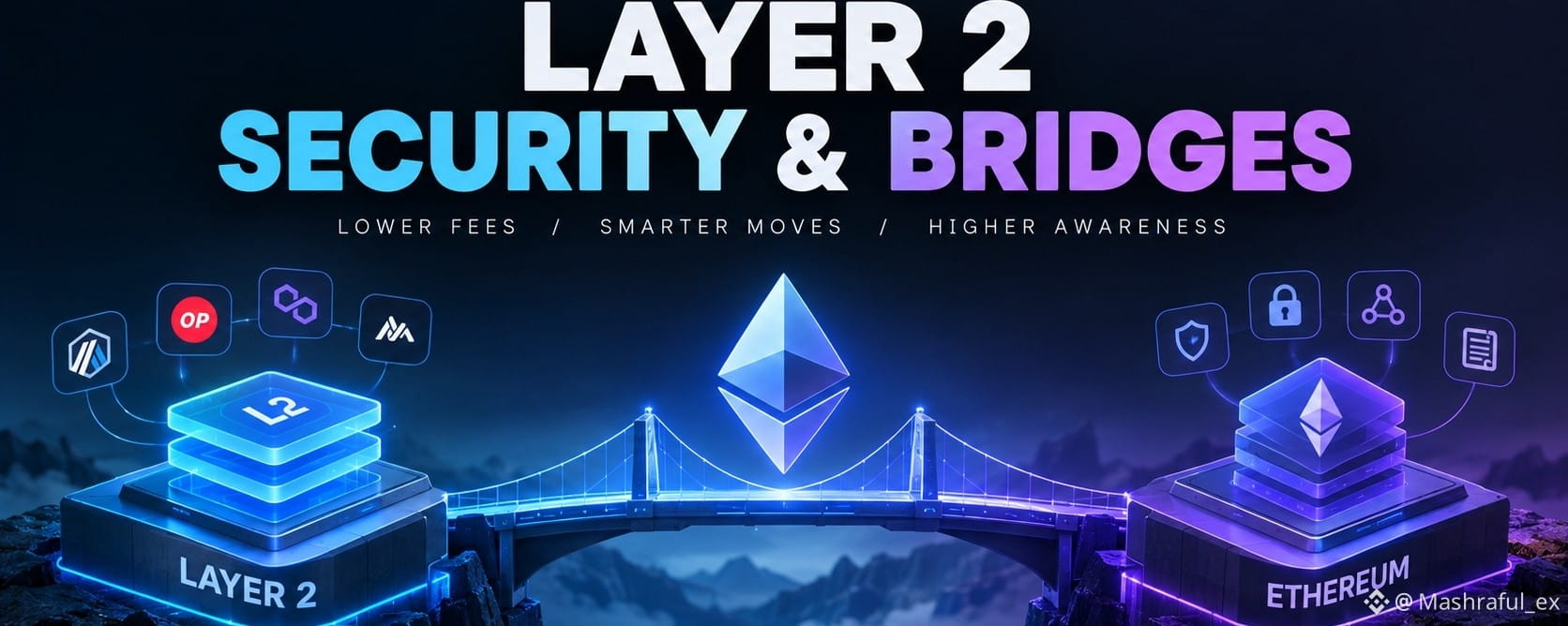

Layer 2 Security & Bridges: What Every Crypto User Should Know
Ethereum Layer 2 networks help make transactions faster and cheaper. But lower fees should not be the only factor when choosing a network.
Understanding how Layer 2 security works—and how bridges move assets between networks—is essential for anyone exploring DeFi, testnets, or Web3 applications.
1. What makes a Layer 2 different?
Ethereum Layer 2 (L2) solutions process transactions outside Ethereum's main execution layer to improve scalability.
Rollups bundle transactions and submit relevant data to Ethereum. This allows transaction costs to be shared across many users.
However, not every network marketed as a Layer 2 inherits Ethereum's security in the same way. Different designs have different assumptions about data availability, transaction verification, and the ability to challenge invalid state changes.
Before using a network, check its architecture and independent risk assessments.
2. What is a crypto bridge?
A bridge enables assets or messages to move between blockchain networks.
For example, you might bridge ETH from Ethereum Mainnet to an Ethereum rollup to interact with applications that offer lower transaction fees.
Common bridge designs include:
- Lock and mint: Assets are locked on one chain, and corresponding tokens are issued on another.
- Burn and mint: Tokens are burned on the source chain and issued on the destination chain.
- Liquidity-based transfers: A liquidity provider supplies assets on the destination chain in exchange for assets sent on the source chain.
These mechanisms have different trust assumptions, liquidity requirements, and operational risks.
3. Why can bridges be risky?
A bridge connects systems that may have different security models. That connection introduces additional points of failure.
Here are four risks worth understanding:
Smart contract vulnerabilities
A bug in a bridge contract can expose funds to theft or cause transfers to fail.
Validator or operator risks
Some bridges depend on external validators, signers, or other operators. Their security depends partly on how those participants are selected, monitored, and incentivized.
Wrapped-token risks
A token representing an asset on another network depends on the mechanism backing or issuing it. If that mechanism fails, the token may lose its intended backing or usefulness.
Phishing and malicious approvals
Fake bridge websites can trick users into signing transactions or granting token allowances to malicious contracts. Always verify the official URL and review transaction details before signing.
A security audit can help identify vulnerabilities, but it does not guarantee that a bridge is safe.
4. Understand withdrawal delays
Moving assets onto a rollup and withdrawing them back to Ethereum Mainnet may involve different processes.
Some optimistic rollups use a challenge period for withdrawals through their native bridges. Under the standard Optimism withdrawal process, a withdrawal must be proven and then wait through a challenge period before finalization.
This is why a withdrawal may take significantly longer than a normal transaction.
Other bridges may offer faster transfers through liquidity providers or alternative verification mechanisms. Faster service does not automatically mean stronger security; examine the trade-offs.
Always check the specific network's official documentation for its current withdrawal rules and fees.
5. A practical checklist before bridging
Before transferring funds, ask yourself:
1. Is the website official? Verify the URL using the project's official documentation.
2. What secures the bridge? Understand whether it relies on Ethereum verification, external validators, liquidity providers, or other mechanisms.
3. Has the bridge been reviewed? Look for public audits, security disclosures, and any available incident history.
4. What will the transfer cost? Consider source-chain gas, bridge fees, and destination-chain gas.
5. How do withdrawals work? Check the expected timeline, challenge periods, and available exit routes.
6. Am I using the correct network and token? Confirm the destination chain and token contract before sending funds.
7. Can I afford the risk? Avoid bridging money you cannot afford to lose.
For additional research, compare Ethereum rollups using "L2BEAT" (https://l2beat.com/) and review the official "Ethereum.org bridge documentation" (https://ethereum.org/developers/docs/bridges).
Final thoughts
Layer 2 networks are an important part of Ethereum's scaling ecosystem, but lower fees are only one part of the decision.
A responsible Web3 user evaluates security assumptions, bridge design, withdrawal conditions, and transaction costs before moving funds.
Remember: the cheapest route is not necessarily the safest route.
What matters most when choosing a bridge: security, speed, or fees? Share your thoughts in the comments.
Sources
- Ethereum.org — What is Layer 2?(https://ethereum.org/layer-2/learn)
- Ethereum.org — Bridges (https://ethereum.org/developers/docs/bridges)
- Optimism — Withdrawal specifications (https://specs.optimism.io/protocol/withdrawals.html)
- L2BEAT — Layer 2 risk assessments (https://l2beat.com/)