


Binance Futures lets you trade crypto price moves with leverage, going long if you expect a rise or short if you expect a fall, without owning the coin. To start, you open a Futures account, pass a short quiz, move USDT into your Futures wallet and place your first order. Leverage multiplies both gains and losses.
👉 New to Binance? Sign up with a bonus and 20% lower trading fees
What is Binance Futures trading?
A futures contract tracks the price of a coin such as BTC. You trade the contract, not the coin itself.
Most people use perpetual contracts. They have no expiry date, so you can hold a position as long as your margin covers it.
USDⓈ-M Futures: margined and settled in USDT or USDC. This is where most beginners start.
COIN-M Futures: margined in the coin itself, such as BTC. Better suited to people who already hold that coin.
How do you open a Futures account on Binance?
Verify your account. Futures is only available on verified accounts in supported regions.
Open Futures from the Derivatives menu and choose USDⓈ-M.
Complete the Futures quiz. Binance asks a few questions about leverage and liquidation before you can trade.
Transfer funds from your Spot wallet to your USDⓈ-M Futures wallet.
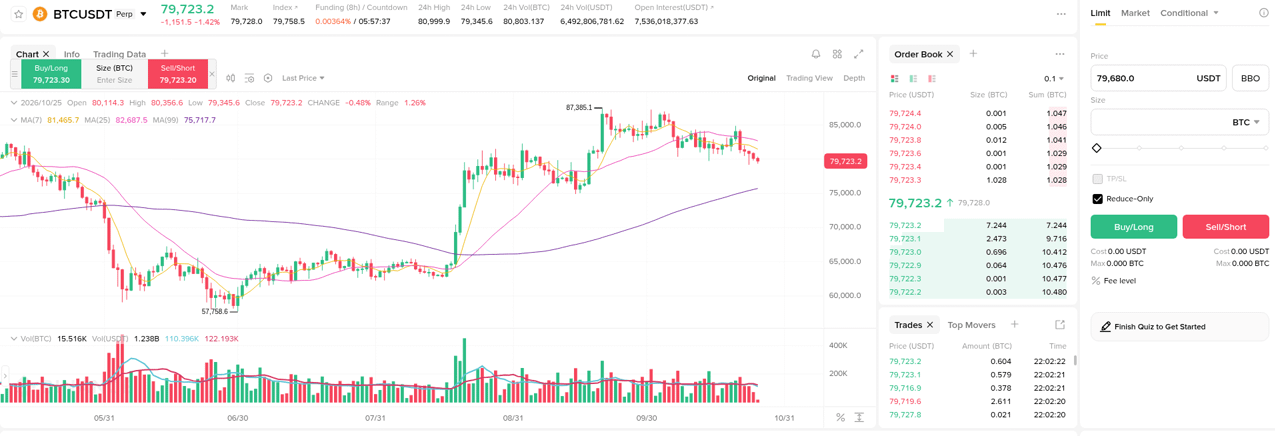
The USDⓈ-M Futures trading screen for BTCUSDT Perpetual, with the chart, order book and order panel.
How do you place your first Futures trade?
Pick a pair, for example BTCUSDT Perpetual.
Choose the margin mode. Isolated limits the risk to the margin of that one position. Cross uses your whole Futures balance.
Set the leverage. As a beginner, keep it low, around 2x to 5x.
Choose an order type. Limit sets your price, Market fills right away at the current price.
Enter the size and click Buy/Long or Sell/Short.
Add a stop loss so one bad move can't empty your account.
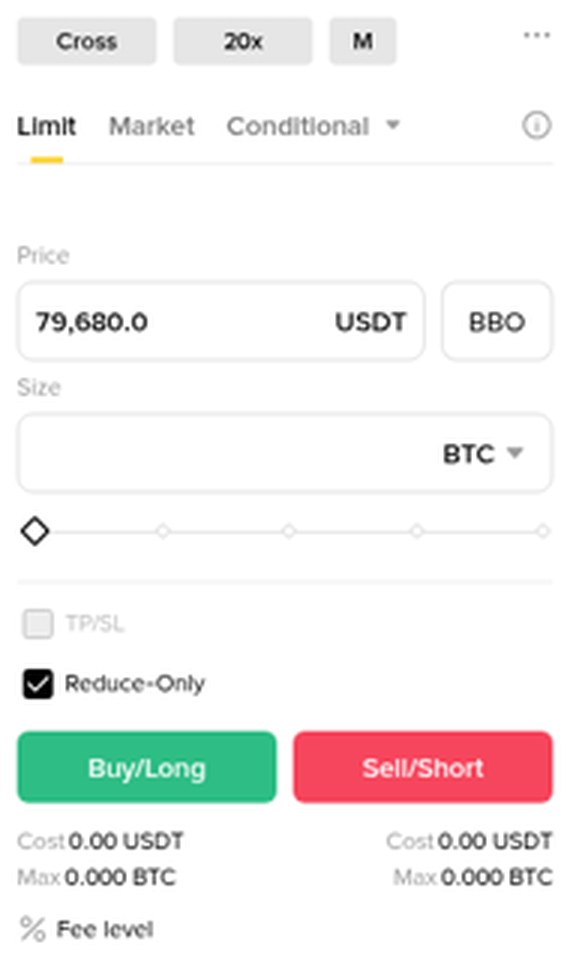
The Futures order panel. Margin mode and leverage sit at the top, then order type, size and the long or short buttons.
Not ready to pick trades yourself? Some beginners prefer to follow experienced traders. Here is how Binance copy trading works and what it costs.
What is liquidation and how do you avoid it?
Liquidation happens when your losses eat through the margin of a position. Binance then closes it, and that margin is gone.
The higher the leverage, the smaller the price move needed. At 20x, a move of about 5% against you can be enough.
Use low leverage and isolated margin while you learn.
Always set a stop loss before you walk away from the screen.
Watch the liquidation price shown in your open position.
Never trade money you can't afford to lose.
What does Binance Futures cost?
You pay a trading fee on the full position size, not just your margin. Regular users pay 0.02% maker and 0.05% taker on USDⓈ-M Futures with USDT.
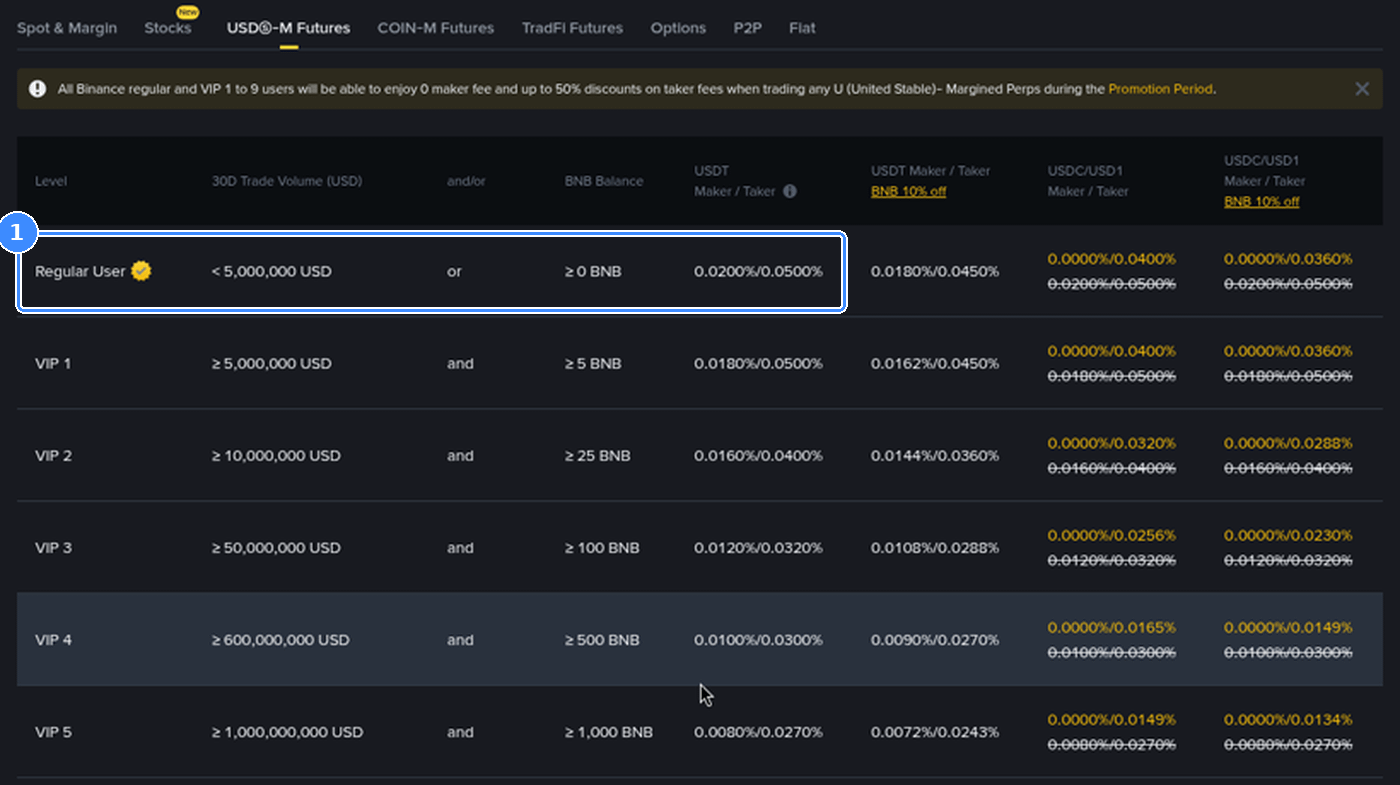
USDⓈ-M Futures fee rates by level. Regular users start at 0.0200% maker and 0.0500% taker.
Perpetual contracts also have a funding rate, a small payment between longs and shorts, usually every 8 hours. It can cost you or pay you, depending on your side.
New accounts opened with code 20LESSFEES get a flat 20% off Spot and Futures trading fees. Our full breakdown of Binance Spot and Futures fees shows how much that saves.
Ready to try Binance Futures?
Start with a small amount, low leverage and a stop loss on every trade. New users can also check the current Binance welcome bonus campaign, worth up to $19,800 for eligible users, on top of 20% lower fees with code 20LESSFEES.
FAQ
Is Binance Futures good for beginners?
It is risky for beginners. If you try it, use low leverage, isolated margin and a stop loss.
What is the minimum to trade Binance Futures?
Each pair has a small minimum order value, often a few USDT. Starting small is the smart move.
What is the difference between long and short?
A long profits when the price rises. A short profits when the price falls.
Can I lose more than my margin?
On isolated margin, your loss is limited to that position's margin. On cross margin, your whole Futures balance is at risk.
Disclosure: 20LESSFEES is my code. If you use it, I may earn a commission from Binance at no extra cost to you. Futures trading carries a high risk of loss. This is not financial advice.