

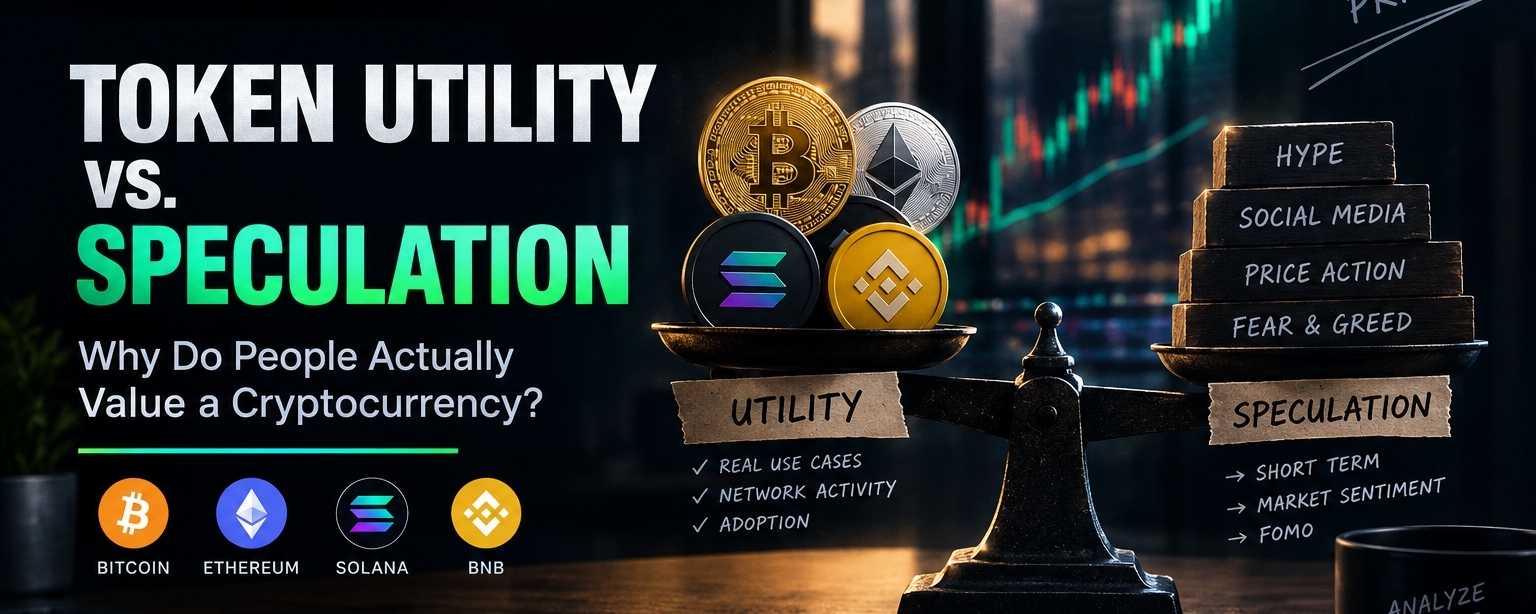

A cryptocurrency can be popular without being useful—and useful technology does not automatically guarantee a valuable token.
This is one of the most important distinctions in crypto.
When people discuss a project, they often focus on its price, social media popularity, or how quickly it has gained attention. But a more fundamental question is often overlooked:
What creates a reason for people to use or hold this token beyond the expectation that someone else will pay more for it?
Let's break it down using real cryptocurrency examples.
🔹 1. What Is Token Utility?
Token utility refers to the functions a cryptocurrency performs within its network or ecosystem.
A token may be used to pay transaction fees, transfer value, secure a blockchain, participate in governance, or access specific services.
Consider these examples:

Bitcoin enables peer-to-peer transfers without requiring a traditional financial intermediary. People also use it as a digital asset for storing and transferring value.
Its usefulness and its market price are related concepts, but they are not identical. Demand, liquidity, regulation, and market sentiment also influence its price.
◆ Ethereum (ETH)
ETH is used to pay transaction fees on Ethereum. It also plays a role in securing the network through staking.
Ethereum supports smart contracts and decentralized applications, creating different sources of network activity beyond simple transfers.

SOL is used to pay transaction fees and participate in staking on the Solana network. Its ecosystem supports applications involving payments, decentralized finance, and digital assets.
Greater network activity can increase the need for transaction fees, but this does not mean SOL's market price must rise whenever activity increases.

BNB is used for transaction fees and other functions across supported parts of the BNB ecosystem. Its exact utility depends on the product or network involved.
These examples show that cryptocurrencies can serve different purposes even when they are all traded in the same market.
🔹 2. What Is Token Speculation?
Speculation occurs when people acquire an asset partly or primarily because they expect its price to change in their favor.
For example, imagine a new token becomes popular after a series of viral social media posts.
Its price rises rapidly, even though its practical uses remain limited.
Some participants may value it because they expect continued attention and future demand—not because the underlying network has demonstrated meaningful utility.
This is speculation.
Speculation is not exclusive to cryptocurrency; it also exists in traditional financial markets. However, crypto assets can be especially volatile when market sentiment changes quickly.
The important distinction is that a price increase is evidence of changing market demand, not proof of lasting utility.
🔹 3. The Difference Between Utility and Demand
Here is where the analysis becomes more interesting.
A token can have genuine utility but limited demand. Conversely, a token with limited practical utility can experience strong speculative demand.
Imagine two hypothetical projects:
Project A
- Offers a useful blockchain service.
- Has a relatively small user base.
- Generates limited activity.
- Has a token whose price remains relatively subdued.
Project B
- Has an exciting narrative.
- Receives extensive social media attention.
- Attracts many speculative participants.
- Experiences a rapid price increase despite uncertain long-term usage.
Project A may demonstrate stronger practical utility, while Project B may experience stronger short-term demand.
Neither example guarantees future performance. Utility, adoption, token design, and market expectations can evolve.
The lesson is simple: usefulness and market valuation must be evaluated separately.
🔹 4. Four Questions to Ask About Any Crypto Project
Before forming an opinion about a token, consider these questions.
1. What problem does the network solve?
Can you explain its purpose in one or two sentences? If the use case remains vague after examining the project, that is a reason to investigate further.
2. Why is the token needed?
A useful product does not automatically make its associated token useful. Determine whether the token is genuinely required for fees, security, access, or another meaningful function.
3. Is anyone actually using the network?
Look beyond social media followers. Relevant evidence may include active users, transaction activity, application usage, and sustained demand for network services.
These metrics also have limitations: automated activity and low-value transactions can make raw numbers misleading.
4. How does the token's supply affect its economics?
Examine circulating supply, future issuance, token unlocks, distribution, and potential dilution.
Even a useful network can have a poorly designed token economy.
🔹 5. The Hidden Connection: Utility Does Not Equal Token Value
This is the mistake many beginners make.
They assume:
Useful project = valuable token.
But that relationship is not automatic.
A network might be widely used while its token captures relatively little economic value. Alternatively, a token might gain market value from scarcity, monetary properties, or speculative demand even when its practical use is limited.
A serious evaluation therefore considers several dimensions together:
- Utility: What can the token actually do?
- Adoption: Is the network attracting meaningful use?
- Tokenomics: How are supply and incentives structured?
- Value capture: Does network activity create a meaningful reason to demand the token?
- Market expectations: How much future success may already be reflected in its valuation?
No single metric answers all five questions.
🔹 6. The Rational Framework: Separate Three Things
When researching Bitcoin, Ethereum, Solana, BNB, or any other crypto asset, separate the following:
Technology: What does the network make possible?
Token economics: Why does the token exist, and how does its design influence supply and demand?
Market valuation: What are participants currently willing to pay, and what expectations may be influencing that price?
These are connected, but they are not interchangeable.
A technological breakthrough does not guarantee token appreciation. Strong demand does not guarantee sustainable adoption. And a token with meaningful utility can still experience substantial price declines.
Understanding these distinctions leads to better analysis without pretending that anyone can predict the market with certainty.
🧠 The Rational Takeaway
The crypto market contains both useful technology and speculative behavior. Sometimes they reinforce each other; sometimes they move in opposite directions.
Bitcoin, Ethereum, Solana, and BNB each have identifiable functions within their respective ecosystems, but those functions alone do not establish whether their tokens are fairly valued.
The better question is not simply, “Is this project useful?” It is, “What role does the token play, how much genuine demand exists for it, and how does that compare with its current valuation?”
That is the difference between understanding a crypto project and merely following its price.
💬 Discussion question: Which matters more when evaluating a cryptocurrency: real-world utility, network adoption, or token economics? Explain why in the comments.
Let's learn to analyze before we assume.
---
Disclaimer: This article is for educational purposes only and is not financial advice or a recommendation to buy or sell any cryptocurrency. Crypto assets are volatile, and utility or adoption metrics do not guarantee future market performance.
#CryptoEducation #Bitcoin #Ethereum #Solana #BNB #TokenUtility #CryptoFundamentals #Blockchain #TheRationalCryptoMind #LearnAnalyzeGrow