

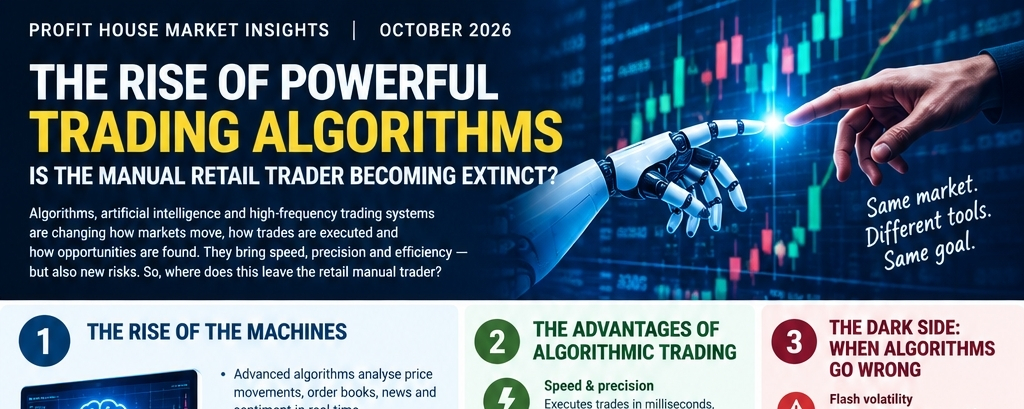

ProfitHouse Market Insights | October 2026
Introduction: A Market No Longer Controlled by Humans Alone
Financial markets are undergoing a fundamental transformation. Powerful algorithms, artificial intelligence and high-frequency trading systems now analyse vast amounts of data, detect patterns and execute orders at speeds impossible for human traders to match.
From Wall Street institutions to cryptocurrency exchanges and retail forex platforms, automated systems are changing how prices move, how liquidity behaves and how trading opportunities emerge.
This raises an important question: In a market increasingly dominated by machines, does the manual retail trader still stand a chance?
The answer is yes—but the rules of competition are changing.
1. The Rise of the Machines
Modern trading algorithms do far more than execute simple buy and sell instructions. Advanced systems can process price movements, order-book imbalances, economic announcements, market sentiment and volatility in real time.
Institutional traders use these systems to execute large orders, manage risk, arbitrage price differences and respond to changing market conditions.
High-frequency trading firms may compete over microseconds, while machine-learning systems attempt to identify patterns that are difficult to detect manually.
In gold, forex and cryptocurrency markets, automated systems can contribute to rapid price movements when liquidity is thin or multiple strategies react to the same information.
However, not every algorithm is sophisticated, and not every automated trader is profitable. A simple bot following poor rules can lose money faster than a human.
2. The Advantages of Algorithmic Trading
Speed and precision: Algorithms can analyse information and execute orders within fractions of a second, reducing the delays associated with manual trading.
Consistency: Automated systems follow predefined rules without fear, greed, hesitation or revenge trading.
Continuous monitoring: Algorithms can monitor multiple instruments and markets simultaneously, including cryptocurrency markets that operate around the clock.
Data processing: Machine-learning models can evaluate large datasets and identify relationships that would be difficult for a human to examine manually.
Risk management: Properly designed systems can enforce position limits, stop-loss rules and maximum drawdown thresholds automatically.
For institutions managing large portfolios, these advantages can be substantial. For retail traders, automation can also improve discipline and execution.
3. The Dark Side: When Algorithms Go Wrong
Algorithms are powerful, but they are not infallible.
Flash volatility: When many systems react to the same signal, rapid buying or selling can amplify price movements.
False signals: Models can misinterpret unusual price behaviour or fail when market conditions change.
Overfitting: A strategy may appear exceptionally profitable in historical testing but fail in live markets.
Liquidity risk: A trade that appears easy to execute during normal conditions may experience significant slippage when liquidity disappears.
Technical failure: Connectivity problems, faulty code, incorrect position sizing or unexpected market conditions can produce substantial losses.
Crowded strategies: When too many traders use similar indicators and automated systems, opportunities can become less profitable or generate abrupt reversals.
Automation removes some human errors, but it introduces technological and model-related risks of its own.
4. What This Means for Gold, Forex and Crypto Traders
For retail traders, the effects are especially visible in short-term markets.
Gold can move sharply around US economic releases, Treasury yield changes and dollar movements. Cryptocurrency prices can react rapidly to liquidations, funding conditions and shifts in market liquidity.
A manual trader waiting for a candle to close may enter after an algorithm has already reacted to the initial price movement.
But speed is not the only source of advantage.
Algorithms can also create temporary price dislocations, overextend moves or trigger stop-loss cascades. A trader who understands market structure may identify a potential reversal after the initial reaction has exhausted itself.
The key is distinguishing a genuine trading opportunity from a move that is still being driven by strong order flow.
5. Where Does This Leave the Manual Retail Trader?
The retail trader is not necessarily competing directly against institutional algorithms in a race for milliseconds. In many cases, attempting to compete on speed is the wrong strategy.
The more practical approach is to compete through selectivity, flexibility and risk control.
First, stop chasing every movement. Institutional systems may exploit tiny price differences that offer little value to a manual trader after spreads and execution costs.
Second, focus on market structure. Trend direction, support and resistance, liquidity zones, breakouts and failed breakouts can provide a framework for interpreting price behaviour.
Third, understand the economic environment. Interest rates, inflation data, central-bank policy and currency movements can help explain why an asset is moving.
Fourth, wait for confirmation. Rather than entering because a candle suddenly moves, look for evidence that the market has established a direction or that a reversal is developing.
Finally, protect capital. A trader who controls losses can remain in the market long enough to learn and improve. No trading advantage matters if excessive exposure destroys the account.
6. The New Competitive Edge: Human Judgment Combined With AI
The future may not be a battle between humans and machines. It may be a partnership between them.
A retail trader can use AI to analyse market conditions, summarise economic news, compare alternative trade scenarios and review historical performance.
Algorithms can handle repetitive tasks, while the trader evaluates context, challenges assumptions and decides when not to trade.
Nevertheless, AI-generated analysis must be independently tested. A convincing explanation is not evidence of a profitable strategy, and a high-confidence signal is not a guarantee.
The strongest approach is to use technology to improve decision-making without surrendering control of risk.
Conclusion: The Manual Trader Must Evolve
Powerful trading algorithms have changed the competitive landscape. They offer institutions speed, scale and analytical capabilities that individual traders cannot easily replicate.
But markets are not perfectly predictable, and automated systems are not immune to failure.
The retail manual trader still has a place—provided they abandon the expectation of winning every short-term race and focus instead on finding selective opportunities, understanding market conditions and controlling downside risk.
The future does not necessarily belong to the fastest trader. It belongs to those who can identify a genuine edge, adapt when conditions change and survive when their analysis is wrong.
In an increasingly automated market, discipline and sound judgment remain valuable advantages.
ProfitHouse Market Insights 2026
Disclaimer: This article is for educational purposes only and does not constitute financial advice. Trading involves substantial risk, including the possible loss of capital. Algorithmic and AI-driven trading systems do not guarantee profits.