

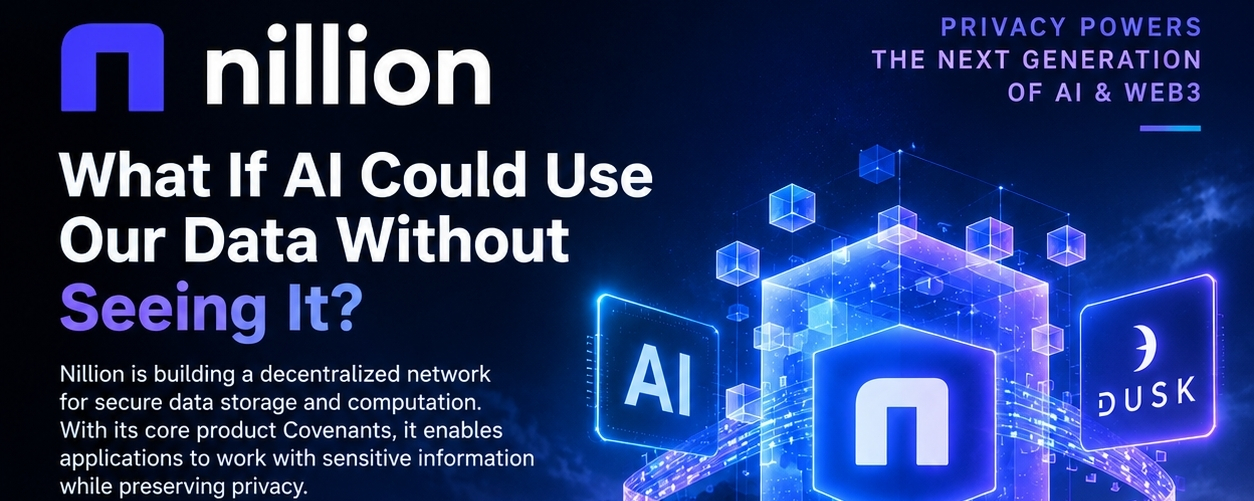

Have you ever wondered what would happen if AI could process sensitive information without actually seeing the data itself? 🤔
That’s one of the reasons I find Nillion ($NIL) so interesting!
Today, AI and blockchain technology are developing rapidly. We use AI for many things, from analyzing information to building smarter applications. However, one major challenge remains: how can we use valuable data while keeping it private and secure?
This is where Nillion comes into the picture. Nillion is building a decentralized network designed for secure data storage and computation. Its technology focuses on something called blind computation, which allows certain operations to be performed on protected data without exposing the underlying information in the usual way.
What really catches my attention is Covenants, one of Nillion’s core products. The idea of enabling applications to work with sensitive information while preserving privacy could open up interesting possibilities for AI agents, Web3 applications, and other data-driven services.
Imagine a future where AI agents could handle private information, applications could offer more personalized services, and developers could build new products without unnecessarily exposing sensitive data. Of course, making this vision work in real-world applications will depend on security, usability, adoption, and actual performance.
Another development worth watching is DUSK and its release on Ethereum mainnet. I’m interested in seeing how this first release fits into Nillion’s broader roadmap and what new capabilities may become available as the ecosystem evolves.
For me, the most exciting part of Nillion isn’t simply the token price. It’s the potential role that privacy-preserving technology could play as AI becomes more deeply integrated into our daily lives.
Still, technology alone doesn’t guarantee success. Real adoption, developer activity, practical use cases, and long-term ecosystem growth are important things to watch. And like any crypto asset, $NIL carries market risk, so it’s worth doing your own research before making an investment decision.
💭 Now I’m curious about your opinion:
If AI could process your private data without directly exposing it, what would you want to use that technology for first — personal AI assistants, financial applications, or something completely different?
Let’s talk about the future of privacy and AI! 👇
