Changpeng “CZ” Zhao compressed a major capital-markets thesis into five words: “IPOs will move on chain.” His September 2026 post did not include a timeline, issuer, or Binance product announcement, so it should be read as a prediction—not confirmation that Binance itself is launching a native on-chain IPO.
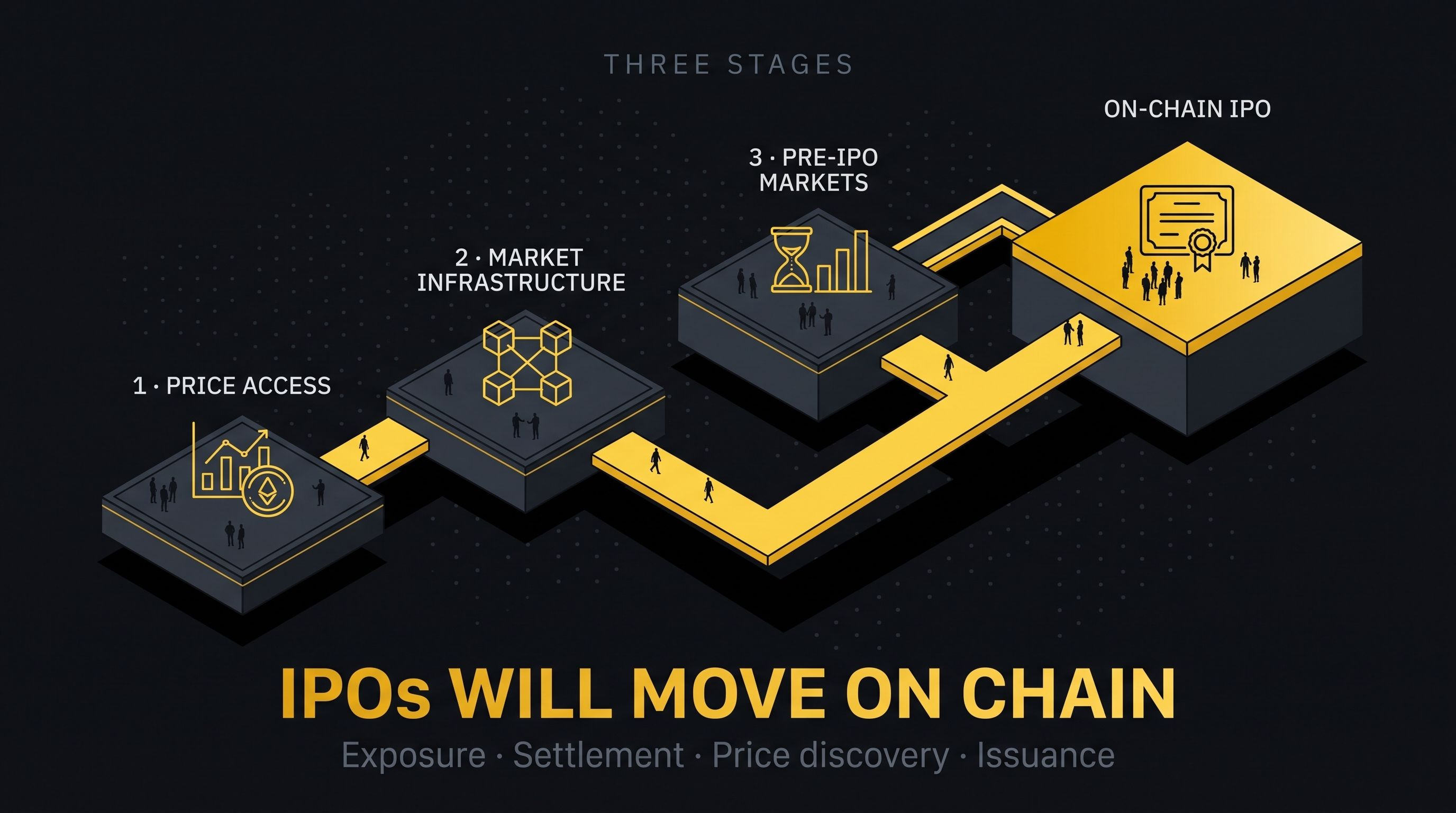
Still, the underlying shift is already visible. Public equities are being wrapped or represented as transferable tokens, regulated market operators are testing blockchain settlement, tokenized securities are entering collateral markets, and crypto venues are creating price exposure to private companies before they list. The progression can be understood in three stages—but those stages are an analytical framework, not a roadmap formally announced by CZ.
What an on-chain IPO means
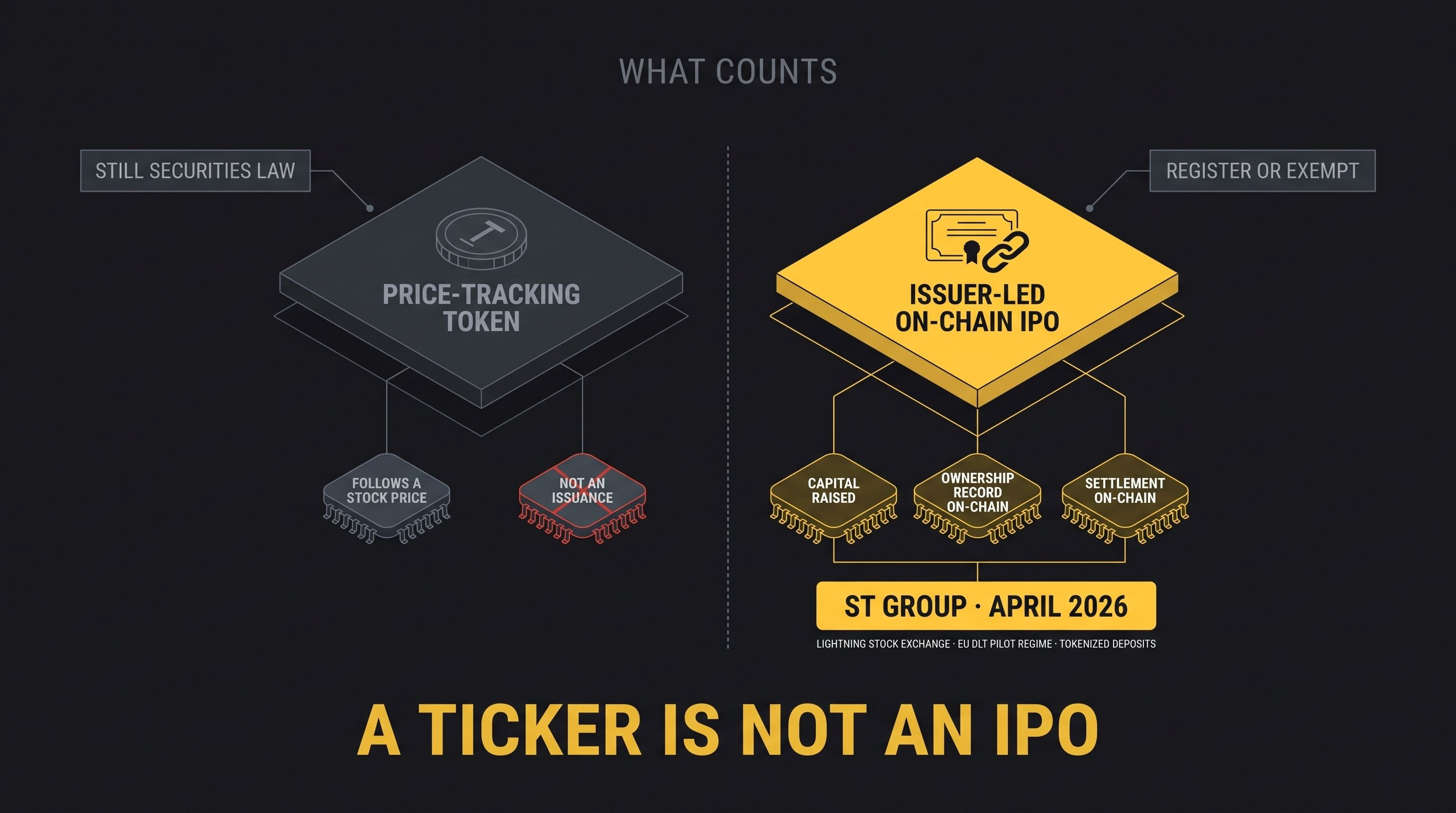
A genuine on-chain IPO is not simply a crypto token that follows a stock’s price. It is a public offering in which the issuer raises capital through securities whose legally recognized ownership record, distribution, or settlement uses blockchain infrastructure.
The distinction matters because “tokenized equity” covers several structures. The U.S. Securities and Exchange Commission separates issuer-sponsored securities—where blockchain transfers update the issuer’s official ownership record—from third-party tokens that may represent a custodial entitlement or synthetic exposure. It also states that putting a security on-chain does not remove it from securities law: the offering must still be registered or qualify for an exemption.
That model has moved beyond theory. In April 2026, French aerospace supplier ST Group completed what legal adviser Clifford Chance described as the world’s first fully tokenized IPO. Its shares were admitted to trading on the Lightning Stock Exchange under the EU’s DLT Pilot Regime, with settlement conducted through tokenized deposits on natively tokenized market infrastructure.
Stage 1: Price access
The first stage brings the price and economic exposure of equities onto blockchain rails without necessarily moving the issuer’s shareholder register on-chain. This is the stage most retail users encounter today.
Products such as xStocks represent U.S. stocks and ETFs through 1:1-backed on-chain tokens, while Ondo offers fully collateralized tokens linked to listed securities. These instruments can support fractional access, wallet transfers, and trading beyond standard exchange hours, but availability is restricted by jurisdiction.
The legal wrapper determines what investors actually own. Kraken explicitly says xStocks do not confer direct ownership even though each token is backed 1:1 by the relevant equity. Binance likewise distinguishes among direct shares that provide beneficial ownership, bStocks that provide economic exposure and on-chain utility, and pre-IPO perpetuals that are derivatives rather than shares.
Structure | Investor receives | What it is not
Direct or issuer-native tokenized share | Legally recognized equity and applicable shareholder rights | Merely a price-tracking token
Custodian-backed token | Contractual or beneficial economic exposure backed by held shares | Necessarily direct ownership on the issuer’s register
Synthetic token or perpetual | Price exposure based on a reference asset or valuation | Equity, an IPO allocation, or a claim on the issuer
Private-market SPV token | A claim defined by an SPV, note, or broker agreement | Automatically the private company’s stock itself
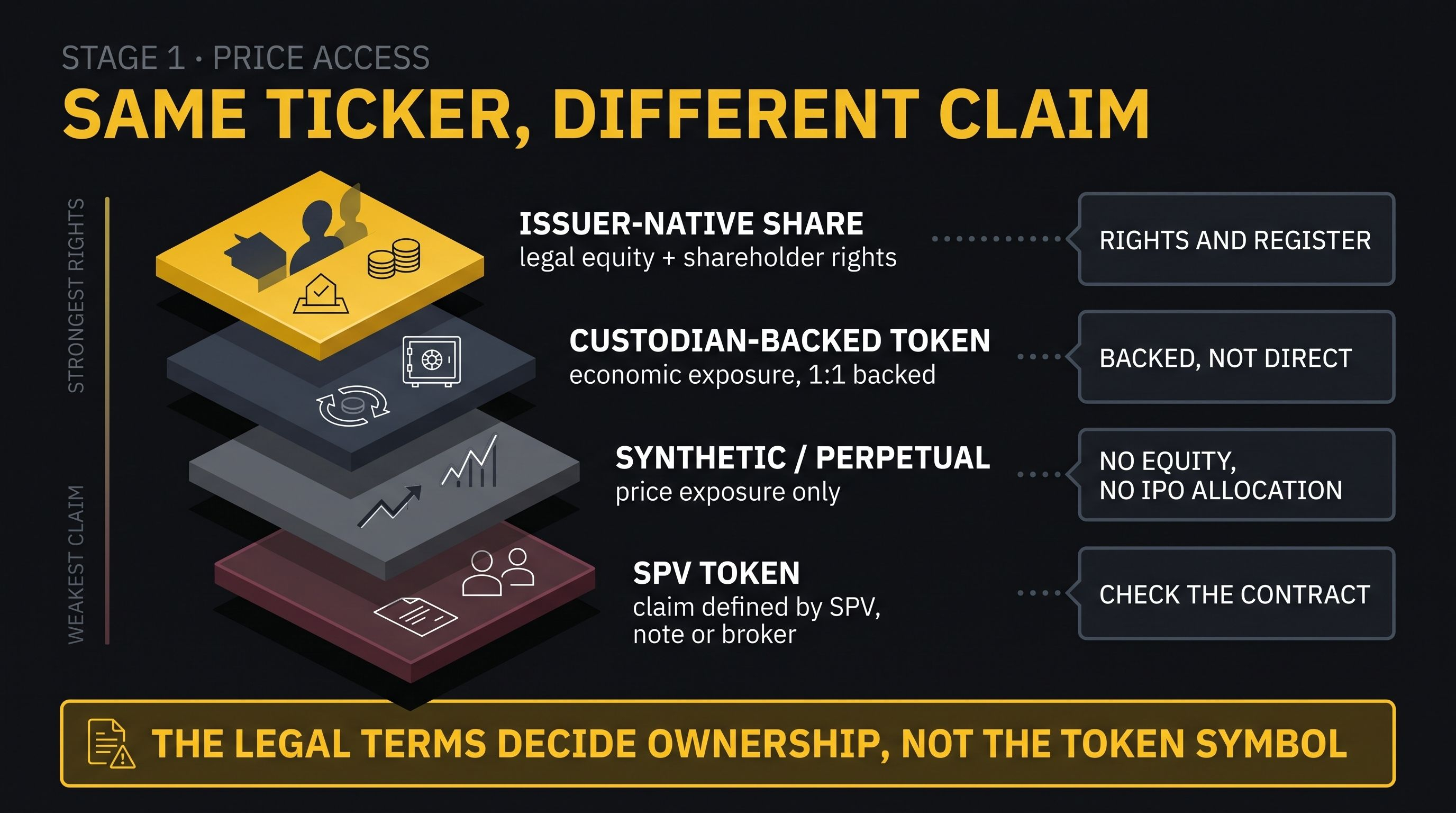
This creates the first major misconception in the market: a token displaying a company ticker is not automatically a share. Voting, dividends, bankruptcy protection, redemption, transferability, and treatment during corporate actions all depend on the product’s legal terms rather than the token symbol.
Stage 2: Market infrastructure
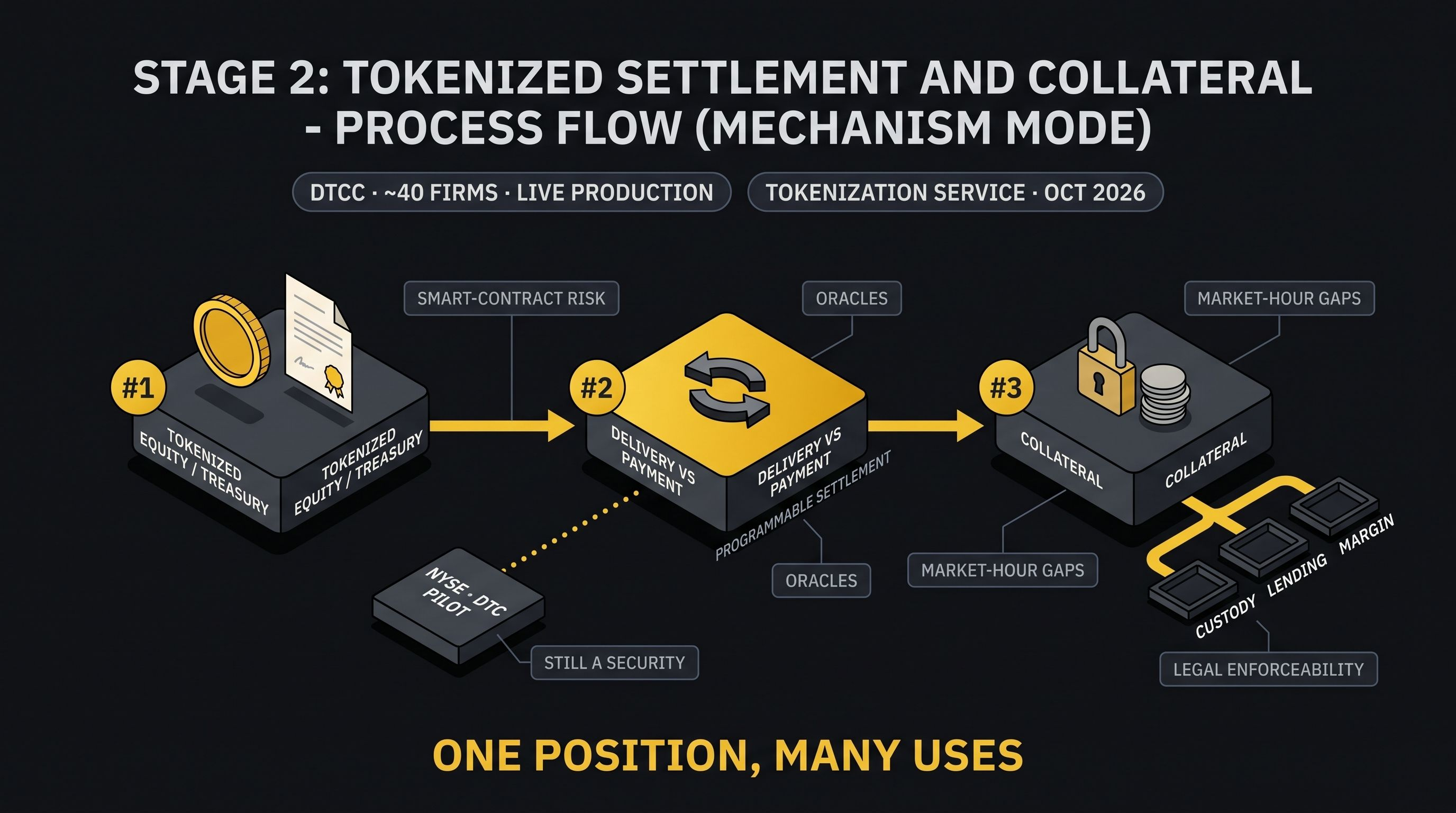
The second stage moves the mechanics of trading and post-trade processing onto blockchain. Here, the opportunity is not only longer trading hours; it is faster settlement, programmable delivery-versus-payment, improved asset mobility, and the ability to move collateral between venues without rebuilding the same position in separate systems.
DTCC has already processed live production transactions involving tokenized U.S. Treasuries and equities, including delivery-versus-payment trades and collateral pledges. About 40 firms participated in its July production event, ahead of the expected October 2026 launch of the DTCC Tokenization Service.
Traditional exchanges are also adapting rather than surrendering the market to crypto-native platforms. An NYSE rule filing proposed allowing eligible securities to trade in tokenized form during a DTC pilot, while preserving their status as securities under the existing market framework.
Tokenized equities are also becoming usable financial building blocks. Ondo says eligible tokenized stocks can be transferred across Ethereum, BNB Chain, and Solana and used in supported DeFi protocols; its SPY- and QQQ-linked assets have entered lending markets as collateral for borrowing and leverage.
This is where blockchain rails begin to change market structure. A conventional equity position is usually confined to a brokerage and post-trade stack. A compliant on-chain position can potentially move between custody, trading, lending, margin, and treasury applications—although smart-contract risk, oracle design, market-hour gaps, liquidity, and legal enforceability remain material constraints.
Stage 3: Pre-IPO markets
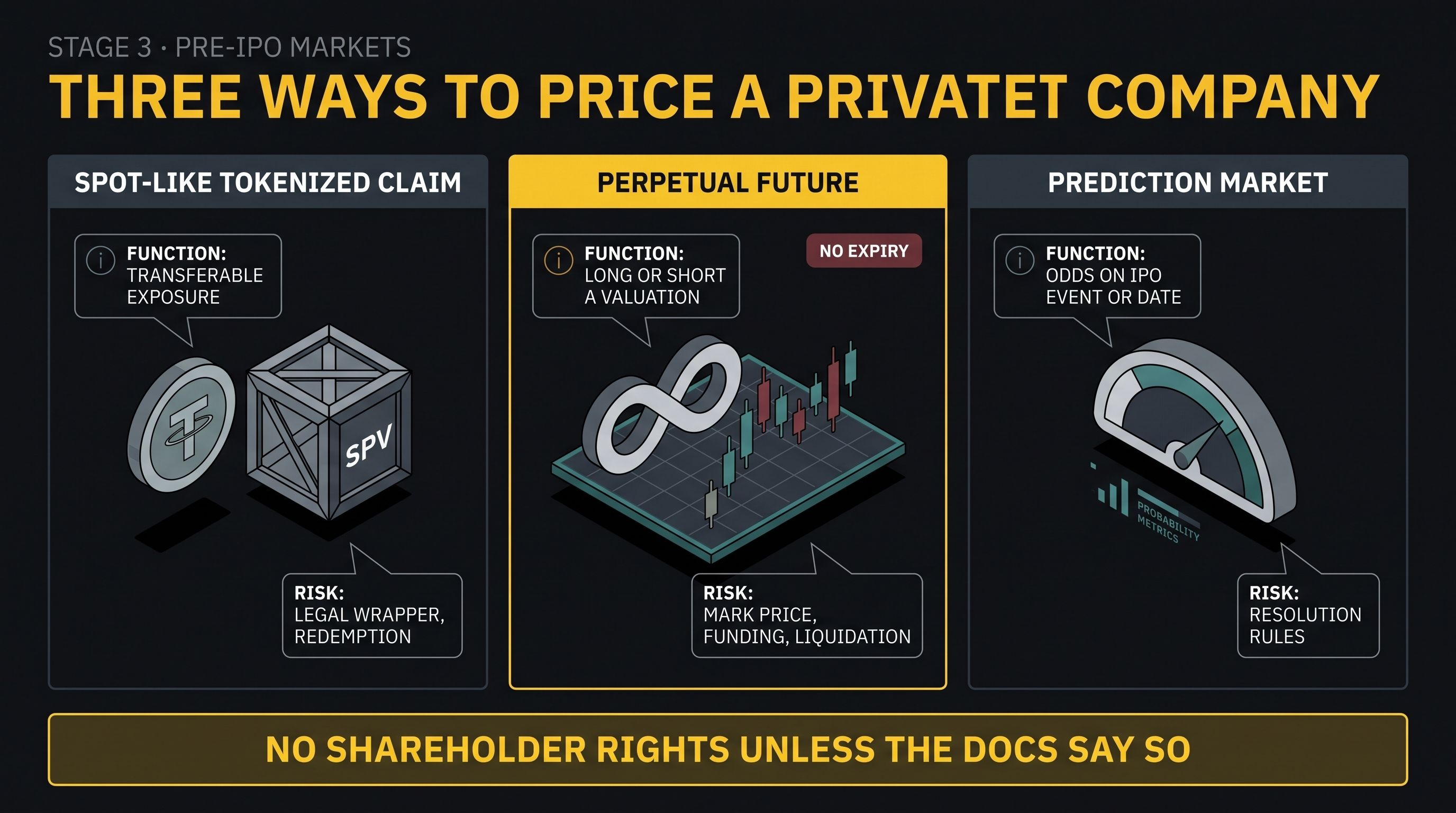
The third stage moves price discovery ahead of the public listing. Crypto venues now offer three broad routes: spot-like tokenized claims, perpetual futures linked to expected private-company valuations, and event-based prediction markets.
Binance’s pre-IPO perpetuals give eligible users synthetic exposure to a private company’s expected valuation. They have no expiry, use funding to help align the contract with a reference value, and do not provide equity or shareholder rights.
Binance Wallet also lists third-party pre-IPO tokenized assets that track selected private-company prices. Binance’s FAQ says these products do not represent direct share ownership, do not grant shareholder rights, and may be traded 24/7 and redeemed under the third-party provider’s rules; access depends on region.
This nuance changes how the phrase “pre-IPO spot” should be used. Some products provide a legally structured claim through an SPV, note, or broker arrangement, while others provide only synthetic valuation exposure. Neither should be described as buying private shares unless the documentation gives the holder an enforceable ownership interest in the underlying company.
Pre-IPO rail | Core function | Primary risk
Spot-like tokenized claim | Transferable exposure defined by an SPV, note, issuer, or broker contract | Legal wrapper and redemption risk
Perpetual future | Leveraged long or short exposure to an expected valuation | Mark-price, funding, liquidation, and basis risk
Prediction market | Probability-based exposure to an IPO event, date, or valuation threshold | Resolution rules and event-definition risk
Private-company pricing is inherently less reliable than public-market pricing. There is no continuous consolidated tape, share classes can carry different rights, valuations may come from infrequent funding rounds or secondary transactions, and an IPO can be delayed or cancelled. Binance states that a cancelled or postponed IPO can trigger delisting and settlement procedures for its perpetual contracts.
Why the gap is narrowing
Historically, private-market access, IPO allocation, public trading, settlement, custody, and collateral management lived in separate systems. Crypto platforms are beginning to connect those stages within one account or wallet: pre-listing derivatives, direct listed shares, tokenized securities, and DeFi-compatible assets can increasingly sit beside one another.
That does not mean private and public markets have merged. It means the interface between them is becoming continuous. Markets can start forming an implied valuation before the IPO, transition toward an announced offer price, then reference the listed share after trading begins.
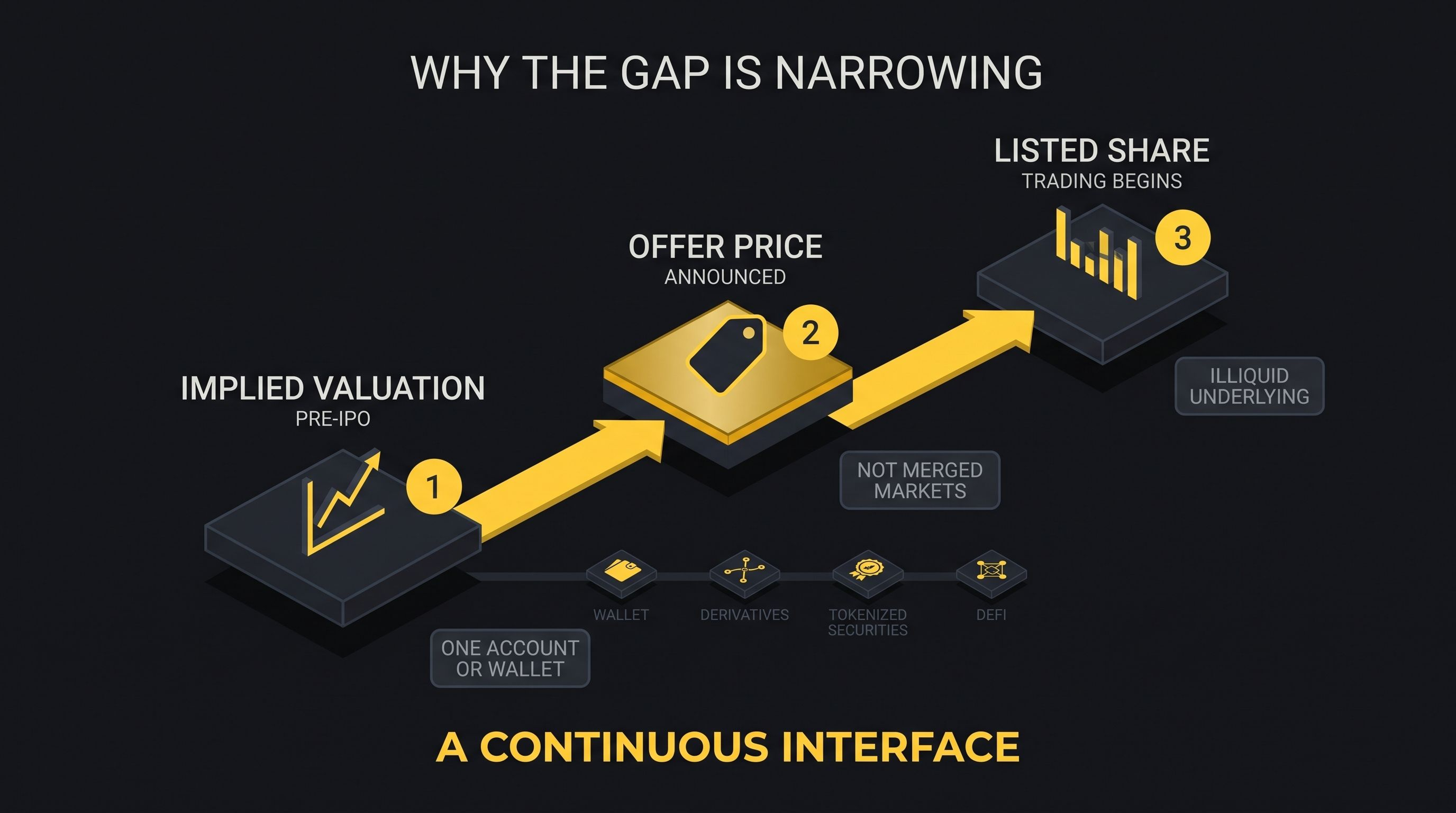
The result could improve access and price discovery, especially for investors outside major financial centers. But it could also produce the appearance of liquidity where the underlying private asset remains illiquid, fragmented, or legally inaccessible.
Regulation remains decisive
Tokenization changes the database and settlement rail; it does not automatically change the legal asset. The SEC’s 2026 guidance says securities remain securities regardless of whether ownership records are maintained on-chain or off-chain.
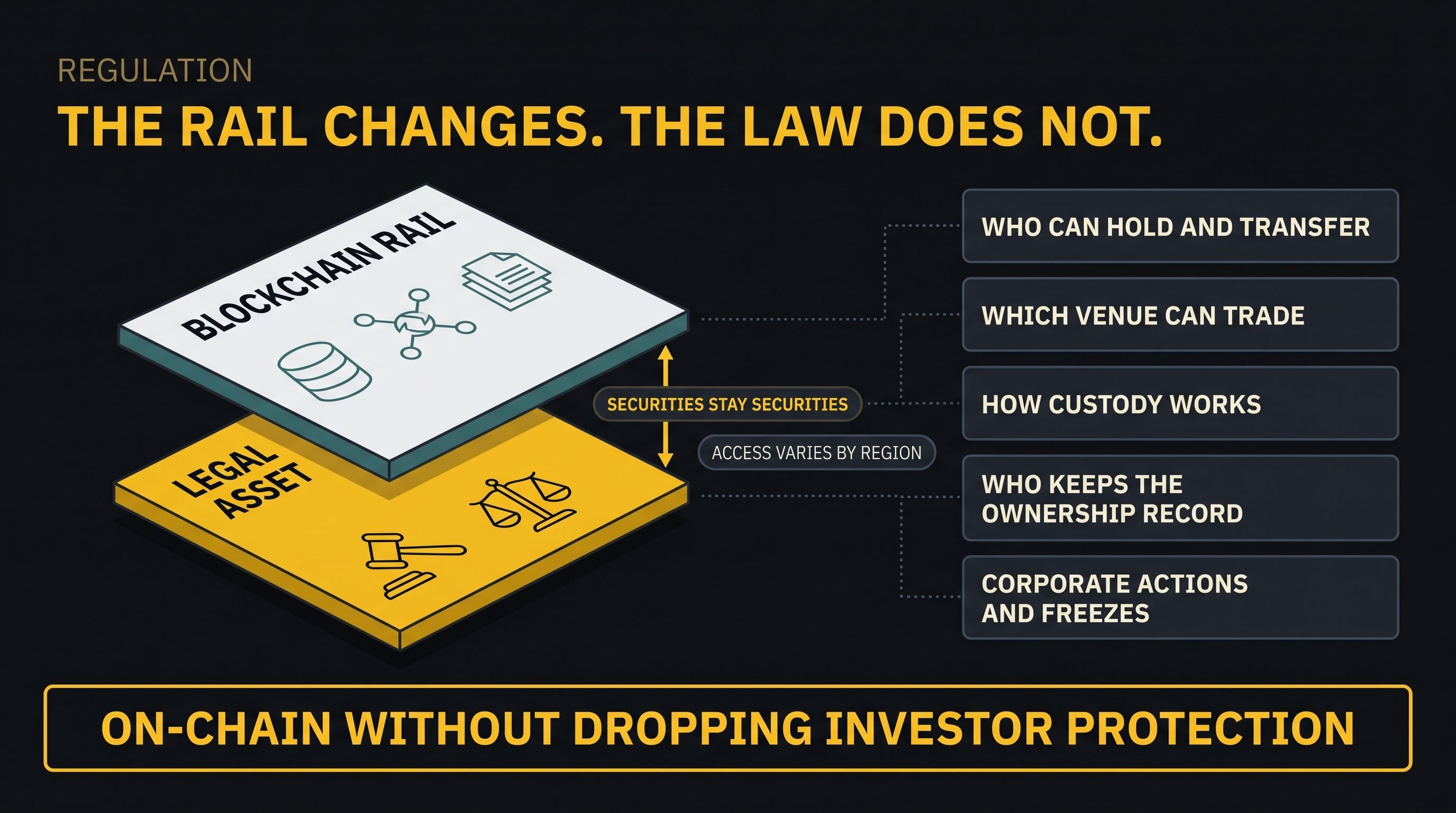
The most important regulatory questions concern who may hold and transfer the token, which venue may trade it, how custody works, who maintains the authoritative ownership record, and how dividends, voting, splits, tender offers, freezes, and recoveries are handled. SEC Commissioner Mark Uyeda has highlighted issuance, custody, trading, liquidity, collateral, and clearing as areas that must be adapted to on-chain environments without abandoning investor protection.
Geographic exclusions show that global access is not yet universal. For example, xStocks are unavailable to U.S. persons and in several other major jurisdictions, while Binance says product eligibility varies by region.
What comes next
The decisive milestone will not be another token that mirrors a listed stock. It will be repeatable, issuer-led offerings in which capital formation, legally recognized ownership, secondary trading, settlement, and corporate actions all operate across compatible blockchain rails.
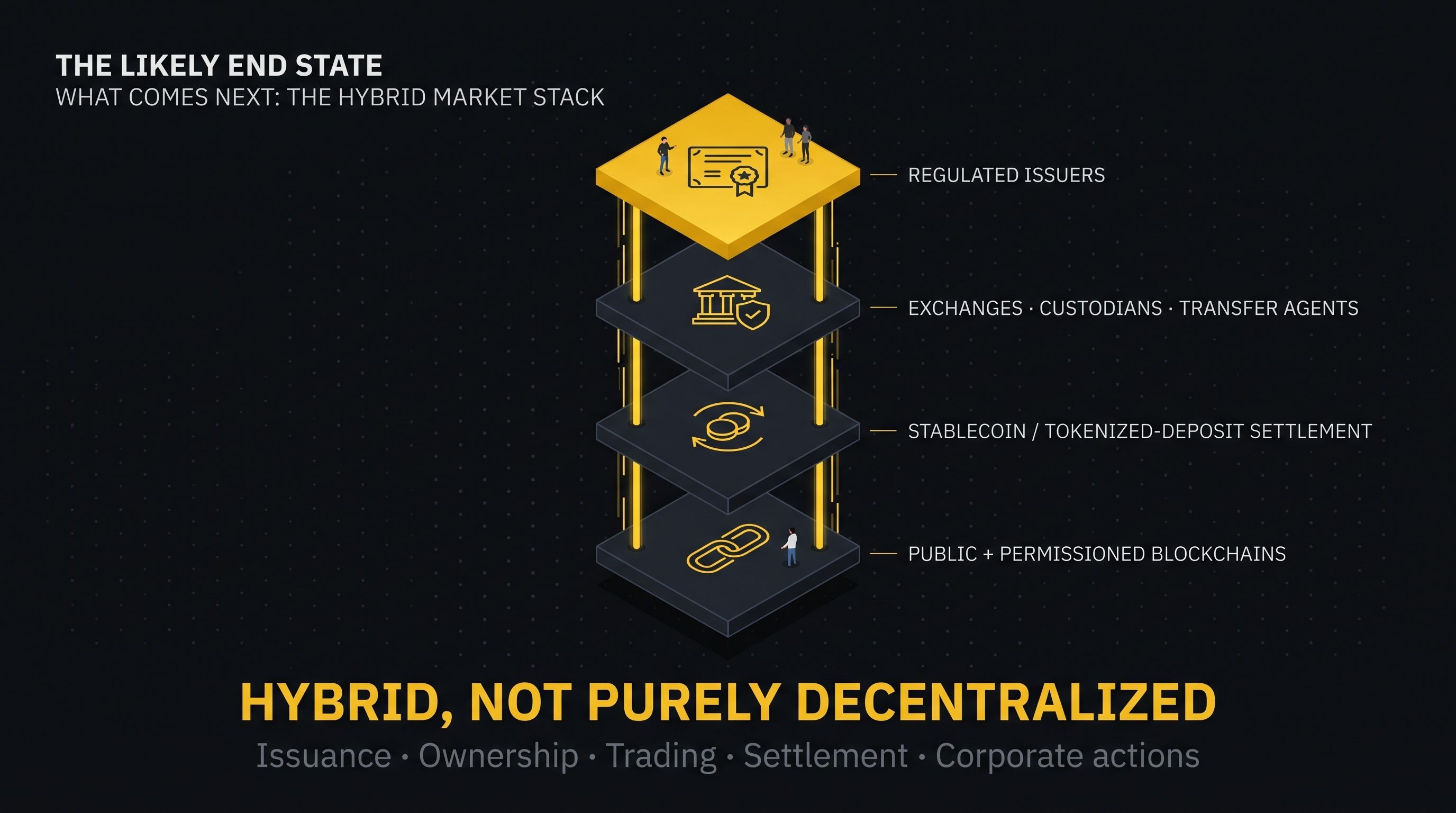
ST Group demonstrates that a fully tokenized public offering can function inside a regulated regime, while DTCC and exchange pilots show that incumbent infrastructure is also moving on-chain. The likely end state is therefore hybrid rather than purely decentralized: regulated issuers, exchanges, custodians, transfer agents, stablecoin or tokenized-deposit settlement, and public or permissioned blockchains working as one market stack.
CZ’s prediction is directionally plausible, but the transition is not a single leap. Stage 1 puts equity exposure on-chain. Stage 2 brings trading, settlement, and collateral onto programmable rails. Stage 3 extends price discovery into the private-market period before listing. A true on-chain IPO closes the loop by making the original issuance itself blockchain-native.