



🌍 #PositiveMindsGlobalResults | Binance Square | October 14, 2026
📉 1. Wall Street Closes Lower as Technology Stocks Retreat
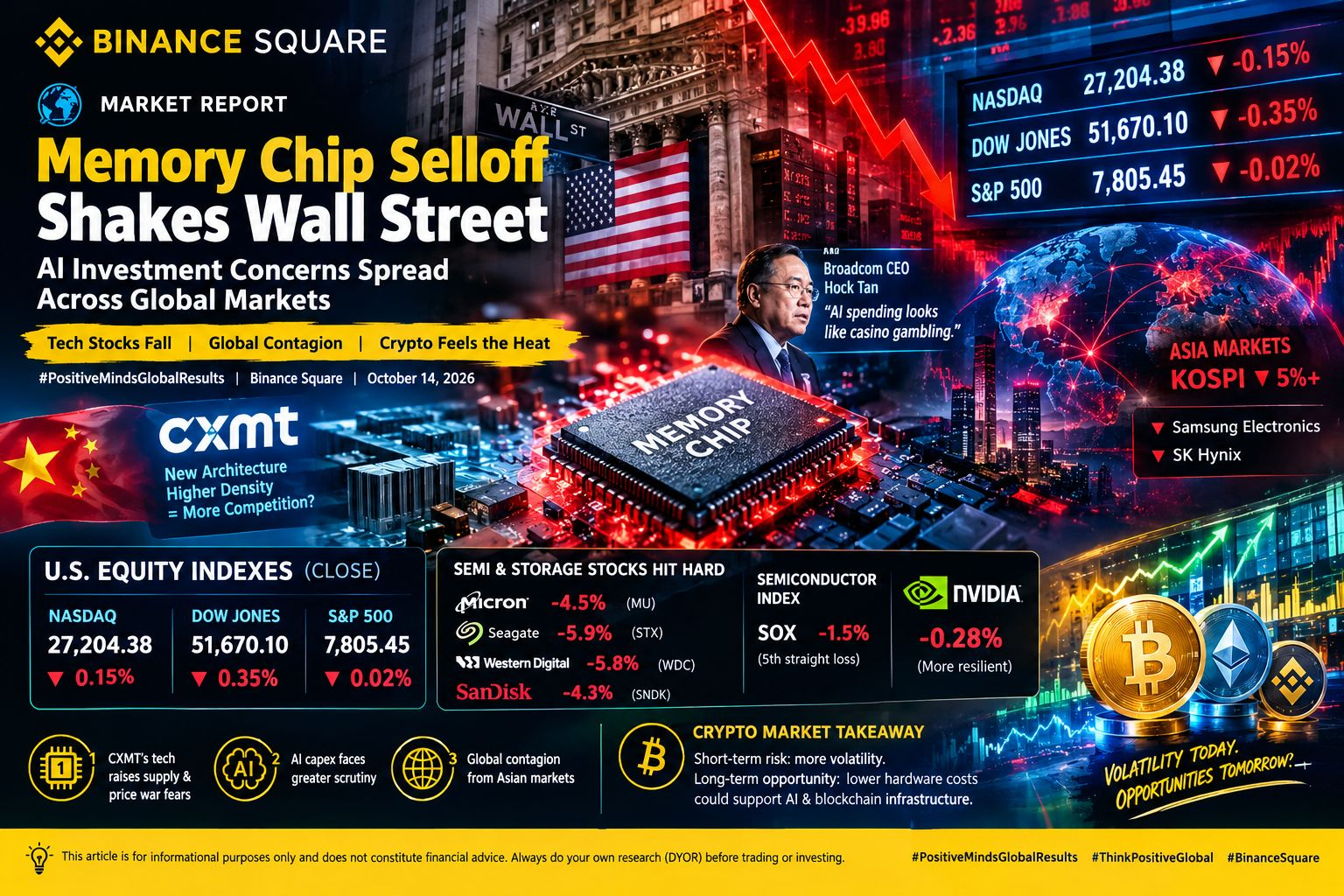
U.S. stock markets ended Tuesday’s session lower as selling pressure across memory chips, data storage companies, and semiconductor stocks weighed on investor sentiment. Mixed third-quarter bank earnings and concerns about AI infrastructure spending added to market uncertainty.
Closing market snapshot:
Nasdaq Composite: 27,204.38, down 0.15%.
Dow Jones Industrial Average: 51,670.10, down 0.35%, or 180.45 points.
S&P 500: 7,805.45, down 0.02%.
The Dow’s reversal from an intraday gain of more than 460 points highlighted fragile market confidence, while the Nasdaq faced pressure from technology-sector weakness.
🔍 2. Three Major Factors Behind the Selloff
① China’s Memory Technology Raises Competition Concerns
Reported advances by ChangXin Memory Technologies (CXMT) intensified concerns about future memory-chip supply, pricing competition, and profit margins. If production capacity expands faster than demand, established manufacturers could face greater pricing pressure. However, the scale and commercial impact of any technological breakthrough require confirmation.
② AI Spending Faces Greater Investor Scrutiny
Investors are increasingly examining whether substantial AI infrastructure investments can generate sustainable returns. Comments attributed to Broadcom CEO Hock Tan reportedly raised concerns about excessive speculation in the sector. The central question is no longer simply how much companies spend on AI, but whether future revenue and profits can justify those investments.
③ Asian Market Weakness Spreads Globally
South Korea’s KOSPI reportedly suffered a sharp decline, with Samsung Electronics and SK Hynix among the major companies under pressure. Weakness among Asian memory-chip manufacturers reinforced concerns about global competition and semiconductor valuations, contributing to a broader risk-off mood.
📊 3. Semiconductor and Storage Stocks Take the Biggest Hit
The reported declines in major companies illustrate the intensity of the selling pressure:
Micron Technology (MU): −4.5%, extending its losing streak.
Seagate Technology (STX): −5.9%.
Western Digital (WDC): −5.8%.
SanDisk (SNDK): −4.3%.
Philadelphia Semiconductor Index (SOX): −1.5%, marking a fifth consecutive losing session.
These moves suggest that investors are reassessing valuations and earnings expectations across the memory and storage industry. Persistent weakness could increase volatility, particularly for companies whose profits depend heavily on memory pricing and data-center demand.
🛡️ 4. NVIDIA Shows Relative Resilience
NVIDIA (NVDA) reportedly declined just 0.28%, outperforming several memory and storage stocks. Its position in AI accelerators and computing infrastructure may offer a different earnings profile from memory manufacturers.
Although lower memory costs could eventually benefit some hardware buyers, the overall impact on NVIDIA and other AI companies depends on demand, supply contracts, system costs, and competition. A smaller daily decline does not necessarily indicate that a stock is immune to broader technology-sector weakness.
₿ 5. What Could This Mean for Bitcoin and the Crypto Market?
The technology selloff presents two competing possibilities for digital assets.
Short-term risk: If investors reduce exposure to riskier assets, cryptocurrencies such as Bitcoin (BTC), Ethereum (ETH), and BNB may experience additional volatility. Liquidity conditions, interest-rate expectations, the U.S. dollar, and leveraged positions could influence the direction of the next move.
Long-term opportunity: More competitive memory prices could eventually reduce certain infrastructure costs for AI and high-performance computing. However, benefits for decentralized computing and AI-blockchain projects would depend on actual adoption, operating expenses, token economics, and sustainable demand.
Lower chip prices alone do not guarantee higher cryptocurrency prices or stronger blockchain adoption.
🔮 6. What Investors Should Watch Next
The next phase of market direction may depend on four key developments:
Semiconductor earnings: Whether memory and storage companies maintain margins despite growing competition.
AI investment returns: Whether major technology companies demonstrate measurable revenue growth from their AI spending.
Global market sentiment: Whether Asian equity weakness spreads further into U.S. and European technology shares.
Crypto market liquidity: Whether Bitcoin and major altcoins remain resilient as investors reassess risk.
🌐 Final Market Perspective
The memory-chip selloff highlights a broader shift in investor priorities: expectations of future growth must increasingly be supported by earnings, realistic valuations, and sustainable demand. AI remains a major long-term technology theme, but its supply chain and investment cycle are not free from correction risks.
For crypto participants, the key is to distinguish temporary market fear from fundamental changes in liquidity, technology adoption, and demand. Watch the data, manage risk carefully, and avoid making decisions based on a single trading session.
What is your view? Will semiconductor weakness trigger a wider technology and crypto correction, or could this pullback create opportunities for long-term investors?
Disclaimer: This article is for informational and educational purposes only and does not constitute financial advice. Market figures and company-specific developments should be independently verified before publication. Always conduct your own research (DYOR) and manage your risk before investing or trading.
#PositiveMindsGlobalResults #ThinkPositiveGlobal #BinanceSquare #StockMarket #WallStreet #Semiconductors #AIStocks #Bitcoin #Ethereum #BNB #CryptoMarket #MarketSentiment
NASDAQ Composite ($IXIC): Fell 0.15% to 27,204.38, burdened by heavy semiconductor sector losses.
Dow Jones Industrial Average ($DJI): Reversed an intraday surge of over 460 points to finish down 180.45 points (-0.35%) at 51,670.10.
S&P 500 ($INX): Slipped fractionally by 0.02% to close at 7,805.45.