

You can hold Bitcoin, trade tokenized Apple, and go long Nvidia with leverage, all from one app. But until recently, one tool was missing: a way to limit your downside without selling anything.
That tool is the option. Binance Stock Options let eligible users buy calls and puts on more than 1,000 U.S. stocks and ETFs. Binance's FAQ says the contracts are physically settled and cover trading hours, fees and expiration.
Why Binance Stock Options matter
Crypto investors already know volatility. What they often lack is a way to shape it. Spot and perpetuals are mostly linear: if the asset falls 20%, your position falls roughly 20%, and leverage amplifies that.
Options add a different payoff. A buyer pays a premium for the right, but not the obligation, to buy (call) or sell (put) at a set strike price before expiry. That lets you hedge or take a view without unwinding a core holding.
The timing fits a wider trend. Crypto platforms are adding stocks, options and AI tools to become "super apps". Binance now offers 7,000+ U.S. stocks and ETFs settled in stablecoins, alongside crypto.
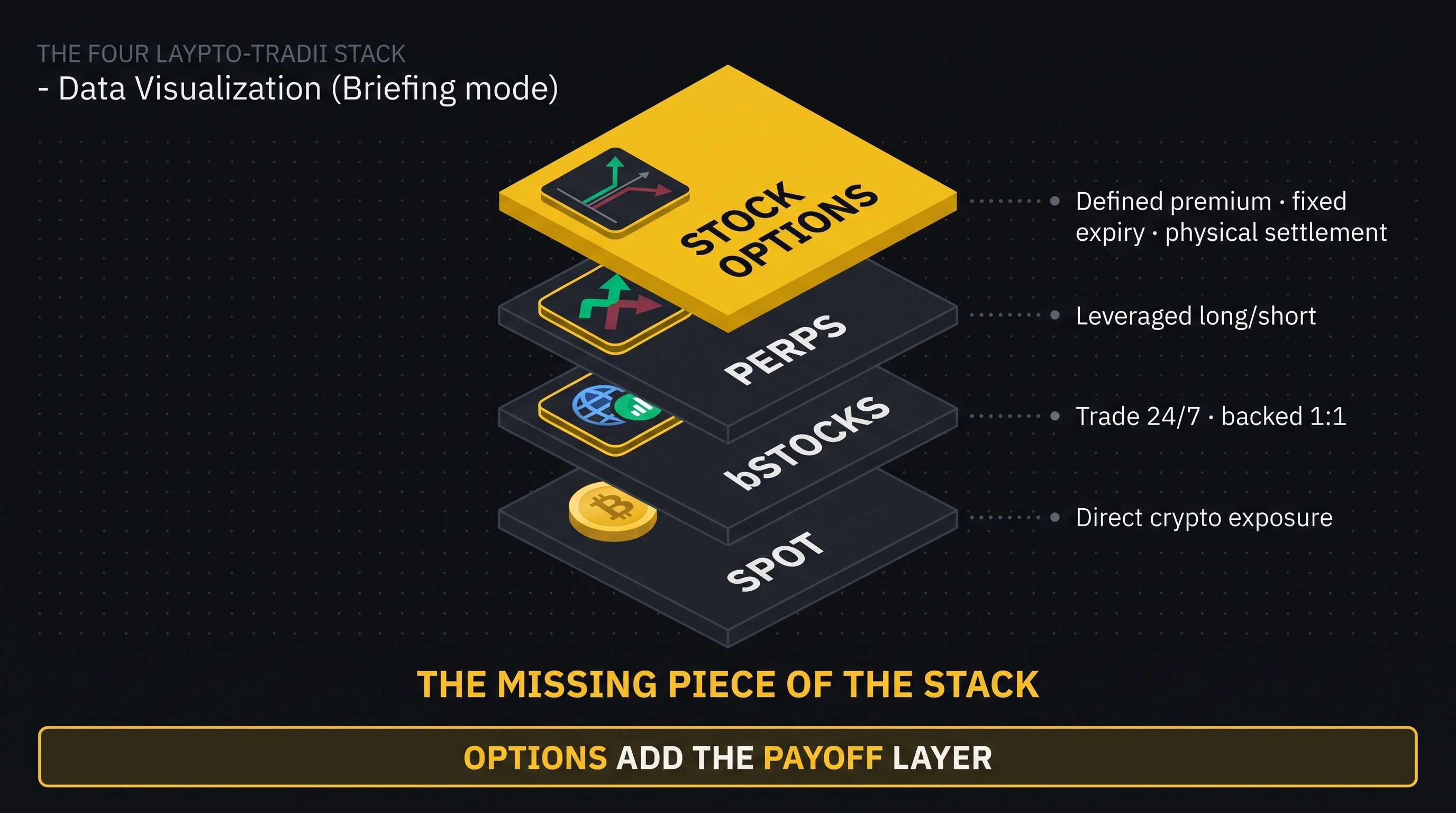
The four layers of the stack
Layer | What it does | Key point
Spot | Buy and hold crypto | Direct crypto exposure
bStocks | Tokenized U.S. equities | Trade 24/7, backed 1:1, convertible both ways
Perps | Leveraged long/short, including TradFi contracts | Binance Futures has listed stock-linked perpetuals
Stock Options | Calls and puts on U.S. stocks and ETFs | Defined premium, fixed expiry, physical settlement
bStocks: stock exposure on crypto rails
bStocks are tokenized securities. Binance says conversion between bStocks and real stocks is free, instant and works both ways, with 1:1 backing that users can verify through Proof of Collateral. They differ from ordinary shares in custody, trading hours, dividends and shareholder rights.
Perps: leverage and shorting
Perpetuals suit short-term directional trades. They also carry funding costs and liquidation risk, which is why many traders want a defined-risk alternative.
Options: the payoff layer
Options are the only layer here where your maximum loss as a buyer is set at the start: the premium you paid. That is the real gap Stock Options fill.
Linear vs. non-linear exposure
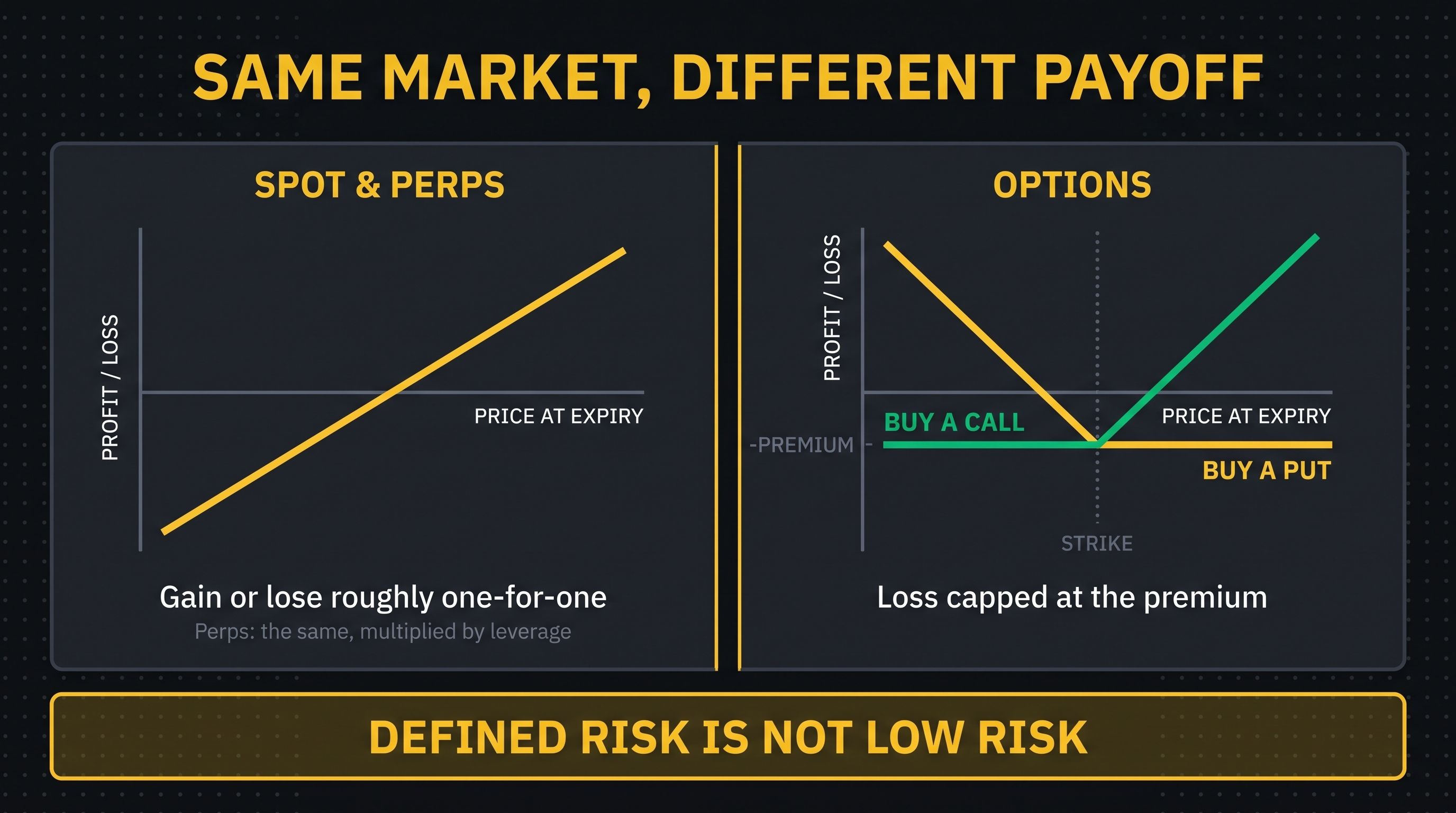
Hold or buy spot: you gain or lose roughly one-for-one with price.
Use perps: the same, multiplied by leverage.
Buy a call: you keep upside above the strike, and your loss is capped at the premium.
Buy a put: you gain if the price falls below the strike, which offsets losses elsewhere.
A practical hedging example
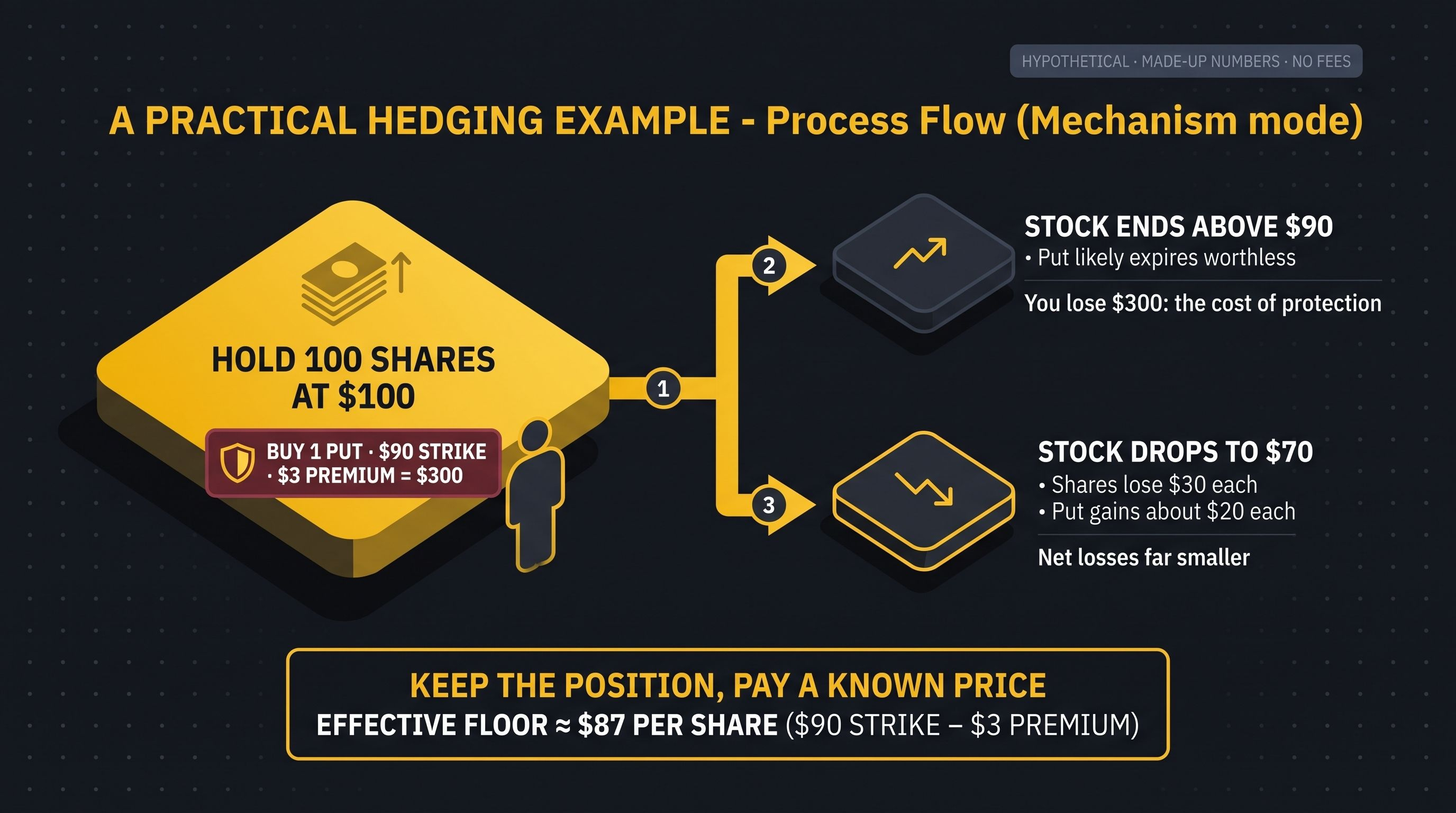
This is a hypothetical example with made-up numbers and no fees.
Say you hold 100 shares of a stock at $100 and expect a rough quarter. You buy one put with a $90 strike for a $3 per-share premium, which costs $300.
Stock ends above $90: the put likely expires worthless. You lose the $300, which was the cost of protection.
Stock drops to $70: your shares lose $30 each. The put gains about $20 each, so net losses are far smaller.
Effective floor: about $87 per share, which is the $90 strike minus the $3 premium.
You kept your position and paid a known price for protection. That is the "modest overlay" idea: hedge part of the exposure rather than all of it.
Risks and limits
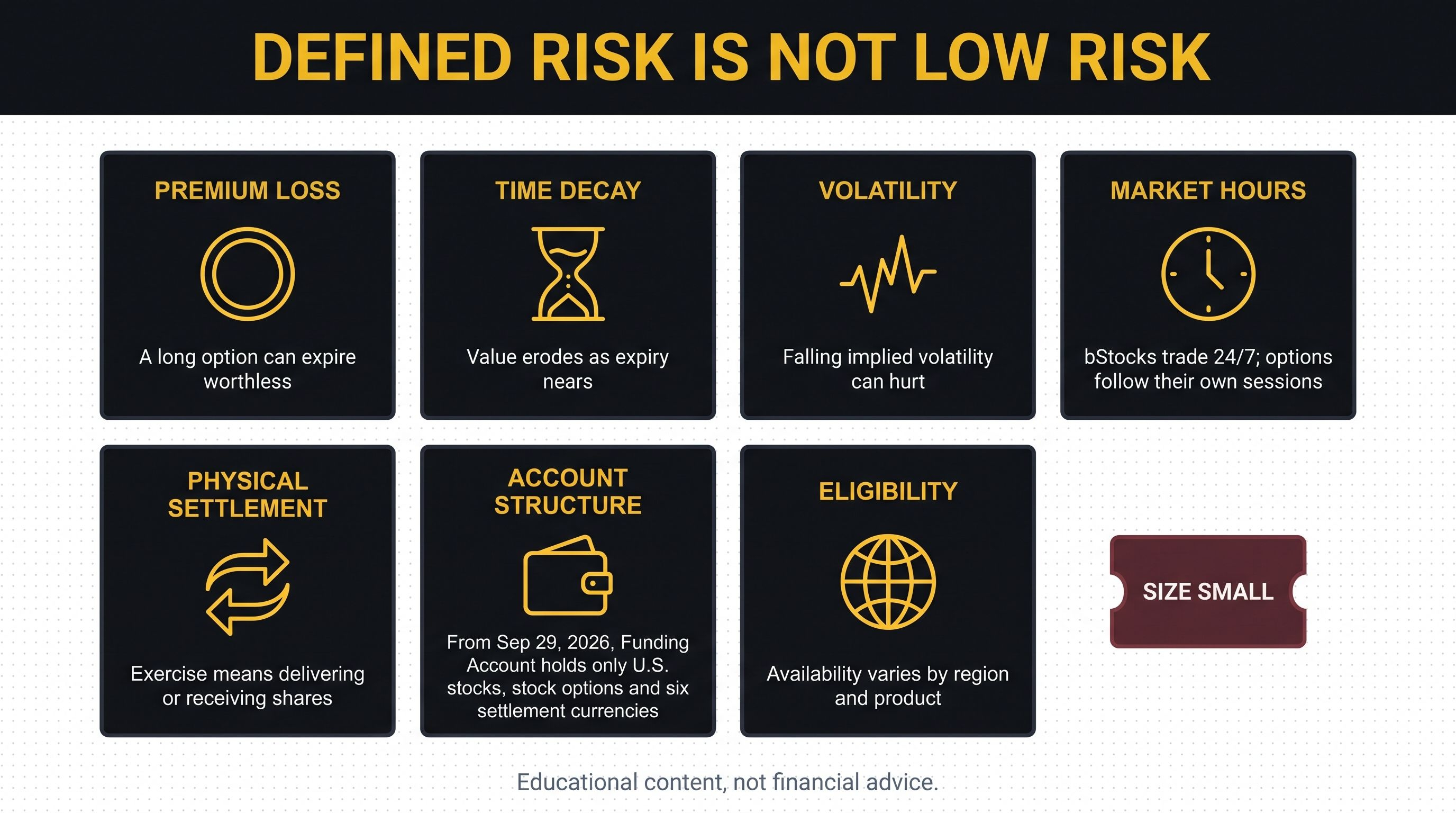
Defined risk is not low risk. Keep these in mind:
Premium loss: a long option can expire worthless.
Time decay: value erodes as expiry nears.
Volatility: falling implied volatility can hurt an option even if the stock moves your way.
Market-hours mismatch: bStocks trade 24/7, but options markets follow their own sessions, so a hedge may not be tradable when you need it.
Physical settlement: exercise means delivering or receiving shares, so you need enough cash or shares.
Account structure: from September 29, 2026, Binance's Funding Account holds only U.S. stocks, stock options and six settlement currencies. Check where your balances sit.
Eligibility: availability varies by region and product.
Is Binance's stack unique?
Not entirely. Kraken offers xStocks perpetuals. Robinhood has launched stock tokens and its own chain. Binance's pitch is the combination under one account, not any single product. Treat "nobody else runs this full stack" as marketing, not a verified fact.
Binance resources to use first
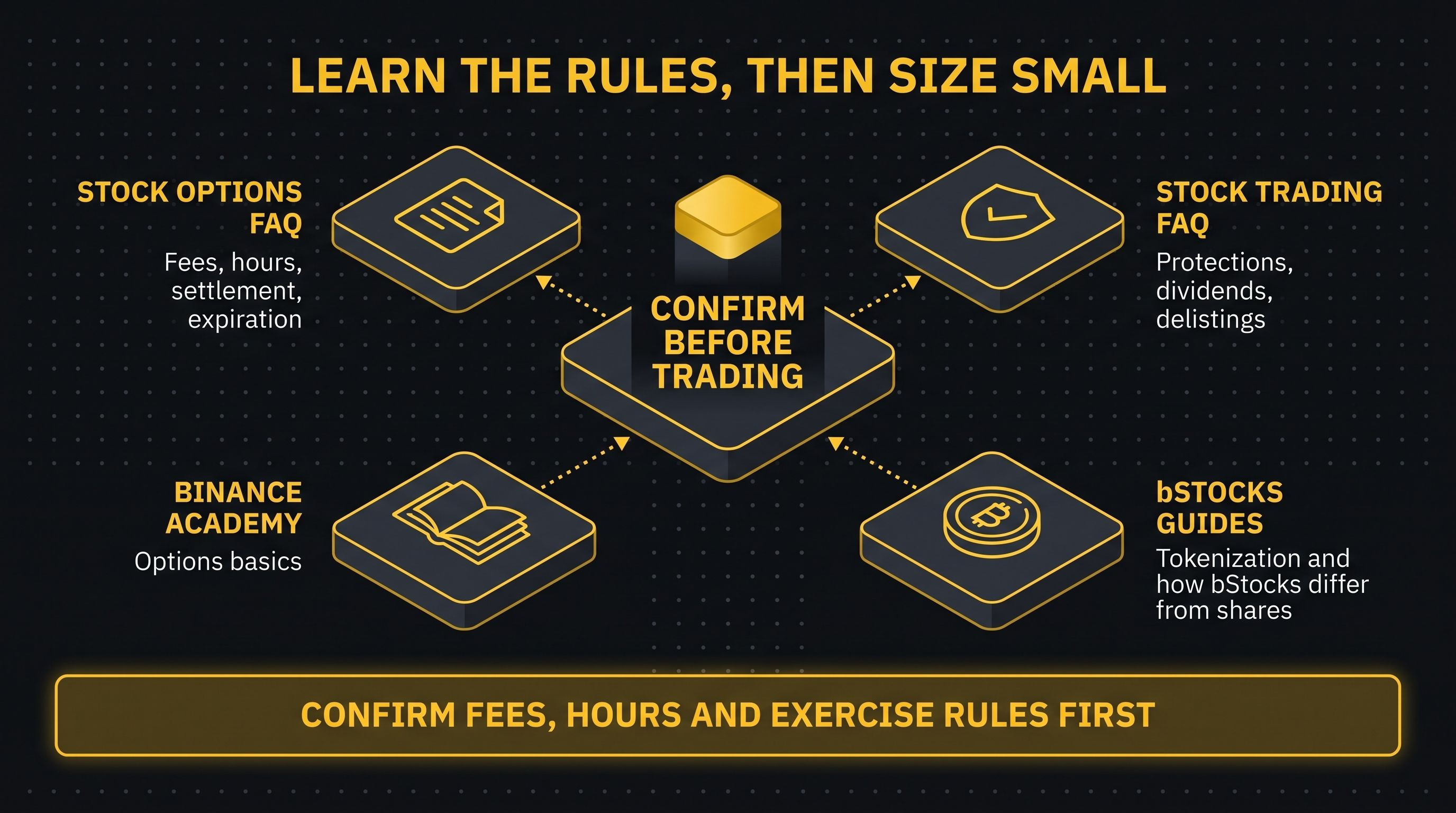
The Stock Options FAQ for fees, hours, settlement and expiration.
The Binance Stock Trading FAQ for protections, dividends and delistings.
The bStocks guides on tokenization and how bStocks differ from regular shares.
Binance Academy for options basics.
Conclusion
Binance Stock Options turn a "buy, hold or leverage" toolkit into one that can also hedge. Used carefully, a small options overlay can protect part of a position or express a view with a capped upfront cost. Learn the settlement and expiry rules first, and size small.
Key takeaways
Binance Stock Options cover 1,000+ U.S. stocks and ETFs and are physically settled.
The stack runs Spot, bStocks, Perps and Options under one account.
Buyer losses are capped at the premium, but that premium can be lost entirely.
Protective puts work like insurance and have a recurring cost.
Market hours, settlement and eligibility differ across layers.
Confirm fees, hours and exercise rules in Binance's FAQ before trading.
FAQ
What are Binance Stock Options?
They are calls and puts on selected U.S. stocks and ETFs, covered in Binance's FAQ.
What is the most I can lose buying an option?
The premium you paid, plus any fees.
Are bStocks the same as owning shares?
No. They are tokenized securities backed 1:1, with differences in custody, dividends and shareholder rights.
Can options hedge crypto?
These options cover stocks and ETFs, not crypto directly. A hedge only works if the option's underlying is related to what you hold.
Is it available everywhere?
No. Eligibility varies, so check the product pages for your region.
#Binance #StockOptions #bStocks #TokenizedStocks #CryptoTradFi