


Most blockchains will scramble when Q-Day hits.
TRON won’t.
Here’s why this matters more than most people realize.
“Q-Day” — the moment a quantum computer becomes powerful enough to break today’s encryption — isn’t science fiction anymore. The US National Institute of Standards and Technology finalized its first post-quantum cryptography standards in 2024. Governments are already mandating migration timelines.
For blockchains, the stakes are existential. Every private key securing every wallet is theoretically at risk. The question isn’t if but when.
What TRON actually did
Not a whitepaper. Not a roadmap slide.
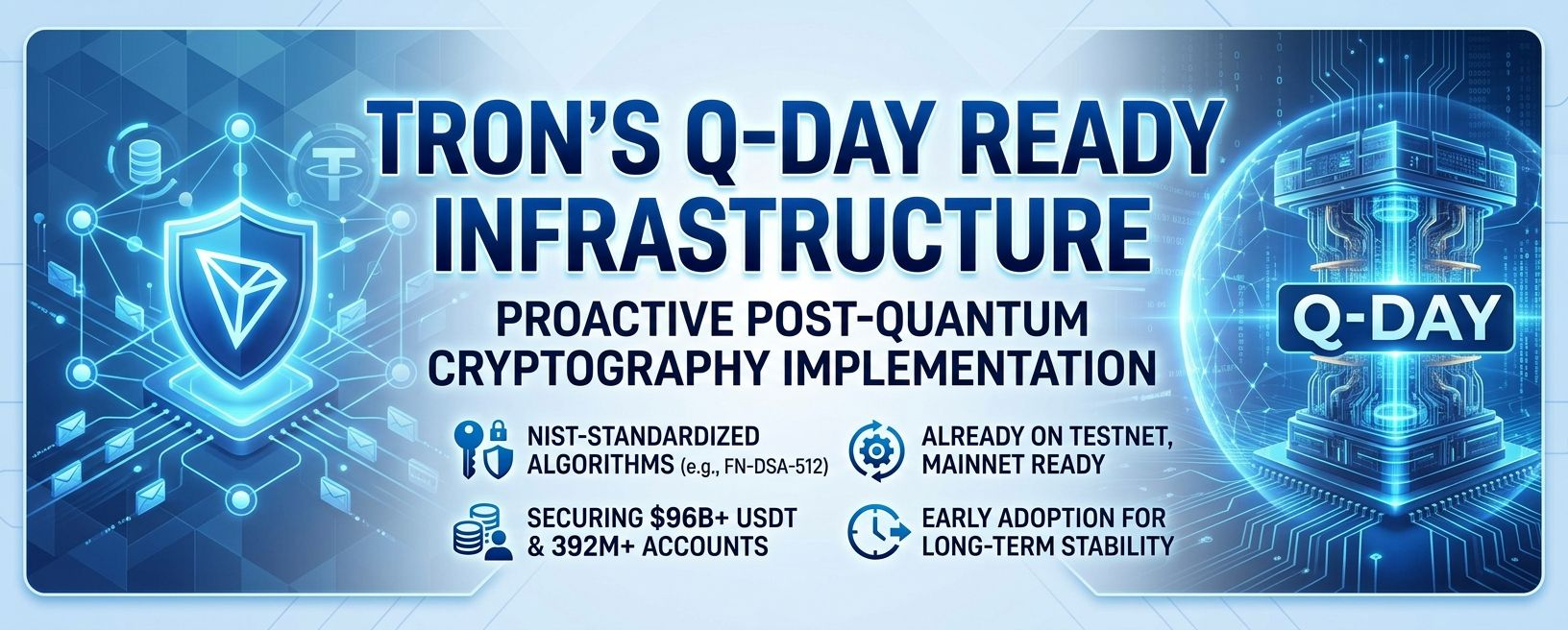
TRON deployed ML-DSA-44 and FN-DSA-512 — two of NIST’s three standardized post-quantum signature algorithms — live on testnet. Transaction signing, block production, P2P node communication, smart contract verification: all covered.
FN-DSA (FALCON) was chosen deliberately. Post-quantum signatures are 10–100x larger than classical ones — a serious throughput problem. FALCON produces signatures of ~666 bytes, the most compact option available. For a network processing 12.7M daily transactions, that trade-off matters.
The timing
Most major blockchains haven’t started. Bitcoin’s elliptic curve cryptography has no upgrade path defined. Ethereum is researching but years from deployment.
TRON is already on testnet, with mainnet ready to activate “at any time.”
$96B in USDT runs on this network. 392 million accounts depend on it.
Being early on quantum resistance isn’t a marketing move. It’s the only responsible choice for infrastructure at this scale.
$TRON $TRX @justinsuntron @TRON DAO @TronDao_JPN @JustinSun @TRON DAO