

Optimism is no longer one chain — it is a revenue-sharing network of chains.
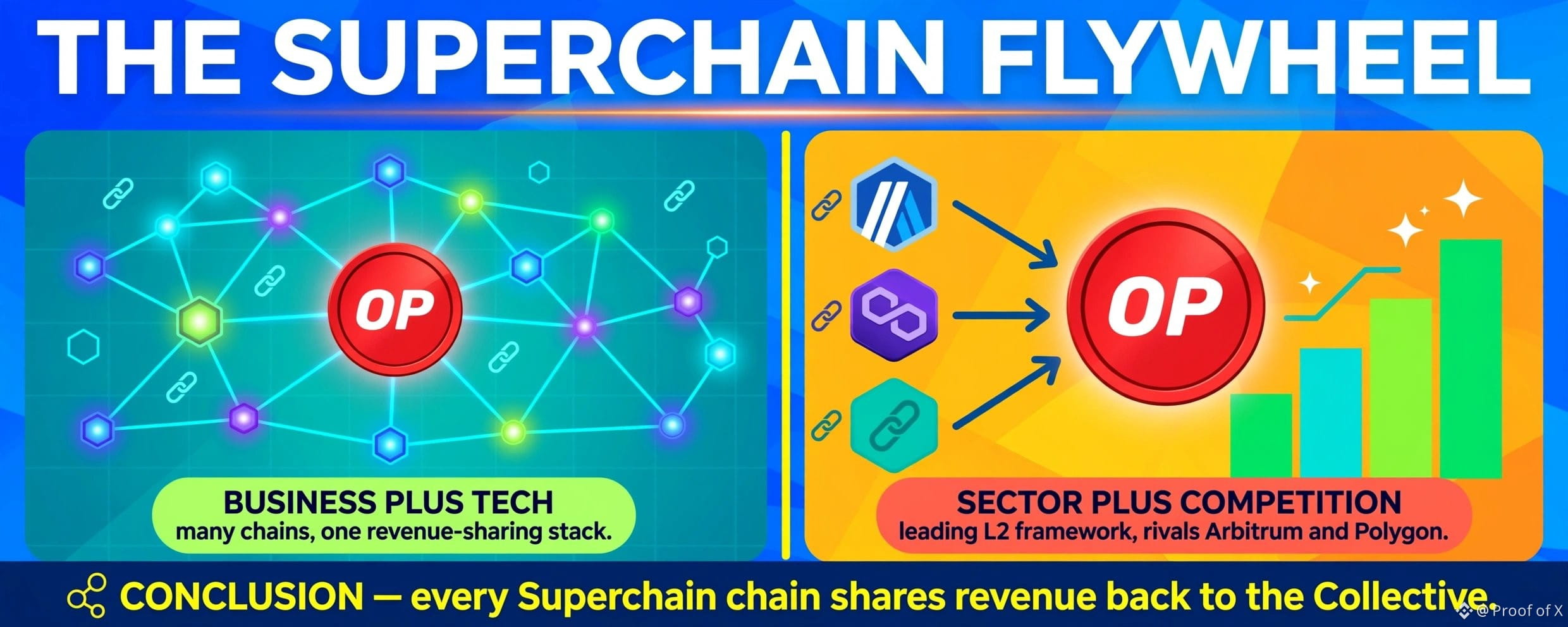
Optimism runs the Superchain, a network of blockchains all built on the open-source OP Stack.
OP Mainnet was the first, but the stack now powers chains run by Coinbase, Uniswap, Kraken, and Worldcoin: Base, Unichain, Ink, and World Chain.
Every chain in the Superchain shares revenue back to the Optimism Collective: the greater of 2.5% of total chain revenue or 15% of onchain profit, defined as fees minus L1 gas costs.
$OP holders participate in governance, voting on protocol upgrades and funding decisions.
The OP Stack is the open-source modular codebase behind OP Mainnet and every Superchain chain.
The project describes the OP Stack as the leading framework for Ethereum Layer 2 chains, powering the majority of L2 activity today.
The design targets fast, low-cost transactions settled with Ethereum's security.
Optimism sits in the Ethereum Layer 2 and rollup sector, the category built to move activity off Ethereum mainnet while settling back to it.
On CoinGecko it is tagged Layer 2, Rollup, and Smart Contract Platform, placing it squarely in the Ethereum scaling sector.
The sector's core value proposition is cheaper, faster transactions with shared security — and the fight is over which stack becomes the default.
$ARB, Arbitrum, is the closest rival: an optimistic rollup that describes itself as the leading L2 in terms of TVL, per its CoinGecko description this run.
$POL, Polygon, offers a modular framework for building optimistic rollup chains, ZK rollup chains, and standalone chains.
Optimism's differentiation is the Superchain model itself: aligned economics across many chains, rather than a single chain competing alone.
MC is about 299 million dollars and FDV is about 558.5 million dollars, per CoinGecko this run.
About 2.30 billion $OP circulate against a 4.29 billion max supply, so roughly 53.6% of the max supply is in circulation.
No verifiable unlock schedule was found this run.
Not financial advice. DYOR. $OP