

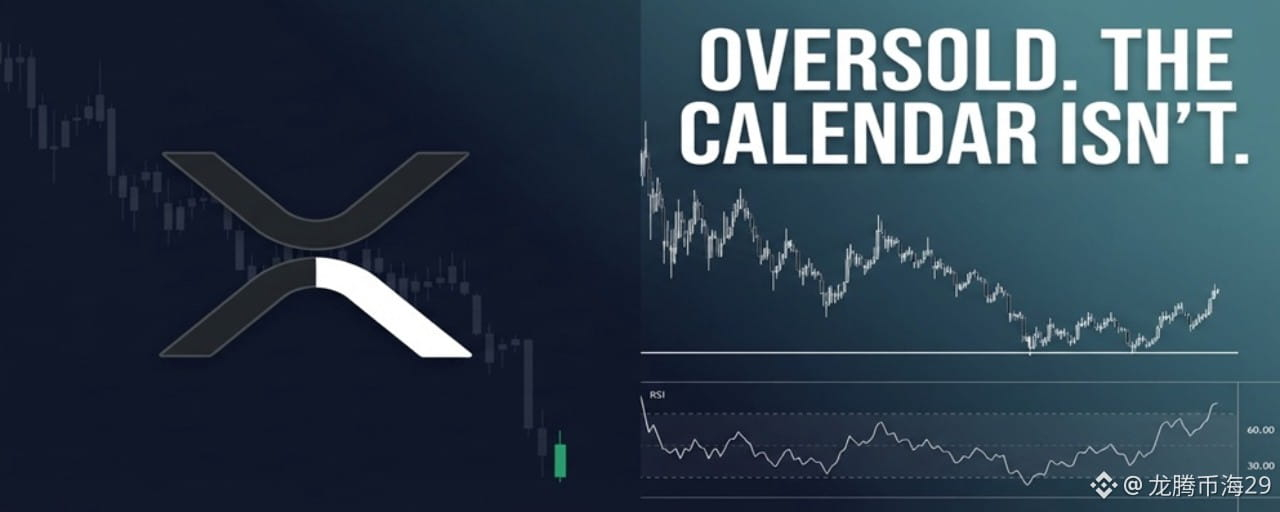

XRP spent most of October drifting lower. From $1.52 on October 6 to roughly $1.40 by October 9, a quiet bleed that felt more like apathy than panic. Then the four-hour RSI dropped to 29.47, below the oversold threshold of 30, reaching a reading last seen when XRP traded near $1.05.
That is a strange sentence to write. The last time momentum was this stretched to the downside, XRP cost about a third of what it costs now. It suggests the recent selling has been forceful enough to compress momentum far faster than price has fallen. But oversold readings are not buy signals. They are warnings that a market has moved too far, too quickly, in one direction. They tell you the rubber band is stretched. They do not tell you when it snaps back.
What makes this particular oversold reading worth watching is the timing.
The technical picture is fragile, but the levels are clear.
The breakdown through $1.45 and then $1.41 was decisive. XRP lost those levels in a fast sequence of red candles, and the first meaningful support now sits between $1.28 and $1.33, where the 200-day moving average provides an additional floor. That zone matters because XRP defended a similar area during the September decline before recovering. On the upside, $1.38 to $1.40 is the first resistance. It used to be support before the breakdown, and reclaiming it would be the minimum requirement for any relief bounce to carry weight. Above that, $1.50 to $1.55 remains the more serious barrier, a level that has capped multiple recovery attempts this month.
The four-hour RSI at 29.47 is extreme, but extreme readings can persist when the selling is driven by macro forces rather than token-specific weakness. Rising Treasury yields and a firmer dollar have weighed on risk assets broadly, and XRP has not been immune. The difference is that XRP has a calendar full of events that most risk assets do not.
Three things are happening within days of each other.
First, the XRP Ledger is activating three protocol amendments across October 8 and 9. Permission Delegation and Batch amendments reached the validator support threshold required for activation, and both were expected to go live during this window. The Batch amendment allows atomic multi-transaction settlements on-chain. Permission Delegation gives account holders granular control over what third parties can do with their assets. Neither is a marketing gimmick. Both are infrastructure upgrades aimed at the kind of institutional use cases that Ripple has been courting for years.
Second, Evernorth Holdings, the XRP treasury company backed by Ripple, had its Nasdaq listing pushed back by an administrative delay. The merger with Armada Acquisition Corp. II was originally scheduled to close October 7, with trading under the ticker XRPN beginning October 8. The company now expects to complete the merger on October 9 and begin trading on October 12. A four-day delay is not a fundamental problem, but it does mean a headline catalyst that some traders positioned for earlier in the week has been deferred. That could explain part of the recent selling pressure: event-driven longs trimming exposure when the expected trigger did not arrive on schedule.
Third, and perhaps most interesting, on-chain data shows whales moving XRP off Binance at the fastest pace in seven months. The 30-day sum of whale outflows from Binance reached 1.38 billion XRP, the highest reading since early 2026. Large holders taking custody of coins is not a guarantee of anything. They could be moving to cold storage for reasons unrelated to price direction. But it does contrast sharply with the bearish derivatives positioning. Funding rates flipped negative earlier this week, sitting at -0.0022% on Thursday, meaning short sellers were paying longs to maintain their positions. When funding is negative and whales are withdrawing, the setup carries a specific kind of tension: leveraged traders are leaning short while large spot holders are removing supply from the exchange.
That does not automatically resolve upward. Negative funding can persist for weeks in a downtrend. Whale outflows can precede further selling as easily as accumulation. But the divergence is worth noting because it describes two different groups of market participants making opposite bets with different time horizons.
The derivatives data adds another layer.
Open interest on XRP perpetuals had been falling heading into October. Binance XRP open interest dropped 15.3% from its six-month high in late September, and the estimated leverage ratio declined from 0.230 to 0.197. That is a deleveraging process, not a new wave of aggressive positioning. The market shed leveraged longs during the pullback. A cleaner derivatives book with lower open interest is not inherently bullish, but it does mean the fuel for a short squeeze is different from what it would be if open interest were climbing while price fell. There are fewer stale long positions to liquidate on the way down, and the shorts that have built positions in recent days face a thinner book if price reverses.
The recent liquidity flush in derivatives markets reduced open interest by another 5.5% in a single day earlier this week, which suggests forced selling has already cleared some of the weaker hands. That process can create the conditions for a bounce, but it does not create the bounce itself.
What bulls need to prove.
The thesis for a meaningful recovery rests on three things happening in sequence. First, XRP needs to hold the $1.28 to $1.33 zone, ideally with the 200-day moving average holding as support. A clean break below that band would shift the technical structure from "oversold pullback" to "trend reversal," and the next references would be the September low near $1.25 and potentially the $1.20 region.
Second, price needs to reclaim $1.38 to $1.40 with volume. An oversold bounce that stalls at former support is a failed bounce, not a reversal. The distinction matters because failed bounces often precede a second leg lower.
Third, the fundamental catalysts need to translate into measurable activity. The XRPL amendments are technically live or activating now. The question is whether they produce visible on-chain usage in the coming weeks. The RWA transfer volume on XRPL already surged to $7.03 billion over a 30-day window as of October 5, a figure that dwarfs the previous month's activity. That number deserves context: it was driven by a relatively small base of holders, which suggests concentrated institutional activity rather than broad retail adoption. High-frequency institutional transfers can be real and meaningful, but they are also more lumpy than retail volume. A single large participant can distort the metric in either direction.
What could invalidate the setup.
The most straightforward risk is macro. If Treasury yields continue climbing and the dollar strengthens further, oversold conditions in crypto will not matter. XRP will trade as a risk asset first and a utility token second. The FOMC minutes released Wednesday did not shift the rate outlook, but the broader macro backdrop remains the dominant variable for all crypto, not just XRP.
A more specific risk is that the whale outflows reverse. If the 1.38 billion XRP that left Binance over the past month starts flowing back, the supply dynamics change quickly. Exchange inflows hitting their highest level since July 2026 is already a warning sign that some holders are preparing to sell. The whale outflow data and the exchange inflow data are not necessarily contradictory. Both can be true: some large holders are accumulating in self-custody while others are moving coins to exchanges to sell. The net effect on price depends on which group is larger.
The Evernorth listing delay is a minor wildcard. If the company completes its merger and begins trading on October 12 as now expected, it could provide a positive headline. If further delays occur, the market may interpret the pattern as operational weakness, which would not help sentiment.
Trader takeaway.
This is not a clean setup. The oversold RSI is real, the fundamental calendar is real, and the whale outflow data is real. But the price structure is broken below $1.40, and the derivatives market is leaning short. The most honest description of the current situation is that XRP is at a decision point where technical exhaustion and fundamental catalysts are colliding with negative positioning and macro headwinds.
For traders watching this, the levels that matter are unambiguous. The $1.28 to $1.33 support band is the line between a pullback and a deeper correction. The $1.38 to $1.40 zone is the first test of whether buyers can take control. The $1.50 to $1.55 resistance is where any sustainable recovery needs to prove itself. Everything between those levels is noise.
The RSI at 29.47 tells you the selling has been intense. It does not tell you the selling is finished. The calendar of events tells you there are reasons for attention. It does not tell you attention will translate into buying. The two things together create an interesting setup. They do not create a certain one.
