

One of the things I find most interesting about Bitcoin is that its supply schedule was decided years before Bitcoin became mainstream.
The first Bitcoin halving happened on November 28, 2012.
The mining reward dropped from 50 BTC to 25 BTC. No central bank made the decision. No committee voted on it. Bitcoin simply reached block 210,000, and the rules built into the network took effect.
That’s what makes the halving so interesting.
What actually happens during a halving?
New BTC enters circulation through mining. Miners receive a block reward for adding blocks and helping secure the network.
But that reward doesn’t stay the same forever.
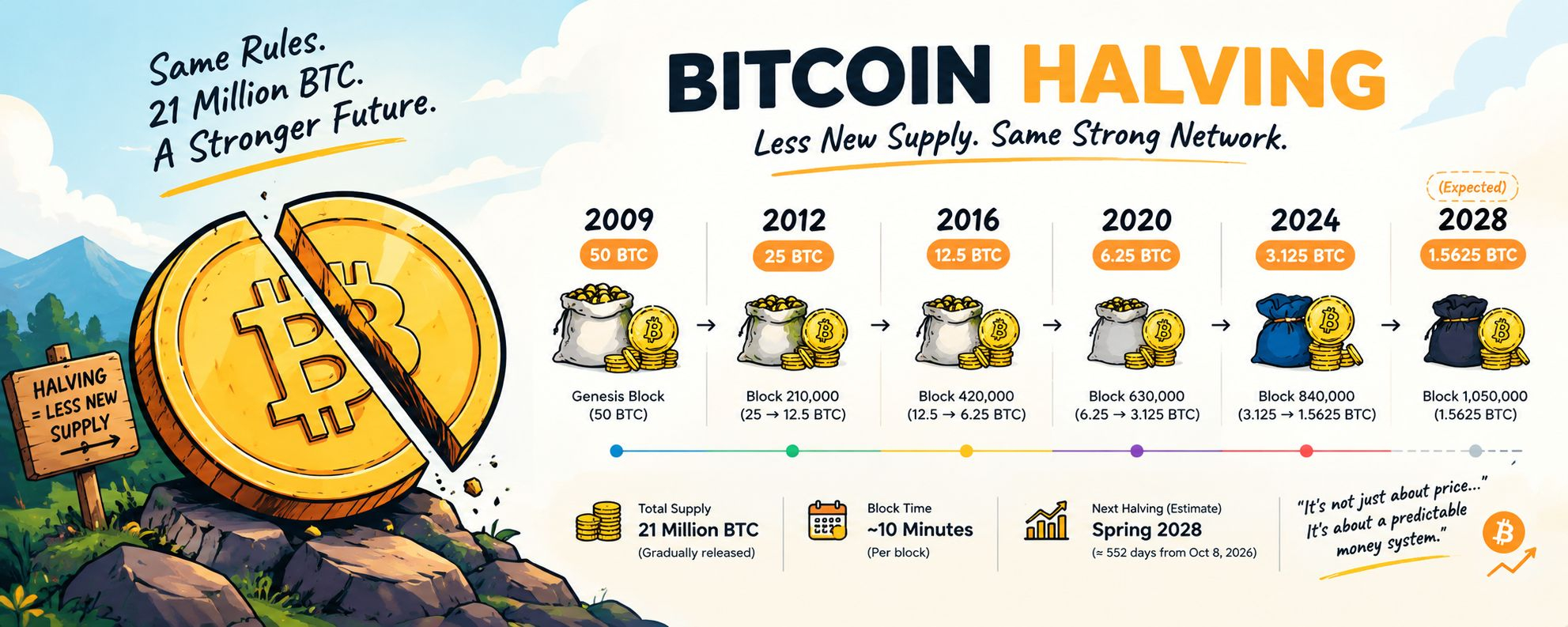
Every 210,000 blocks, it gets cut in half. Since Bitcoin aims for roughly 10 minutes per block, a halving happens about every four years.
So far, the reward has gone:
50 BTC → 25 BTC → 12.5 BTC → 6.25 BTC → 3.125 BTC
The next step will take it down to 1.5625 BTC.
And this wasn’t something added later. It was part of Bitcoin’s original design.
Satoshi Nakamoto created Bitcoin with a maximum supply of 21 million BTC. The idea was to gradually reduce the number of new coins entering circulation over time.
That gives Bitcoin a supply schedule people can actually verify through the code and the blockchain.
Bitcoin in 2012 was a completely different world
The first halving happened when Bitcoin was still very small.
BTC was trading around $12 on the day of the event. The community was tiny compared with today, but people who were involved understood that something important was happening.
The actual milestone was block 210,000, mined on November 28, 2012.
That block contained 457 transactions, a 25 BTC subsidy and roughly 13.56 BTC in fees.
Around 10.5 million BTC had already been mined by that point.
Then came the 2013 rally
Bitcoin was around $12 at the first halving.
About a year later, BTC was trading near $1,075, with the late-2013 market reaching above $1,100 on some historical price data.
That’s an incredible move.
But the halving shouldn’t be treated as a simple “halving = price goes up” formula.
The halving reduces the amount of new BTC being created. Price still depends on demand, adoption, liquidity, market conditions and investor sentiment.
There were many things happening in 2013 besides the halving.
The pattern has continued
Bitcoin has now completed four halvings:
2012: 50 → 25 BTC
2016: 25 → 12.5 BTC
2020: 12.5 → 6.25 BTC
2024: 6.25 → 3.125 BTC
The next one will happen at block 1,050,000 and reduce the reward to 1.5625 BTC.
As of October 8, 2026, Bitcoin was around block 970,498, leaving roughly 79,500 blocks until the next halving.
If blocks continue averaging around 10 minutes, that points roughly toward spring 2028.
The exact date can move because Bitcoin follows block production, not a fixed calendar date.
The part I find most impressive
The biggest story isn’t whether the next halving will push BTC higher.
It’s that the same basic monetary rules created in Bitcoin’s early days are still running today.
The reward gets smaller.
New supply slows down.
The rules are transparent.
And anyone can verify what is happening on-chain.
That doesn’t guarantee a higher BTC price.
But it does make Bitcoin’s monetary policy unusually predictable.
So what do you think will matter more for Bitcoin over the next decade:
the decreasing supply of new BTC, or the growth in adoption and demand?