

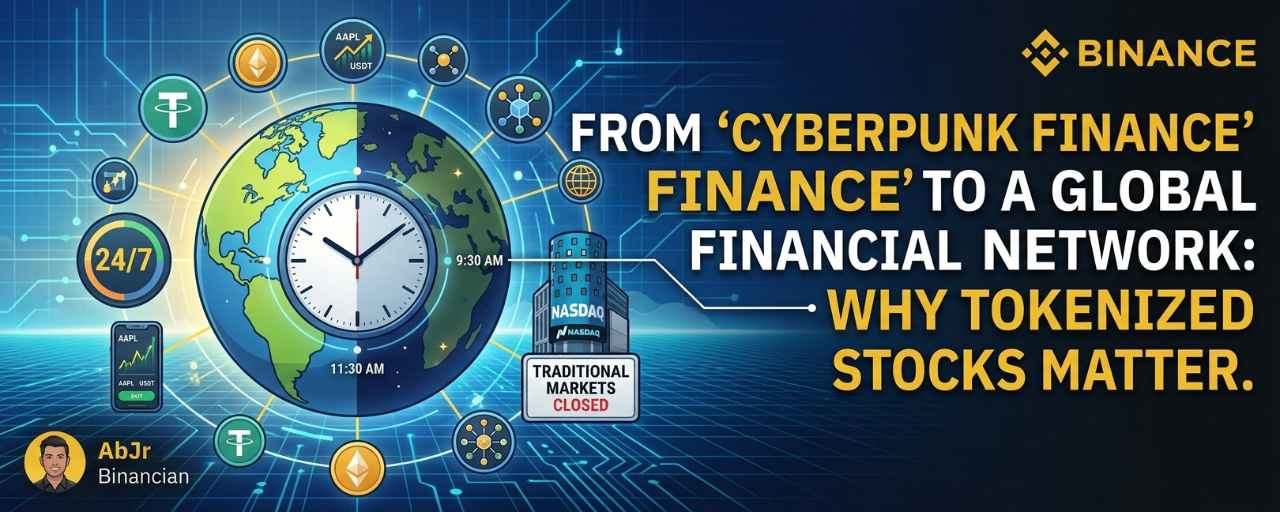
For years, putting traditional financial assets on a blockchain sounded like something from the future.
Stocks on-chain.
24/7 trading.
Global access.
DeFi applications built around traditional assets.
It sounded more like cyberpunk finance than the conventional financial system.
But in 2026, the numbers are starting to tell a different story.
Tokenized stocks crossed US$3 billion in market capitalization in the fourth week of September, more than quadrupling from around US$0.7 billion at the beginning of the year. Binance Research identifies tokenized stocks as the fastest-growing RWA category of 2026.
Yet market capitalization isn't the most interesting number.
The more important question is:
Are people actually using these assets?
The answer is increasingly visible on-chain.
From Issuance to Activity
Tokenization becomes much more interesting when an asset doesn't just sit in a wallet.
In Q3 2026, on-chain transfers of tokenized stocks, including trading volume, exceeded US$100 billion.
In Q1, the figure was just US$6 billion.
That's more than a 16× increase in three quarters.
This matters because it shows that tokenized stocks are moving beyond the initial stage of simply creating blockchain representations of traditional equities.
They're becoming active on-chain assets.
And activity is what creates an ecosystem.
A tokenized stock can potentially be:
• traded around the clock
• transferred on-chain
• supplied to liquidity pools
• used in lending markets
• deployed across DeFi applications
• integrated with other digital assets
That creates a very different proposition from simply holding a traditional brokerage position.
Why BNB Chain Matters
This is where BNB Chain has become particularly significant.
According to Binance Research, BNB Chain held around US$1 billion in tokenized stocks by mid-September, representing approximately 34% of the market.
It also led by holder count, with around 1.8 million tokenized-stock holders, roughly 45% of the total market.
The growth has been rapid.
BNB Chain's share of tokenized-stock market capitalization was around 5% at the beginning of 2026. By September, it had reached roughly 34%.
That makes BNB Chain an important distribution and liquidity venue for the emerging tokenized-equity market.
And one of the biggest contributors to that growth has been bStocks.
bStocks: From Zero to a Major On-Chain Product
bStocks launched in June 2026.
Within less than four months, its market capitalization reached approximately US$800 million, representing roughly a quarter of the tokenized-stock sector.
Binance Research also identifies bStocks as the most transferred tokenized-stock product on-chain.
That's significant because it highlights two different dimensions of adoption:
Market capitalization tells us how much value exists.
Transfer activity tells us how much that value is being used.
And bStocks has been growing on both fronts.
Earlier in the year, Binance Research reported that bStocks had already crossed US$500 million in market capitalization less than seven weeks after launch, while on-chain trading volume was rapidly expanding.
The product's growth also coincided with a broader increase in tokenized-equity activity.
The 24/7 Market Is a Different Market
Traditional stock markets operate within defined trading hours.
Blockchain networks don't.
That creates one of the clearest differences between tokenized equities and conventional equity-market infrastructure.
Binance Research found that US$1.5 billion of bStocks changed hands on Binance while US equity markets were closed during the period studied in July.
That activity represents trading opportunities that simply don't exist in the same form when access is tied to conventional market schedules.
For a global market, this matters.
An investor in Asia, Africa, Europe or the Middle East doesn't necessarily operate on the same clock as Wall Street.
A blockchain-based market can provide a common set of rails that remain available across time zones.
That doesn't eliminate market risk or liquidity constraints.
But it changes the architecture of access.
And Then There Is DeFi
Perhaps the biggest long-term difference is what happens after a stock becomes a token.
A traditional stock generally stays inside the infrastructure built around traditional securities.
A tokenized stock can potentially interact with smart contracts.
Binance Research found that the share of tokenized-stock value deployed in DeFi increased significantly during 2026. Its September analysis reported DeFi active TVL of approximately US$289 million, up from US$21.6 million at the start of the year.
That activity includes applications such as:
Liquidity pools
Tokenized stocks can be paired with other assets and used to provide liquidity.
Lending
Tokenized equities can potentially be used as collateral within supported lending markets.
Composability
Because the asset exists as a blockchain token, smart contracts can interact with it programmatically.
This is where tokenization moves beyond simply creating a digital wrapper around an existing asset.
It creates an opportunity for financial assets to become programmable building blocks.
The Bigger Shift: From Crypto-Native Assets to Real-World Finance
The early on-chain economy was dominated by crypto-native assets.
Tokens.
Stablecoins.
NFTs.
Memecoins.
DeFi protocols.
Now, traditional financial assets are increasingly appearing on the same infrastructure.
Binance Research notes that tokenized stocks' DEX ratio rose from near zero through 2025 and the first half of 2026 to an average of 11% in September, approaching the 17% average for memecoins during the same month.
That doesn't mean tokenized stocks are replacing crypto-native assets.
It shows something more interesting:
The definition of an on-chain asset is expanding.
The blockchain economy is gradually becoming less isolated from traditional finance.
Crypto assets and traditional financial assets can increasingly exist on shared rails.
So What Is Actually Changing?
The story isn't simply:
“Stocks are now available on blockchain.”
That's only the first step.
The more important progression is:
Tokenization → Distribution → Trading → Liquidity → DeFi Utility
And that's why the latest data matters.
Tokenized stocks have crossed US$3B in market capitalization.
On-chain transfers have exceeded US$100B in Q3.
BNB Chain has reached approximately US$1B in tokenized stocks and 1.8M holders.
And bStocks has grown to approximately US$800M in less than four months.
These numbers don't mean the tokenized-equity market has already replaced traditional finance.
It remains a relatively small market compared with conventional equities.
But they do show that tokenization is moving beyond the experimental stage and into a phase where distribution, liquidity and utility can be measured on-chain.
The interesting question is no longer simply:
“Can stocks be tokenized?”
We've already seen that they can.
The bigger question is:
“What happens when traditional financial assets become native participants in an always-on, programmable financial network?”
That's the shift worth watching.
And BNB Chain is already one of the places where that shift is happening.
Data source: Binance Research, “Rewriting the On-Chain Economy,” using data from RWA.xyz, DeFiLlama and other sources, as of September 28, 2026.
Note: bStocks are tokenized securities and are not the same as direct ownership of shares in the underlying companies. Availability and eligibility vary by jurisdiction. DYOR.