

Imagine opening your phone on a Sunday and buying a fraction of a real company’s shares. No traditional trading window. No waiting for a market to reopen.
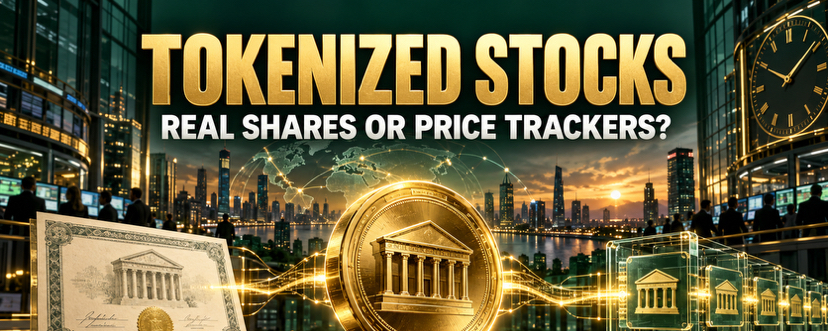
That is the promise attracting attention to tokenized stocks. But the real opportunity is more nuanced than “stocks on blockchain”, and understanding the difference could help investors avoid confusing a genuine share with a token that only tracks its price.
What has actually changed?
On 17 September, the U.S. Securities and Exchange Commission issued a temporary, conditional exemption for certain tokenized securities venues to trade eligible U.S.-listed shares through permissioned automated market-maker pools. The framework is subject to safeguards, including a requirement that eligible tokens provide holders the same rights and privileges as the equivalent traditional shares. (sec.gov)
That is a meaningful regulatory step. It is not blanket approval for every platform to put any company’s shares on any blockchain.
The conditions matter. A venue must give an issuer an opportunity to object before listing a third-party tokenised share. And under this framework, trading in the token must stop when trading in the underlying share is halted on its primary exchange. (sec.gov)
That last point is easy to miss: “on-chain” does not automatically mean “available 24/7.”
What about NYSE and Blockchain.com?
On 23 September, the New York Stock Exchange and crypto brokerage Blockchain.com announced that they would explore tokenised versions of U.S.-listed stocks. The announcement signals institutional interest, but exploration is not the same as a product launch or proof that retail investors can buy these tokens today. (reuters.com)
For investors, the distinction between live, approved, planned and under exploration is essential. Headlines can move faster than products, regulation and market access.
Where could the opportunity emerge?
If tokenised securities gain traction, the investment opportunity may extend beyond the tokens themselves. Investors may want to watch several parts of the market infrastructure:
🔹 Trading venues that can meet securities-market rules
🔹 Custody providers responsible for protecting assets and records
🔹 Settlement networks designed to transfer ownership efficiently
🔹 Digital cash used to pay for securities on-chain
🔹 Compliance and identity tools that help platforms verify eligible users
This is a watchlist of market segments to research, not a list of guaranteed winners. Adoption will depend on whether institutions and investors use these systems at meaningful scale.
A practical checklist before considering a tokenised share
1. What does the token legally represent?Does it provide ownership rights in the underlying share, or only price exposure through a separate claim or derivative?
2. What shareholder rights do you receive?Check voting rights, dividend treatment and what happens during corporate actions.
3. Who holds the underlying asset?Identify the issuer, custodian and legal structure. Read the documentation rather than relying on the product name.
4. Can you actually buy or sell it where you live?Availability, investor eligibility and protections may differ by country. A product available in one market may not be available to South African investors.
5. Is there real liquidity?A market that is technically open can still have few buyers and sellers. Low liquidity can mean wider spreads and harder exits.
6. What are the total costs and risks?Check trading fees, custody costs, blockchain transaction fees, redemption rules and what happens if a platform or service provider fails.
The takeaway
Tokenisation could make securities easier to transfer, divide and settle digitally. But the investor opportunity depends on legal ownership, access, liquidity and protections, not simply on whether a token appears on a blockchain.
The most useful question right now may not be “Which token should I buy?” It may be: Which products give investors clear rights, reliable access and a credible route to trade or redeem?
Would you consider a tokenised share if it offered the same rights as a traditional share? Tell us what you would check first—and follow Crypto & Capital for practical market explainers.
Educational content only. Not financial advice.
#TokenizedStocks #Tokenization #RWA #Investing #DigitalAssets