


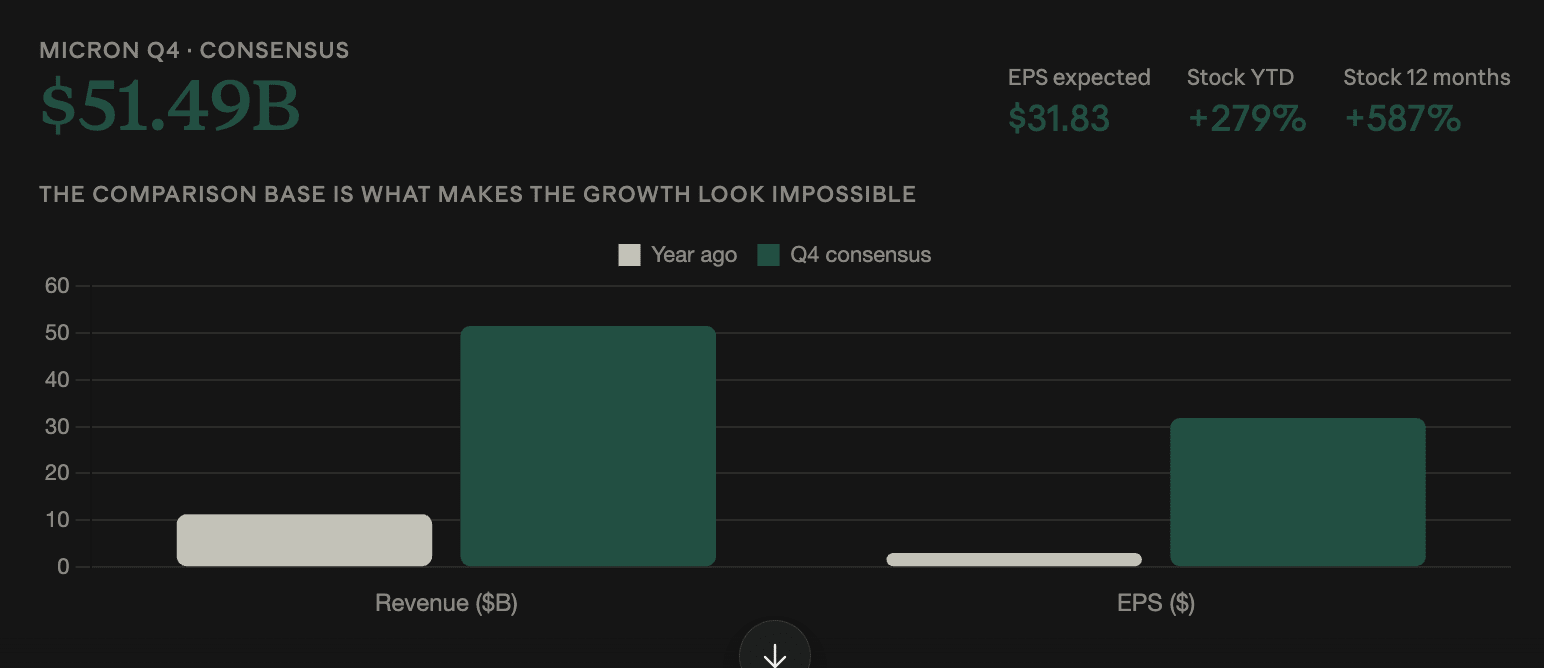
Micron reports fourth quarter earnings after the bell on Wednesday, with Wall Street expecting earnings per share of $31.83 and revenue of $51.49 billion.
Those compare against $3.03 and $11.31 billion a year ago — increases of 950% and 355%.
The stock has risen 279% year to date and 587% over the past 12 months, which sets a high bar for what counts as good news.
The Headline Beat Is Not the Variable
Consensus at 950% EPS growth means a beat is largely expected. The stock has already moved on the assumption.
What the print actually decides is whether the memory cycle has further to run.
Memory is severely operationally leveraged. Fabs carry high fixed costs, so when pricing turns, margin expands far faster than revenue — which is how Micron went from $3.03 per share to a consensus of $31.83 in four quarters.
The same mechanism works in reverse. A cycle that turns produces margin compression faster than revenue decline, and the year-ago comparisons that flatter the current quarter become punishing within two.
So the question for Wednesday is not the quarter. It is what management says about DRAM contract pricing into 2027.
What a Bullish Outcome Looks Like
Three things would extend the trade.
DRAM pricing holding or rising into the first half of 2027 would be the strongest signal, because it means supply has not caught demand. DRAM is expected to deliver $38.22 billion of the quarter's revenue, roughly 76% of the total, and it is the line tied directly to AI infrastructure.
Capacity commentary matters second. Memory cycles end when suppliers add enough capacity to break pricing, so any indication that Micron and its competitors are holding discipline supports the cycle continuing.
Customer concentration and order visibility is the third. Hyperscaler purchase commitments extending further out reduce the risk that demand is being pulled forward.
Micron's August announcement of up to $10 billion over ten years for a research institution in Boise, Idaho signals the company expects a long cycle. Confirmation in the guidance would matter more than the spending plan itself.
What a Bearish Outcome Looks Like
The warning signs are narrower but clearer.
Any softening in DRAM pricing guidance would hit hardest, because that is the line the valuation rests on. A beat on the quarter paired with cautious pricing commentary would likely still sell off.
NAND is the second area to watch. At $12.29 billion expected, it serves consumer devices rather than data centres, and it is where the pricing pressure hitting phones and laptops shows up first. Weakness there is a demand signal even if DRAM holds.
Consumer electronics makers have been absorbing memory costs by raising prices — Apple lifted the iPhone 18 Pro line by $100 against the iPhone 17 Pro. Those increases have cut unit sales while protecting margins, and that arrangement has a limit. Commentary suggesting device makers are resisting further cost pass-through would indicate the cycle is closer to its end than its middle.
Korea Sent a Different Signal Three Days Ago
The timing complicates the read.
South Korea's Kospi fell 2.7% on Monday with Samsung Electronics and SK Hynix both down more than 5%. Both are memory manufacturers and both function as the region's AI proxy.
That may reflect positioning ahead of Micron rather than a view on memory — traders reducing exposure before a print that will reprice the whole complex. Or it may be the market pricing something the US session has not yet.
Memory has swung hard in both directions all month. Micron and SanDisk each fell more than 7% on September 14 against Nvidia's 4% after Anthropic CEO Dario Amodei called for slowing frontier AI development. By September 22 the Philadelphia Semiconductor Index had risen five straight sessions after Meta's Muse agent topped the App Store and AMD briefly cleared $1 trillion.
Memory carries higher beta than logic within the AI trade, which is why Micron's guidance moves more than its results.
The Macro Backdrop Is Working Against It
The print lands into a difficult tape regardless of content.
The 30-year Treasury yield crossed 5.6% on Tuesday, its highest since June 2002, and the 10-year reached a fresh 2007 high near 5.3%.
Rising discount rates weigh most heavily on equities with cash flows weighted years forward, which describes the entire AI infrastructure complex. A strong print into rising yields may be received less well than the same print into falling ones.
PCE inflation data arrives before the Wall Street open on the same day, so sentiment will already have been set by the time Micron reports.
The Crypto Read-Through
The connection runs through the miners that pivoted to AI compute.
IREN, Hut 8, HIVE, Core Scientific and TeraWulf lagged Bitcoin badly through September, with the top-10 mining median gaining 1.8% against Bitcoin's 22%. The pivot removed their leverage to Bitcoin while adding full exposure to AI sentiment.
Strong DRAM guidance supports the demand case those companies built their capital spending around. Weak guidance undermines it — and they carry the AI beta without the memory pricing upside.
JPMorgan's counterpoint from last week still stands: neocloud contract pricing has moved to $15-$20 per megawatt from $10-$15, which suggests compute demand remains firm regardless of what memory pricing does.