

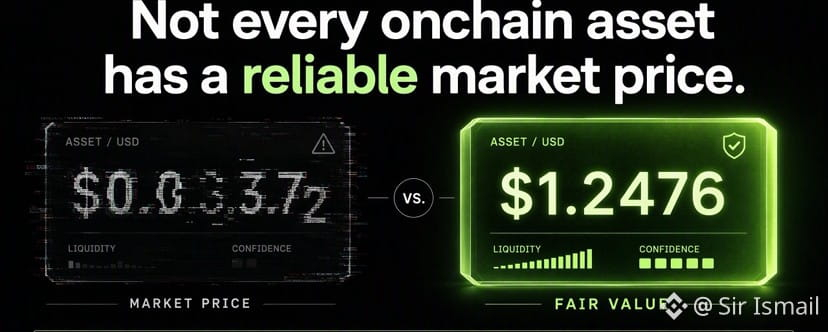

One of the biggest problems with onchain assets is something we don’t talk about enough:
Not every asset has a reliable market price.
Thin liquidity can create distorted prices, manipulation risks and inaccurate collateral valuations.
That’s where DIA Value becomes interesting.
Instead of simply asking:
“What price is this asset trading at?”
DIA can calculate fundamental fair value from verifiable data.
Its valuation models include:
→ Net Asset Value (NAV)
→ Proof of Reserves
→ Redemption Value
→ Contract Exchange Rate
→ Reserve-Backing Ratio
→ Vault Share Price
This matters for assets such as:
Tokenized funds
RWAs
Stablecoins
Yield-bearing tokens
Vault positions
Illiquid DeFi collateral
DIA Value is designed to derive value from the underlying mechanics, reserves, contracts and assets rather than relying solely on thin secondary-market trading.
And that’s a bigger opportunity than simply providing another price feed.
Market oracles tell you what an asset is trading at.
Fair-value infrastructure can help determine what that asset is fundamentally worth.
As DeFi moves toward more complex assets and institutional RWAs, this distinction could become increasingly important.
That’s one of the DIA narratives I’m watching closely. 👀
$DIA | RWA | DeFi | Fair Value | Oracle Infrastructure