
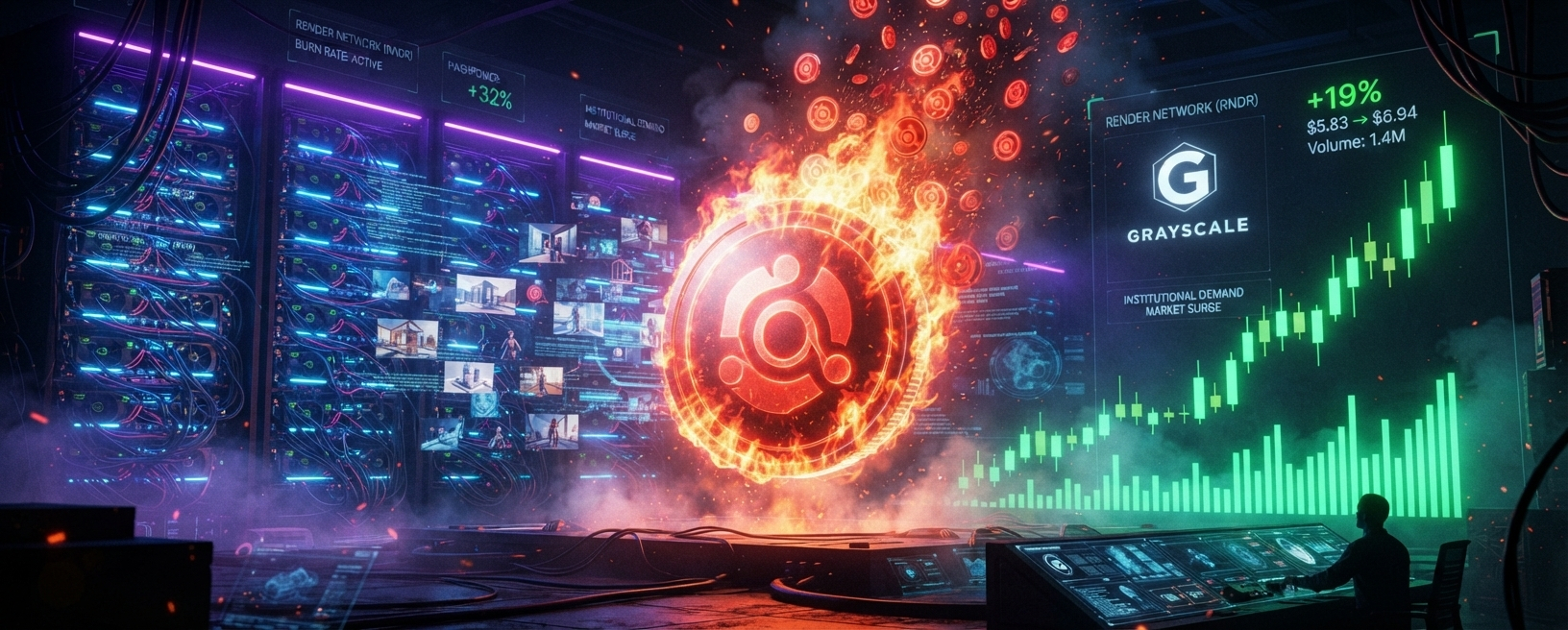


AI tokens move for many reasons. Some move on narrative alone. Render’s latest advance came with a cleaner package. The token jumped about 19%, trading near $1.83, as broader AI-linked names stayed firm and Fear & Greed sat around 71. Volume was strong, near $162 million over 24 hours. Network activity reached roughly 77 million rendered frames. About 1.16 million RENDER were burned. Grayscale’s decentralized AI allocation still carries a notable position, around 21% of that fund.
That combination matters more than the percentage gain. Traders are not only asking whether AI beta is working. They are asking whether compute demand and token sinks can keep pace with the supply side of a DePIN network.
Why Render Is Back on the Desk
Risk appetite is clearly present. Greed-range sentiment and strong flows into AI-linked names create room for mid-cap infrastructure to re-rate quickly. Render sits in a more useful corner of that complex than pure story tokens. Its network converts GPU work into measurable output. Frames rendered and tokens burned give the market two numbers it can argue about. One speaks to usage. The other speaks to supply.
What stands out is the institutional overlay. A concentrated Grayscale position does not guarantee price support on any given day. It does show that at least one regulated product channel has treated RENDER as a core decentralized AI exposure rather than a peripheral bet. In a tape already favoring AI infrastructure, that kind of allocation can reinforce attention when on-chain activity is also rising.
Technical Tape and Sector Correlation
The breakout came with rising volume, which is the first filter worth applying. Advances on thin liquidity are easy to dismiss. A roughly 19% move with nine-figure volume forces a more serious read. Momentum is clearly extended. RSI risk is real after a move of this speed. That does not automatically invalidate the breakout. It does mean the next phase often depends on whether price can hold higher levels through a pause rather than needing constant new highs.
Sector correlation remains a central variable. Render still trades as part of the broader AI and DePIN basket. When that basket is in favor, idiosyncratic strength gets amplified. When the basket rotates out, even solid network prints can struggle to hold attention. Pro traders should treat RENDER’s relative strength against both Bitcoin and the wider AI token set as part of the setup, not as an afterthought. If the sector bid fades and Render loses the breakout zone on rising sell volume, the move starts to look like another high-beta spike. If the sector cools and Render holds up better than peers, the usage-and-burn story gains credibility.
On-Chain: Throughput, Burns, and Supply Reality
The burn of about 1.16 million RENDER is the cleanest tokenomic signal in the latest package. Burns only matter if they are recurring and linked to actual network demand rather than one-off events. In Render’s case, the more persuasive argument is the loop: work gets done on the network, activity is visible in frames rendered, and token sinks reduce circulating supply as that work is paid for. That is a different structure from AI tokens that rely mainly on emissions narratives or roadmap optionality.
Seventy-seven million rendered frames help anchor the discussion in throughput. No single print proves durable demand. Sustained utilization does. The market has become more skeptical of DePIN names that can show node counts without showing work. Render’s advantage, when it works, is that the product output is legible. GPU time goes in. Rendered frames come out. The token sits in the middle of that process.
Supply dynamics still deserve caution. Burns improve the marginal picture. They do not erase broader circulating supply or the possibility of distribution into strength. Exchange balances, holder concentration, and whether large wallets lean into or out of rallies remain part of any serious assessment.
Fundamentals, Risks, and Positioning
The fundamental case is that decentralized GPU networks can capture a slice of AI and rendering demand that would otherwise remain entirely inside centralized cloud providers. Cost, availability, and workload flexibility all create openings. Render’s positioning in rendering and related compute markets gives it a clearer commercial surface than many abstract compute tokens. Institutional packaging through vehicles such as Grayscale’s decentralized AI exposure adds another distribution channel for that thesis.
Risks are familiar but still binding. AI narrative premiums can compress quickly when sentiment rolls over. Utilization can soften. Competition from other DePIN compute networks and from traditional cloud pricing remains intense. There is also execution risk inside the token itself: if burns slow while price runs ahead of usage, the market will treat the latest rally as leverage on the sector rather than a re-rating of the network.
For pro traders, the practical approach is to respect the volume-backed breakout while defining invalidation below the post-move support band, especially if funding becomes crowded. For longer-term investors, the better scorecard is still utilization trend, burn persistence, and whether institutional ownership remains sticky through drawdowns rather than only through up weeks.
Closing View
Render’s latest strength is better grounded than a pure narrative spike. A 19% advance, strong volume, millions of rendered frames, a visible token burn, and a meaningful institutional fund weight form a coherent package. Fear & Greed at 71 helps explain why the market was ready to pay for that package now.
The data suggests Render is being treated as one of the cleaner ways to express decentralized GPU demand inside the current AI bid. That status is provisional. It holds if usage and burns continue to show up when the easy momentum fades. It weakens if price keeps rising while the work metrics stall. From here, the useful question is not whether AI compute demand exists. It is whether Render’s burn-plus-usage loop can keep converting that demand into a token structure the market is willing to hold after the first pause.