

For months, the Layer 2 scaling debate across #Web3 has revolved around an uncomfortable reality: many L2s can introduce new layers of liquidity fragmentation, execution overhead, and token incentives without necessarily creating a strong economic connection to their underlying Layer 1.
Within the #Hyperliquid ecosystem, Kinetiq Research is taking a different approach.
As a major liquid staking protocol within the ecosystem, Kinetiq is introducing Elysium, a purpose-built L2 designed not to compete with Hyperliquid but to extend HyperCore’s capabilities while connecting execution activity to ecosystem value accrual.
The result is an infrastructure model focused on one central question:
What if an L2 could scale execution without disconnecting that activity from the economic engine of its parent network?
1. The Bottleneck: Why HyperEVM Needs an Execution Engine
Hyperliquid’s dual architecture, combining HyperCore for low-latency trading with HyperEVM for smart-contract execution, was designed with deliberate constraints.
Those constraints help protect HyperCore’s high-performance order-book environment. However, during periods of elevated network activity and market volatility, they can create friction for more demanding on-chain applications.
Three key challenges stand out:
Gas Spikes: Simple token swaps on HyperEVM can become significantly more expensive during periods of congestion.
Dual-Block Friction: High-frequency strategies, algorithmic market makers, and liquidation systems can face limitations when operating around EVM execution timelines.
Throughput Constraints: More complex DeFi applications can be restricted by available EVM execution capacity.
This creates a clear infrastructure requirement.
Hyperliquid does not necessarily need another generic EVM environment. It needs an execution layer that can expand application capacity while remaining tightly connected to HyperCore.
Elysium is designed around that premise, targeting 300 Mgas/s throughput and 100–200 ms block times.
2. Core Architectural Breakthroughs
Elysium approaches the L2-L1 relationship through three major architectural components.
A. Native HYPE Gas Integration
Rather than introducing another gas asset that users must acquire and manage, Elysium uses native HYPE for gas.
$HYPE bridges on a 1:1 basis, reducing the complexity associated with wrapped assets and helping maintain a more unified economic experience across the Hyperliquid ecosystem.
The objective is straightforward: scale execution without unnecessarily fragmenting the user experience or economic structure.
B. The L1Read Precompile: A Native Oracle Advantage
One of Elysium’s most important architectural components is its L1Read precompile, which is co-located with a Hyperliquid node.
Rather than depending entirely on external oracle updates, #Elysium contracts can access relevant HyperCore information directly.
“Contracts on Elysium can query live HyperCore order book state, mark prices, and position data at ~100 ms granularity for standard call gas.”
This architecture has significant implications for applications that depend on timely market information.
AMMs, algorithmic trading systems, and PropAMMs can access HyperCore data with substantially lower latency, creating an environment better suited to applications where pricing precision and execution speed matter.
C. A Complete Token Lifecycle
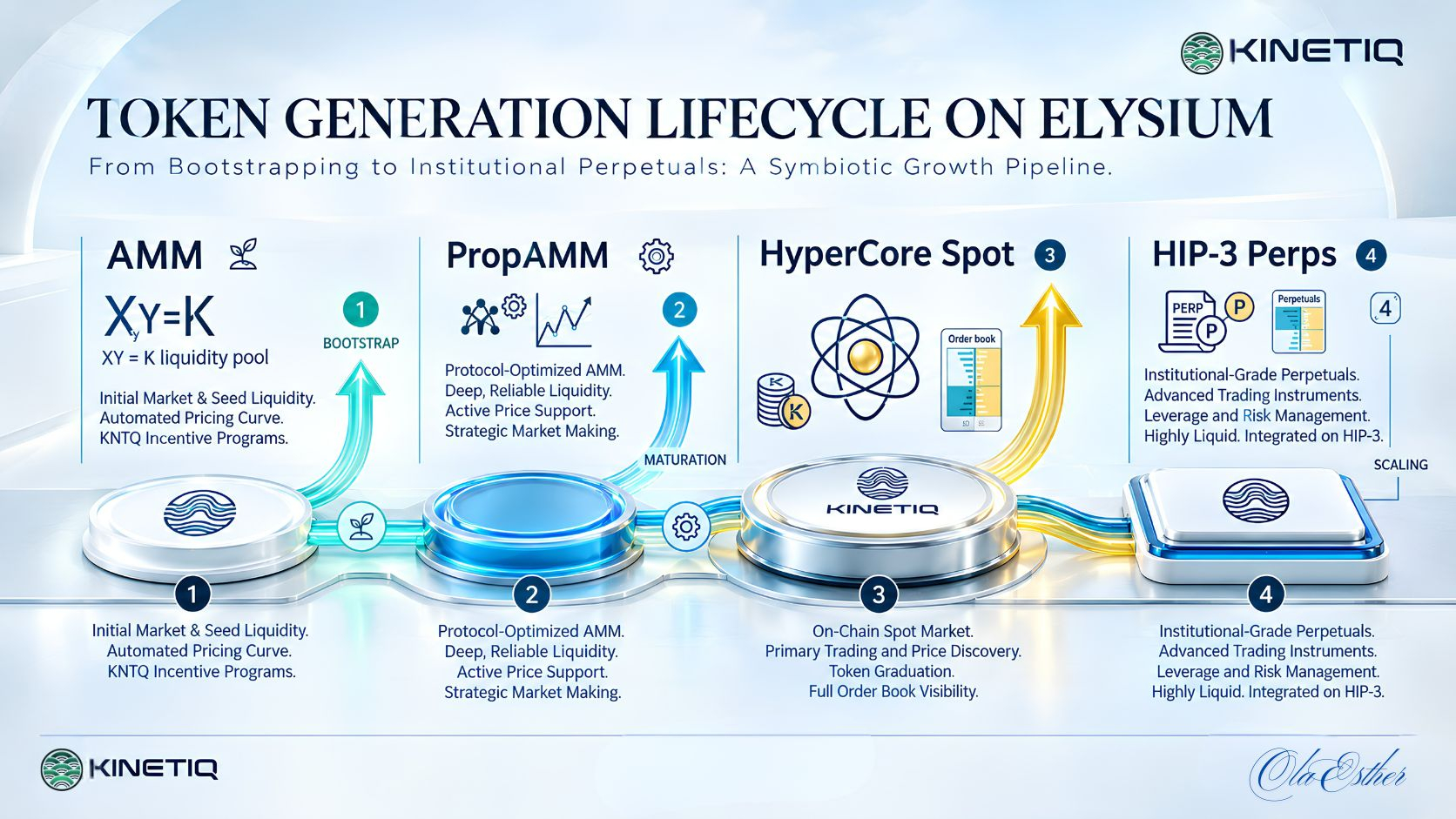
Elysium also introduces a structured pathway for assets to progress from initial liquidity formation toward deeper market infrastructure.
The lifecycle can be viewed in three stages:
Bootstrapping: New assets begin within low-cost Elysium AMMs.
Maturation: As liquidity develops, assets can transition into PropAMMs using native L1Read market-depth data.
HyperCore Graduation: More mature assets can progress into HyperCore Spot order books and, where applicable, HIP-3 perpetual markets.
This creates more than an isolated L2 environment.
It establishes a potential lifecycle connecting asset creation, liquidity formation, market maturation, and deeper Hyperliquid-native markets.
3. The Sequencer Fee Model: Rethinking Value Accrual
The most distinctive part of Elysium’s design may be its approach to sequencer revenue.
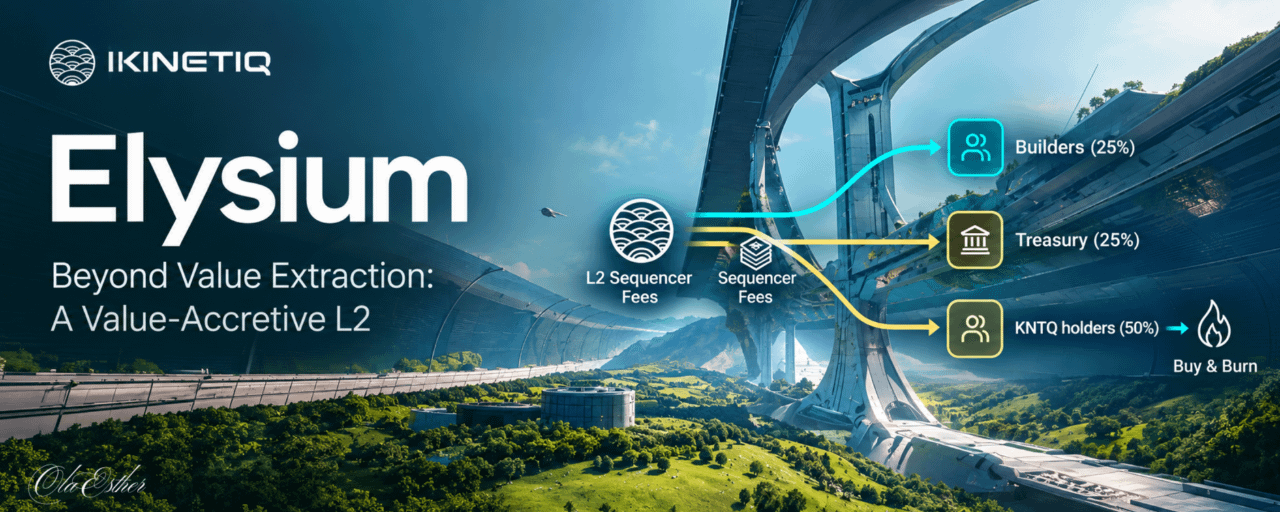
Instead of treating sequencer revenue as an isolated source of income, Elysium distributes 100% of sequencer fee proceeds across builders, the ecosystem treasury, and KNTQ buy-and-burn activity.
Elysium Sequencer Revenue
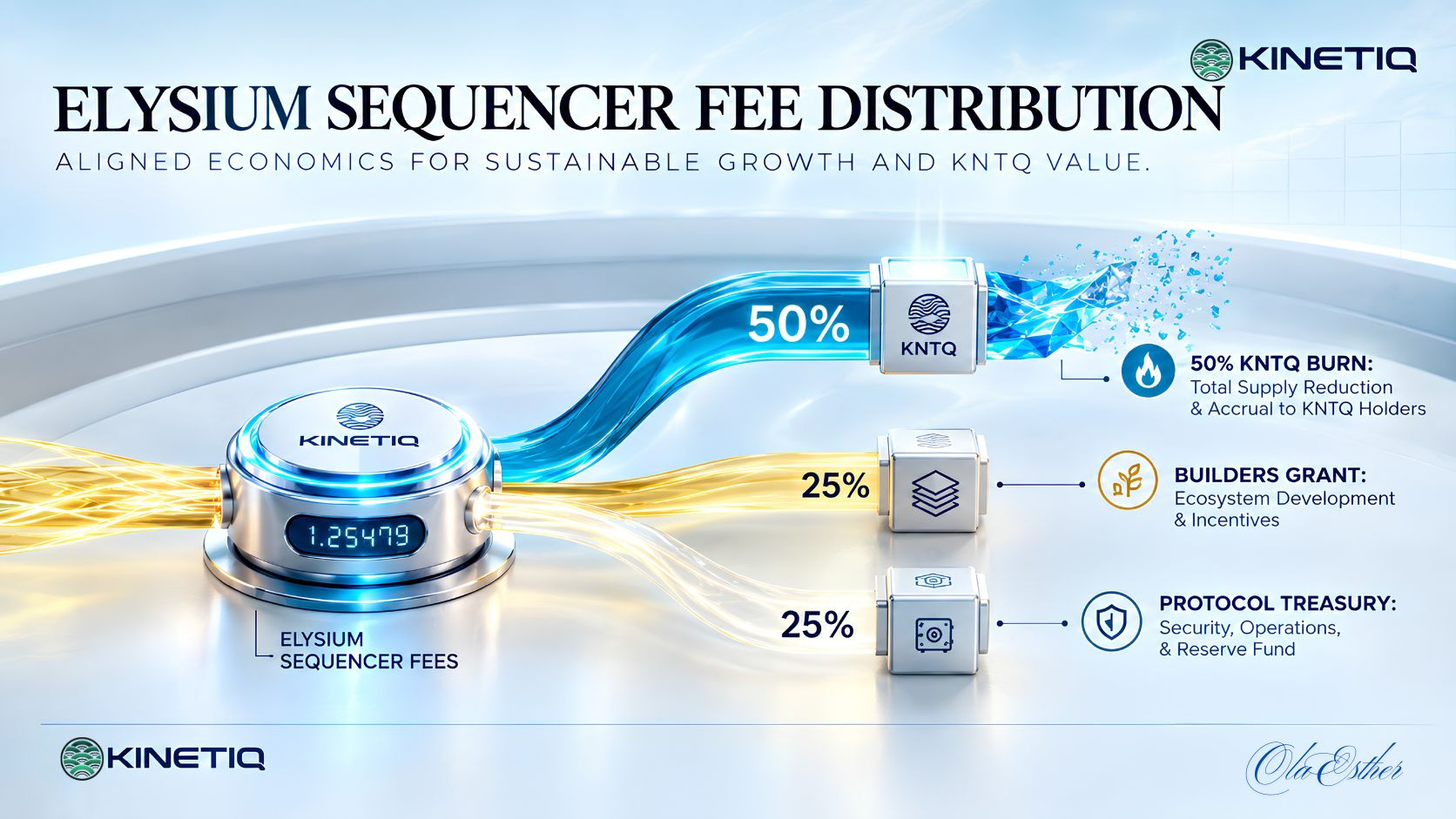
25% → Builders Automatically compensates developer teams according to network block-space usage.
25% → Ecosystem Treasury Supports long-term protocol development, security, and ecosystem initiatives.
50% → KNTQ Buy & Burn Half of sequencer fee proceeds are directed toward purchasing and burning $KNTQ.
The economic relationship is therefore straightforward:
More network execution → more sequencer fees → more KNTQ buy-and-burn activity.
This creates a direct connection between Elysium’s network utilization and KNTQ’s token-supply dynamics.
Rather than relying solely on governance utility, KNTQ becomes economically connected to the activity generated by the infrastructure surrounding it.
That distinction is important when evaluating L2 token models.
4. Why Elysium Matters for Hyperliquid
Elysium represents a different approach to scaling.
Instead of positioning an L2 as an independent destination that competes for liquidity and users, its architecture is designed around complementarity with the underlying Hyperliquid stack.
For developers, it provides additional execution capacity.
For traders and market makers, it creates infrastructure designed around faster access to HyperCore data.
For the broader ecosystem, its sequencing model creates a mechanism through which network activity can contribute to ecosystem development and KNTQ supply reduction.
And for Hyperliquid itself, the broader proposition is about expanding execution capacity without abandoning the economic and technical advantages of HyperCore.
Elysium is not simply about adding another execution layer. Its larger proposition is about making that execution layer economically connected to the ecosystem it extends.
5. The Bigger Picture
The evolution of Layer 2 infrastructure is moving beyond the simple question of “How much throughput can this chain provide?”
The more important questions are becoming:
Where does the liquidity go?
Who captures the economic value created by execution?
How closely is the L2 connected to its underlying network?
Does increased activity strengthen the broader ecosystem or simply create another isolated economy?
Elysium attempts to address these questions through a purpose-built architecture combining HYPE-native gas, direct HyperCore data access, high-throughput execution, structured token lifecycles, and a sequencer-fee model connected to KNTQ.
That makes its significance larger than simply being another L2.
Elysium represents an attempt to build an execution layer where scaling, composability, and value accrual are designed to reinforce one another.
As Hyperliquid’s ecosystem continues to expand, this model could provide an interesting blueprint for how future L2s approach the relationship between execution infrastructure and the economic systems they are built to extend.