

Elysium: A New Era for Hyperliquid and the Case for a Value Accretive L2
Layer 2s were built to solve one major problem: increase execution capacity without abandoning the ecosystem of the underlying network.
But there is another question worth asking:
Who captures the value created by that additional activity?
That question makes Kinetiq's Elysium particularly interesting.
Elysium is being designed as a Hyperliquid aligned Layer 2 that settles to HyperEVM while sitting closely alongside HyperCore. The goal is not to create another isolated blockchain. It is to provide more execution capacity while keeping assets, liquidity and market infrastructure connected to Hyperliquid. Kinetiq's current documentation describes Elysium as pre launch, meaning some specifications may still be refined.
Why Elysium?
Hyperliquid already has strong infrastructure for onchain trading through HyperCore.
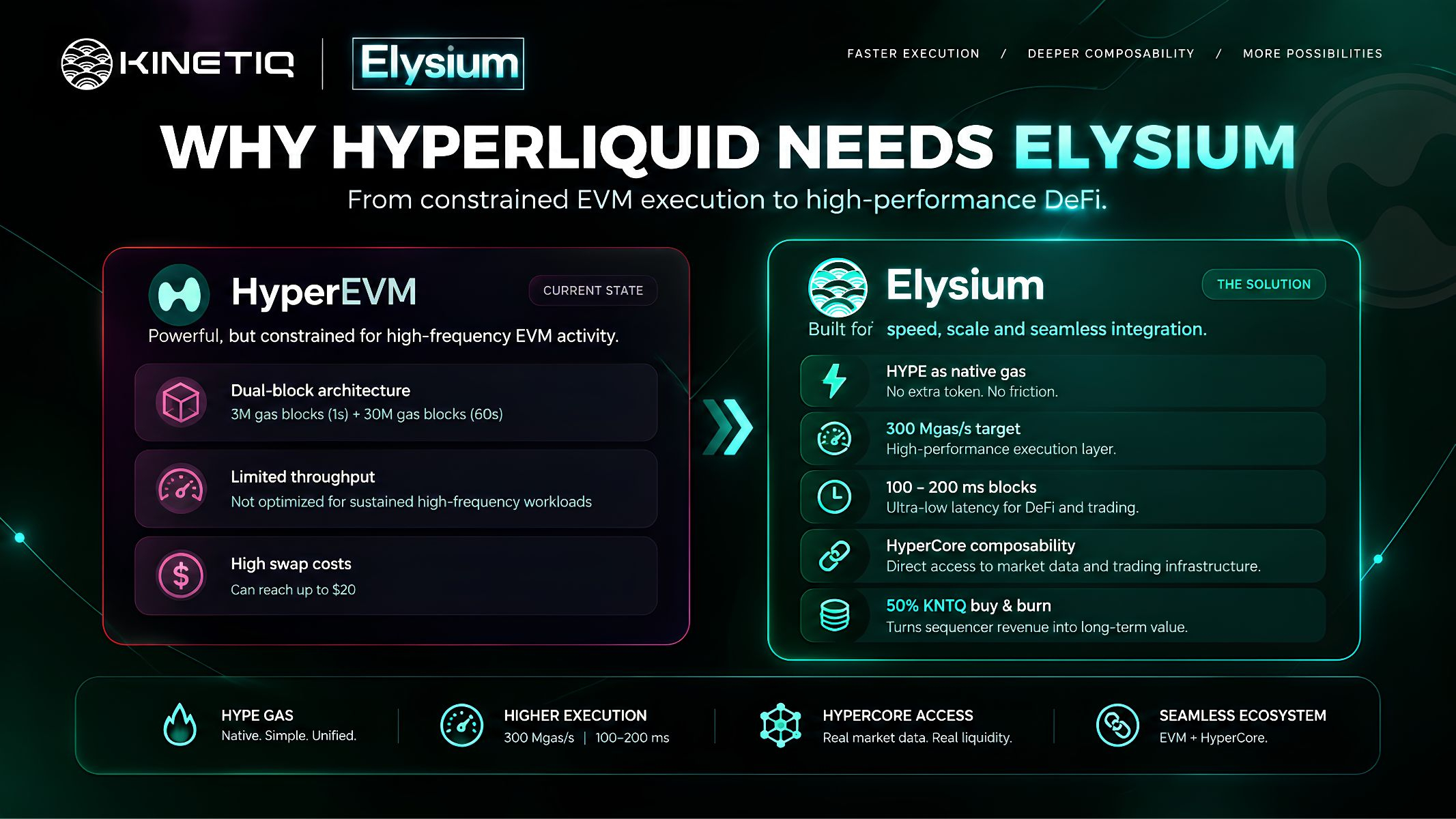
However, HyperEVM is deliberately constrained. Its current architecture uses 3M gas small blocks at one second intervals, with 30M gas larger blocks on a 60 second cadence. That architecture helps maintain composition with HyperCore, but it is not designed for sustained high frequency EVM workloads.
Elysium is designed to handle those workloads.
Its current technical target is 300 Mgas per second with 100 to 200 millisecond blocks. That is particularly relevant for applications such as high frequency trading and professional market making.
HYPE remains at the center
Elysium uses $HYPE as its native gas token.
That means users do not need to acquire an entirely new gas asset just to interact with the network. HYPE moves into Elysium as native gas and can move back to HyperEVM on a 1:1 basis.
This keeps Elysium economically connected to Hyperliquid instead of creating another isolated token economy.
Spot trading and the token lifecycle
One of the most interesting parts of Elysium is its focus on spot markets.
The network is designed to support PropAMMs and connect applications directly with HyperCore.
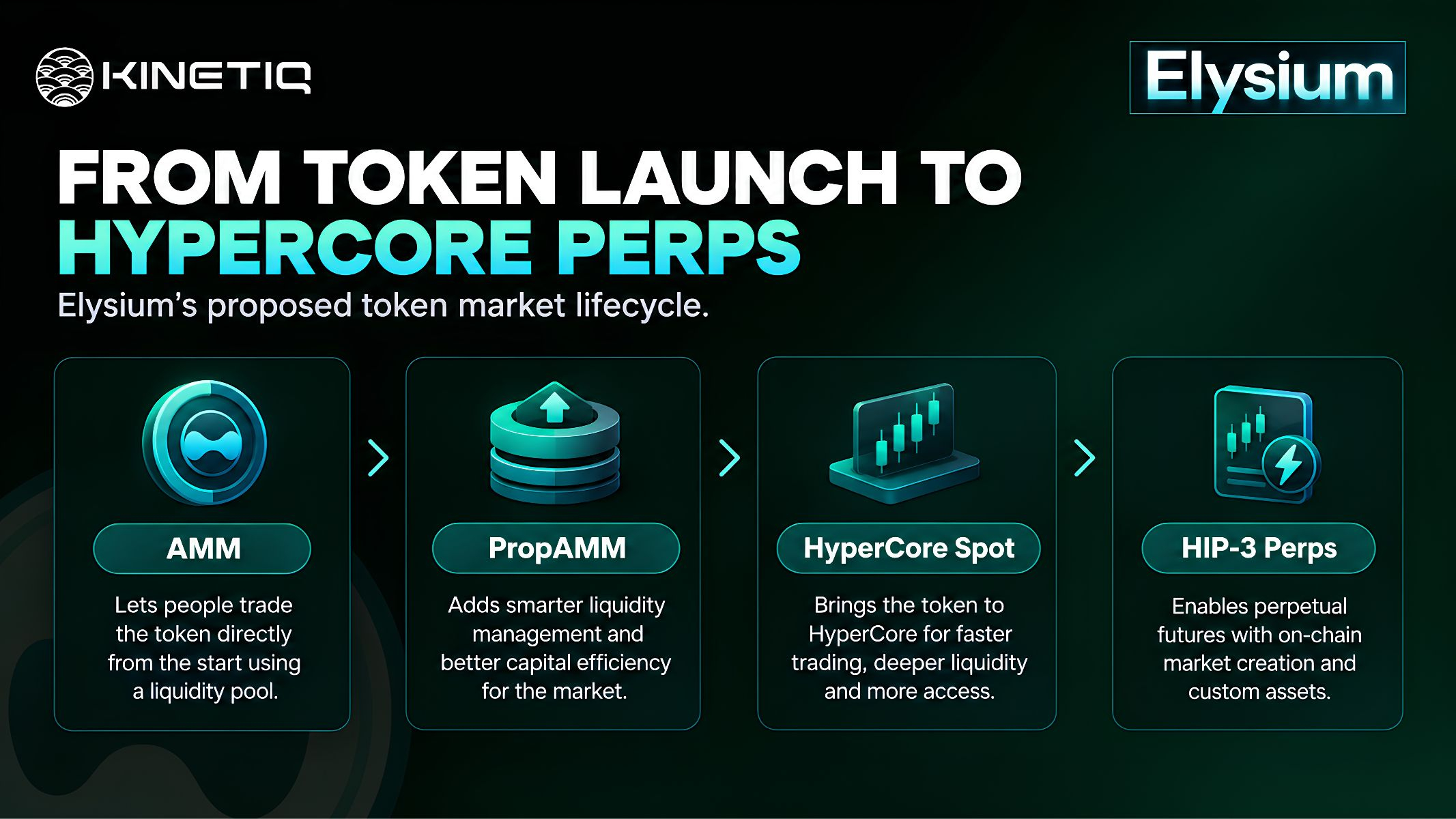
The proposed lifecycle is:
AMM → PropAMM → HyperCore Spot → HIP 3 Perps
This creates a path where a token can begin with early liquidity, graduate toward professional market making, establish a HyperCore spot market and potentially expand into perpetual markets.
That is more than a scaling upgrade.
It is an attempt to create a complete market lifecycle inside the Hyperliquid ecosystem.
The 50% KNTQ buy and burn
This is probably the most important economic design choice.
Elysium's announced sequencer fee structure is:
25% → Builders
25% → Kinetiq Treasury
50% → KNTQ buybacks and burns
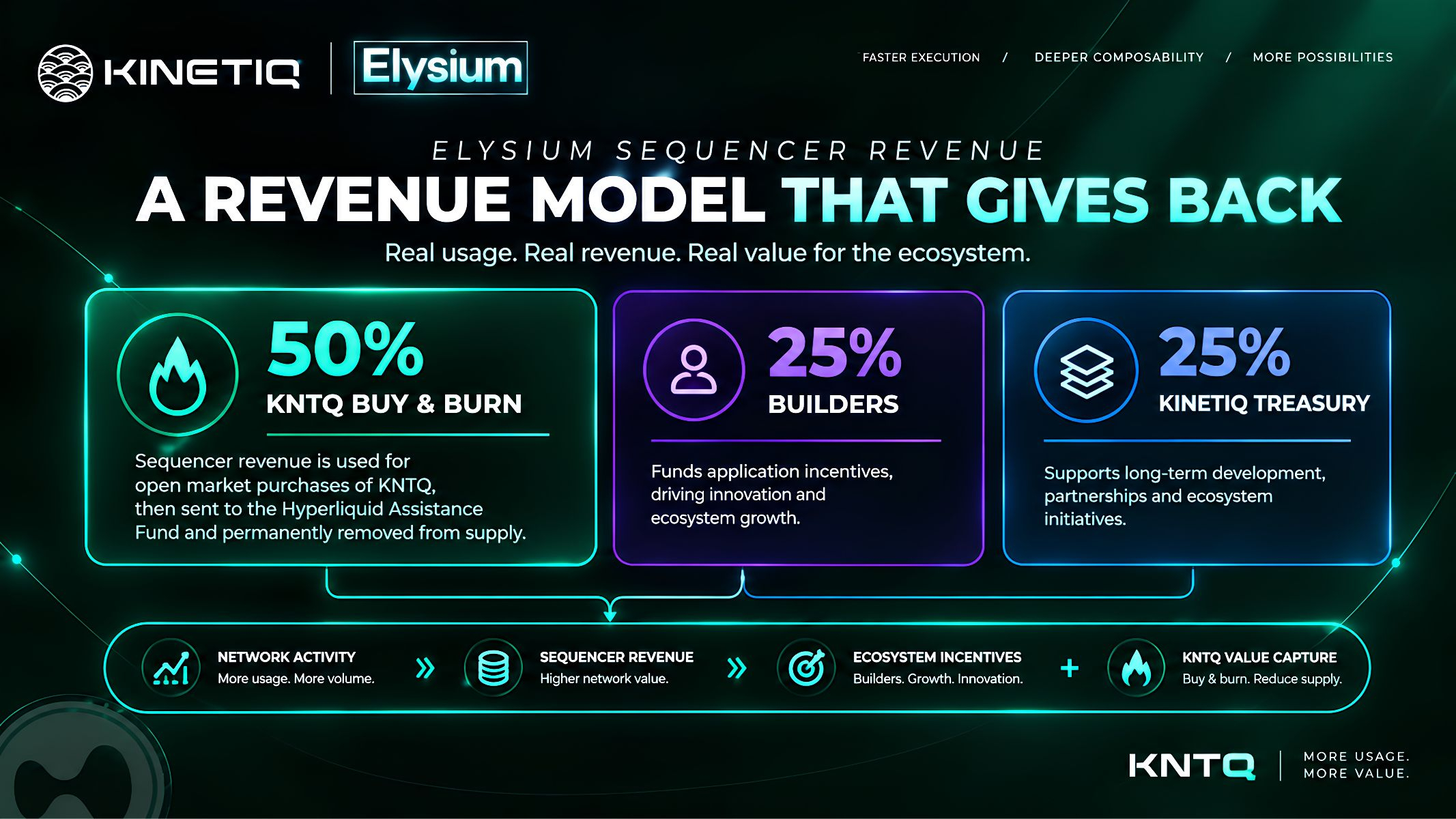
Kinetiq's documentation confirms that 50% of Elysium sequencer revenue is used for programmatic KNTQ purchases, with purchased tokens sent to the Hyperliquid Assistance Fund and permanently removed from supply.
The idea is straightforward.
More network activity can create more sequencer revenue.
More sequencer revenue means more capital allocated toward KNTQ purchases.
Purchased KNTQ is then removed from supply.
That creates a direct connection between Elysium usage and KNTQ's supply dynamics.
But there is an important reality check.
A 50% buyback allocation is not enough by itself.
The mechanism only becomes economically significant if Elysium attracts meaningful activity.
Builders need to deploy.
Traders need to use the applications.
Market makers need to provide liquidity.
And users need to generate real transaction demand.
So the real test is not the tokenomics chart.
It is network usage.
Why this could matter for Hyperliquid
Traditional L2s can sometimes become economic islands.
They attract users and liquidity, but much of the value created can remain inside the new execution layer.
Elysium is taking a more integrated approach.
It uses $HYPE for gas, connects to HyperCore, targets Hyperliquid spot markets, supports the AMM to PropAMM to spot to perps lifecycle and directs 50% of sequencer revenue toward KNTQ buybacks and burns.
That makes the value flow much more closely connected to the original ecosystem
My thoughts
The most interesting thing about Elysium is not simply that it aims to be faster than HyperEVM.
It is the combination of:
More execution capacity
Native $HYPE gas
HyperCore composability
A complete token lifecycle
And usage linked to KNTQ value capture
If the network attracts real builders and real trading activity, Elysium could become an important execution layer around Hyperliquid rather than simply another L2 competing for attention.
But the market still has to prove the thesis.
Infrastructure can be technically impressive and still fail to attract meaningful usage.
For Elysium, adoption will be the ultimate benchmark.