

$BRK.B.US #BuffettStepsDownAsBerkshireChairman
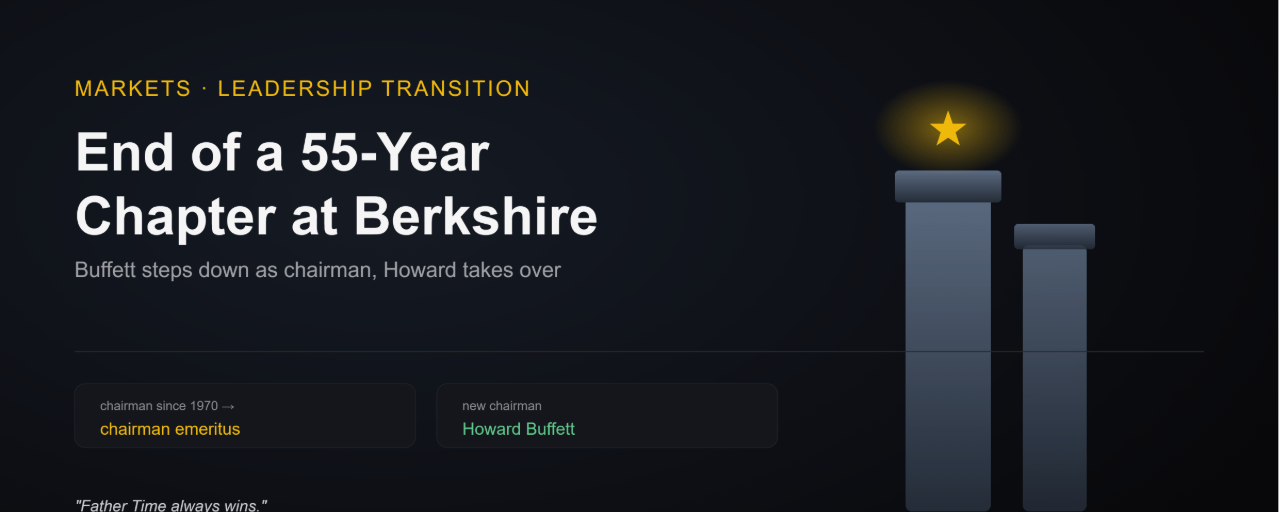
Warren Buffett has officially stepped down as chairman of Berkshire Hathaway, a title he held since 1970, moving into the honorary role of chairman emeritus. His son, Howard Buffett — a Berkshire board member since 1993 — takes over as chairman, executing a succession plan that's been years in the making.
This isn't a sudden shakeup. It comes roughly nine months after Greg Abel took over as CEO, a transition Buffett first announced back in May 2025. Under the new structure, Abel runs Berkshire's day-to-day operations, while Howard is expected to focus on preserving the company's culture and long-term values from a board-level seat. Buffett, now 96, remains a director and shareholder, closing his farewell remarks with a line as simple as his investing philosophy: "Father Time always wins."
Why this matters beyond one company
Berkshire's leadership has been remarkably stable for over half a century, and its performance under Buffett — growing at roughly 19% annually, vastly outpacing the broader market since the 1960s — has made it one of the most studied case studies in long-term value investing anywhere in the world. A transition of this scale at a conglomerate touching insurance, railroads, and consumer brands is a notable moment for markets broadly, not just for Berkshire shareholders.
A lesson that extends into crypto
Succession stories like this raise a question worth sitting with for any investor, in any market: does a carefully planned, multi-year transition preserve what made an institution successful — or does something inevitably shift once the founding figure steps back?
It's a fair question for crypto too. Many of today's leading projects are still deeply tied to their founders' vision and public voice. As the space matures, how well these projects can survive leadership transitions — planned or otherwise — may end up being just as important as their technology.
$BRK.B.US #Buffett #Berkshire #Investing
