Bitcoin was designed to move without banks. That doesn't mean it moves beyond regulation.
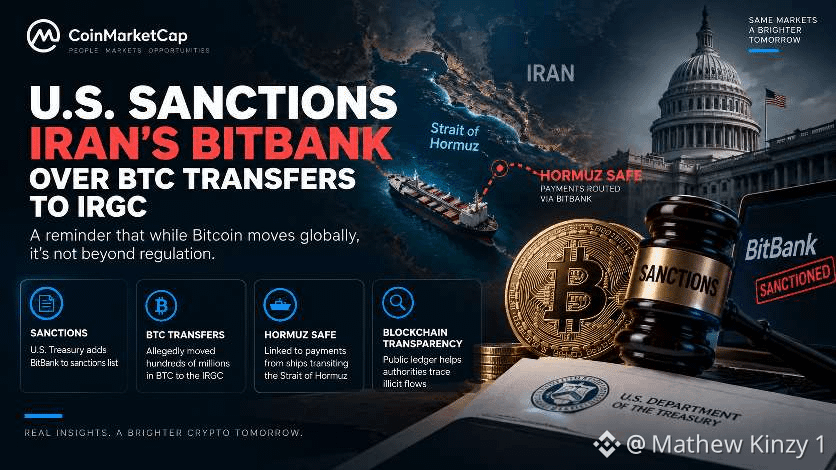
The U.S. Treasury has sanctioned Iranian crypto exchange BitBank, alleging it was part of a network that transferred hundreds of millions of dollars in $BTC to the IRGC. Treasury says payments connected to the Hormuz Safe system were routed through the exchange.
What interests me is what this says about Bitcoin itself.
A permissionless network can move value globally, but its public ledger also creates a trail investigators can analyze. And once those funds interact with exchanges, custodians or other regulated infrastructure, sanctions enforcement can become much more practical.
So crypto's borderless nature doesn't automatically mean financial activity becomes invisible or unreachable.
As $BTC becomes more integrated into global finance, compliance and blockchain intelligence may become just as important as the infrastructure moving the money.
Does blockchain transparency ultimately make crypto harder to use for sanctions evasion than traditional financial networks?
The U.S. Treasury has sanctioned Iranian crypto exchange BitBank, alleging it was part of a network that transferred hundreds of millions of dollars in $BTC to the IRGC. Treasury says payments connected to the Hormuz Safe system were routed through the exchange.
What interests me is what this says about Bitcoin itself.
A permissionless network can move value globally, but its public ledger also creates a trail investigators can analyze. And once those funds interact with exchanges, custodians or other regulated infrastructure, sanctions enforcement can become much more practical.
So crypto's borderless nature doesn't automatically mean financial activity becomes invisible or unreachable.
As $BTC becomes more integrated into global finance, compliance and blockchain intelligence may become just as important as the infrastructure moving the money.
Does blockchain transparency ultimately make crypto harder to use for sanctions evasion than traditional financial networks?