
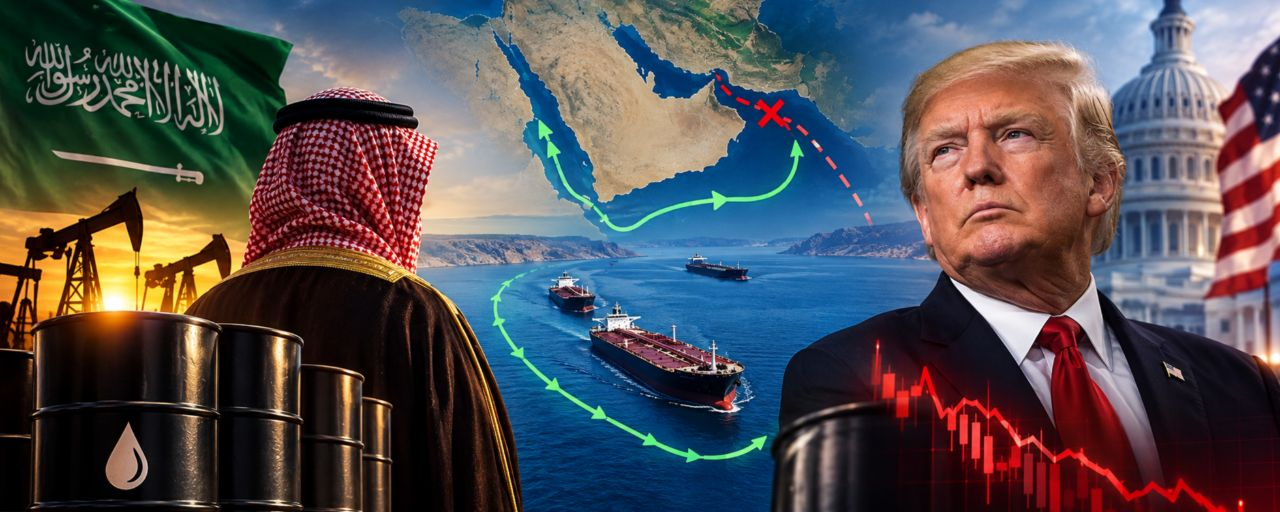

Crude is parked just above $100 a barrel. Still up close to 15% on the month. But whatever pushed it there a week ago has run out of gas. Literally, in a sense. Traders found a workaround, and that is the whole headline here, not some sudden ceasefire, not a war cooling off. Just Saudi Arabia figuring out how to move oil around the mess instead of through it.
Brent settled Thursday just under $105, down about 1%. WTI eased roughly half a percent, settling near $102. By Friday morning the slide had picked up: WTI down to $100.28, Brent to $102.85, both off close to 2% intraday.
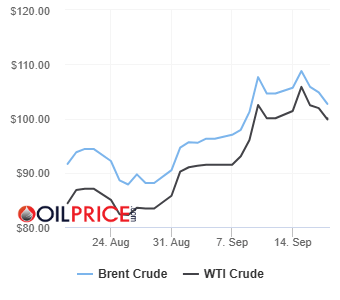
None of that says the war is cooling. It isn't. What it says is that the market has, for now, found enough spare capacity to look past it. Other economists have suggested that the market has repriced the risks of Houthis joining the conflict following their significant July 2026 offensive and subsequent September 2026 capture of Yemen's entire Red Sea coast.
Rerouting Around a Broken Pipeline
Riyadh has reportedly started sending extra crude cargoes to Asian refiners via ship-to-ship transfers near Oman's Sohar port. A workaround for a workaround, essentially, since the whole point is sidestepping the mess created when the East-West pipeline went offline.
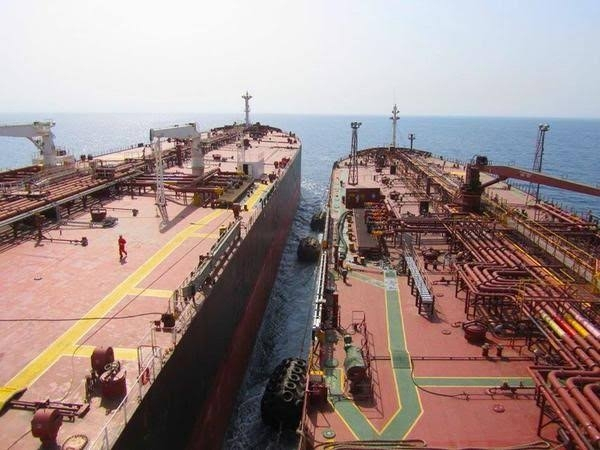
And it is not some minor spur line. It is the 745-mile East-West pipeline, the one that lets Saudi Arabia haul crude from its eastern fields to the Red Sea port of Yanbu without going anywhere near a blockaded Strait of Hormuz.
Drones took it out in the second week of September. Half the capacity, Saudi officials say, comes back within days. Full repairs? Six weeks, maybe more. Rystad Energy's verdict: a month-long closure is a big deal but survivable. Longer than that, and you are looking at a reshuffling of global crude flows from scratch
Houthis Push Deeper Into Yemen
On the ground, none of this looks calm. Fighting has flared around Marib and Taiz, two provinces sitting on top of Yemen's main oil and gas fields, as Houthi forces push an offensive that could shove the country back into full civil war. The 2022 truce? On life support.
Along the coast, the Houthis have taken Mocha, Dhubab, Perim Island, and both Hanish islands, Greater and Lesser, all clustered right around the Bab el-Mandeb Strait. That is the chokepoint between the Red Sea and everything moving between Europe and Asia. Government troops, for their part, mostly got out of the way.
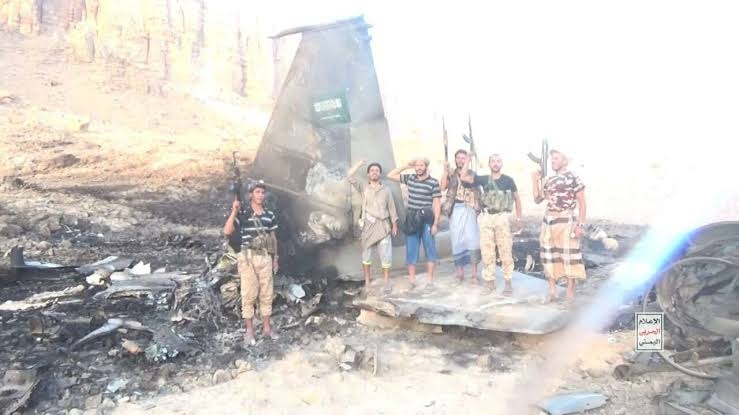
Then there's the F-15. Houthi media put out footage this week claiming to show the wreckage of a Saudi F-15, brought down over Marib by what the group says was a locally built surface-to-air missile.
BBC Verify pinpointed the crash site first, using satellite imagery; CNN independently confirmed the same spot. Riyadh hasn't said a word. If the claim holds, it's only the second time a US-built F-15 has gone down to hostile fire in this war, and Yemen is a long way from where this war actually started.
Beijing's Quiet Diplomacy
Quietly, somewhere off camera, something else has been happening. Reuters reports China has been leaning on Iran, privately, to get the Houthis under control, after Saudi Arabia went to Beijing and asked for exactly that. Three Iranian sources say the private message was blunter than anything China has said in public, where the line has stayed soft: restraint, dialogue, safe navigation. Asked for comment, Beijing's foreign ministry stuck close to script: "escalating regional instability is not in the interests of any party."
Iran's answer, per the same sources, put the ball back in Washington's court. Stability, Tehran says, depends on ending the US-Israeli war first. China has not threatened to pull back economically if Iran does not deliver. It does not really need to. Beijing buys the overwhelming majority of Iran's seaborne oil exports and is one of the few places Tehran can still turn for capital while its economy absorbs the cost of war and sanctions. And Beijing has moved the needle before. It brokered the deal that patched things up between Iran and Saudi Arabia back in 2023.
Washington Eyes an Endgame
Trump, talking to reporters in North Carolina on Wednesday, said the US is "hopefully" nearing the end of a war that started on 28 February and has now dragged on for nearly seven months. He said he had been in direct contact with Tehran, no further detail offered, and is expected to sit down with Gulf leaders on the sidelines of next week's UN General Assembly to talk about what comes next.
The bill for this war is still being counted, too. UN investigators said this week that two US airstrikes on Iran back in February, one on a school in Minab, another on a sports complex in Lamerd, killed at least 178 civilians between them, and that there are reasonable grounds to believe those strikes amounted to war crimes. Meanwhile, UKMTO logged yet another tanker hit by an unidentified projectile in the Strait of Hormuz. Just the latest in a run of attacks that has not really let up since Iran effectively shut the waterway to normal traffic.
An oil market pricing in de-escalation and a war that keeps opening new fronts- Marib, the Red Sea, now Hormuz again- do not sit easily together. For now, traders are betting the pipeline gets fixed before the war finds somewhere else to spread.