

Introduction
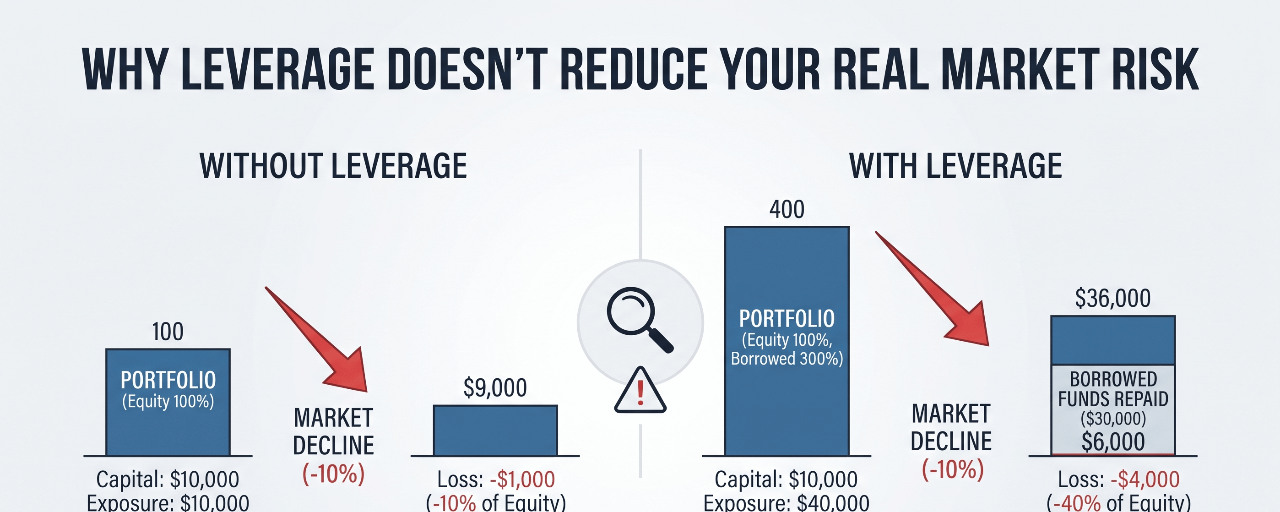
In crypto futures, the term leverage is often marketed as a way to “amplify profits.” While it indeed lets a trader control a larger notional position with a relatively small margin, it does not reduce the underlying economic exposure of that position. This distinction is essential for anyone who wants to protect capital while navigating volatile markets.
1. What Leverage Actually Does
Leverage allows a trader to control a position whose notional value is larger than the margin committed. For example, with 10× leverage, a $1,000 margin can control a $10,000 notional exposure. The key point is that the trader’s risk—the amount they could lose—still scales with the $10,000 exposure, not the $1,000 margin.
"Leverage allows a trader to control a position whose notional value is larger than the margin committed. It does not reduce the economic exposure of the position."
2. Higher Leverage = Less Room for Adverse Moves
When leverage rises, the price distance a trader can withstand before a margin call shrinks. This is because the same amount of margin now backs a larger notional, so even a modest adverse price move can deplete the margin buffer.
"Higher leverage leaves less room for adverse price movement before margin becomes stressed, so position size and stop‑based account risk remain more important than choosing the highest leverage available."
Consequently, a trader using 50× leverage will see a margin call after a much smaller price swing than a trader using 5× leverage, even if both hold the same notional size.
3. Position Size Trumps Leverage Choice
Because margin stress is directly tied to the notional exposure, position sizing—how much notional you actually take on—becomes the primary lever for risk control. A trader can mitigate risk by:
Limiting Notional Exposure: Choose a notional that aligns with the amount of capital you are willing to risk, regardless of leverage.
Setting Stop‑Loss Orders: Define a price level where the position will be exited automatically, capping potential loss.
Monitoring Maintenance Margin: Keep an eye on the maintenance margin requirement, which can trigger liquidation if breached.
These practices are more effective than simply selecting a lower leverage, because they directly address the size of the exposure and the exit strategy.
4. A Simple Thought Experiment
Imagine two traders, Alice and Bob, each deposit $1,000 as margin. Alice uses 5× leverage, controlling a $5,000 notional. Bob uses 20× leverage, controlling a $20,000 notional. If the market moves against them by 5%, Alice’s position loses $250 (5% of $5,000), while Bob loses $1,000 (5% of $20,000). Bob’s higher leverage has amplified his loss, even though both posted the same margin.
The lesson: leverage does not shield you from larger losses; it merely magnifies the impact of price moves on the notional you control.
5. Practical Takeaway
Never equate high leverage with low risk. The margin you post is only a fraction of the risk you are taking.
Focus on the notional exposure you are comfortable with, and use stop‑losses to define acceptable loss levels.
Regularly review maintenance margin requirements to avoid unexpected liquidations.
By internalising these principles, traders can avoid the common pitfall of thinking that a tiny deposit guarantees limited downside.
Conclusion
Leverage is a powerful tool, but it does not diminish the economic exposure of a futures position. Higher leverage reduces the price cushion before a margin call, making disciplined position sizing and stop‑loss management the real safeguards for capital. Understanding this relationship equips traders to use leverage responsibly and protect their portfolios in the fast‑moving crypto futures arena.
For further reading on responsible trading practices, explore Trading Turtle’s broader curriculum on futures mechanics and risk management.