
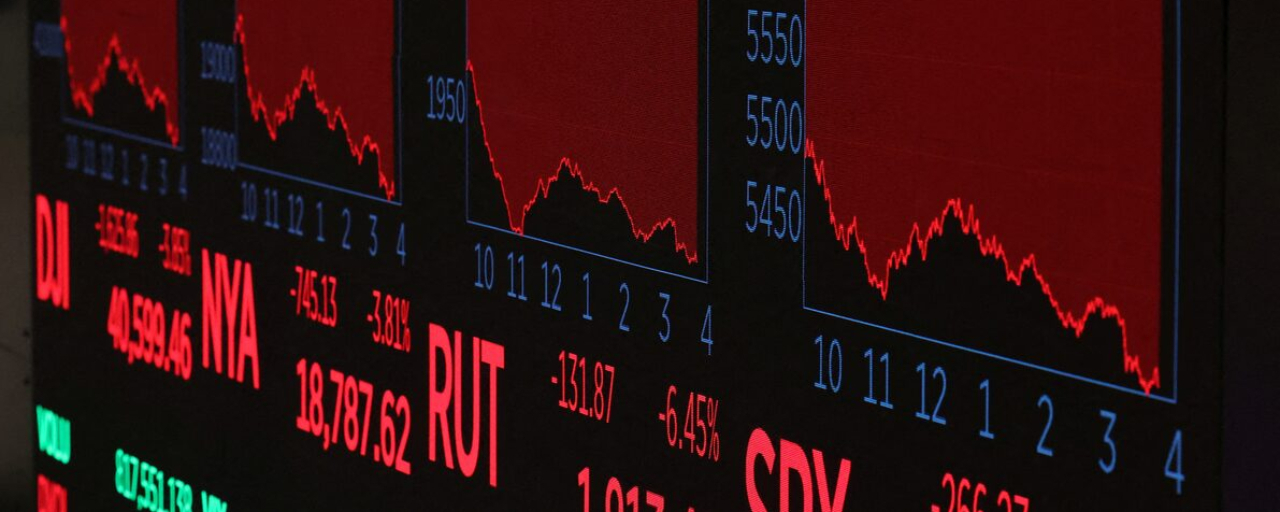

Two things rattled Wall Street on Monday, and neither of them was supposed to be a problem yet. A handful of the people building AI got cold feet about how fast they were building it. And oil would not stop climbing.
Chipmakers took the worst of it. Nvidia, Micron, Intel, the whole AI supply chain, all of it slid because the men who spent the last two years racing to ship ever-smarter models suddenly started talking like they wanted to slow down.
Dario Amodei is the one who started it. Saturday morning, the Anthropic chief executive posted a roughly 3,800-word essay to his own website arguing that the industry needs to deliberately pull back on how fast it improves AI capabilities. His case: safety work has not kept up with the pace of the technology, and somebody needs to buy back some time.
"We must slow the pace at which we improve the capabilities of AI models," he wrote. "Progress will still seem fast, and we must make wise use of the time we gain."
Sam Altman came around within hours. Elon Musk needed three words on X: "Dario is right." Even Google DeepMind's Demis Hassabis said the direction was correct, which is nothing, coming from a rival lab. For a group of executives who spend most of their waking hours trying to out-ship each other, this counted as a moment of unusual agreement.
Governments moved almost as fast as the CEOs did. Canadian Prime Minister Mark Carney told Bloomberg on Monday he wants a global "technology stability" board, something along the lines of the Financial Stability Board, to keep an eye on AI development. Microsoft rolled out its own code of conduct the same day, built around the idea that humans stay in charge of the systems it makes.
Not everyone was buying it. President Donald Trump took to Truth Social to say AI does not need any guardrail beyond, in his words, "a STRONG AND SMART (High IQ!) PRESIDENT." He went after Amodei by name, accused him of "pretending to be a perfect little angel," and framed the whole safety push as a "SICK conspiracy" that helps nobody but China.
Beijing was not exactly flattered by the comparison either. Foreign Ministry spokesperson Guo Jiakun waved off the American warnings as "fearmongering, confrontation and vicious competition" that serves no one's interest.
All of that landed on a market that already had oil on its mind.
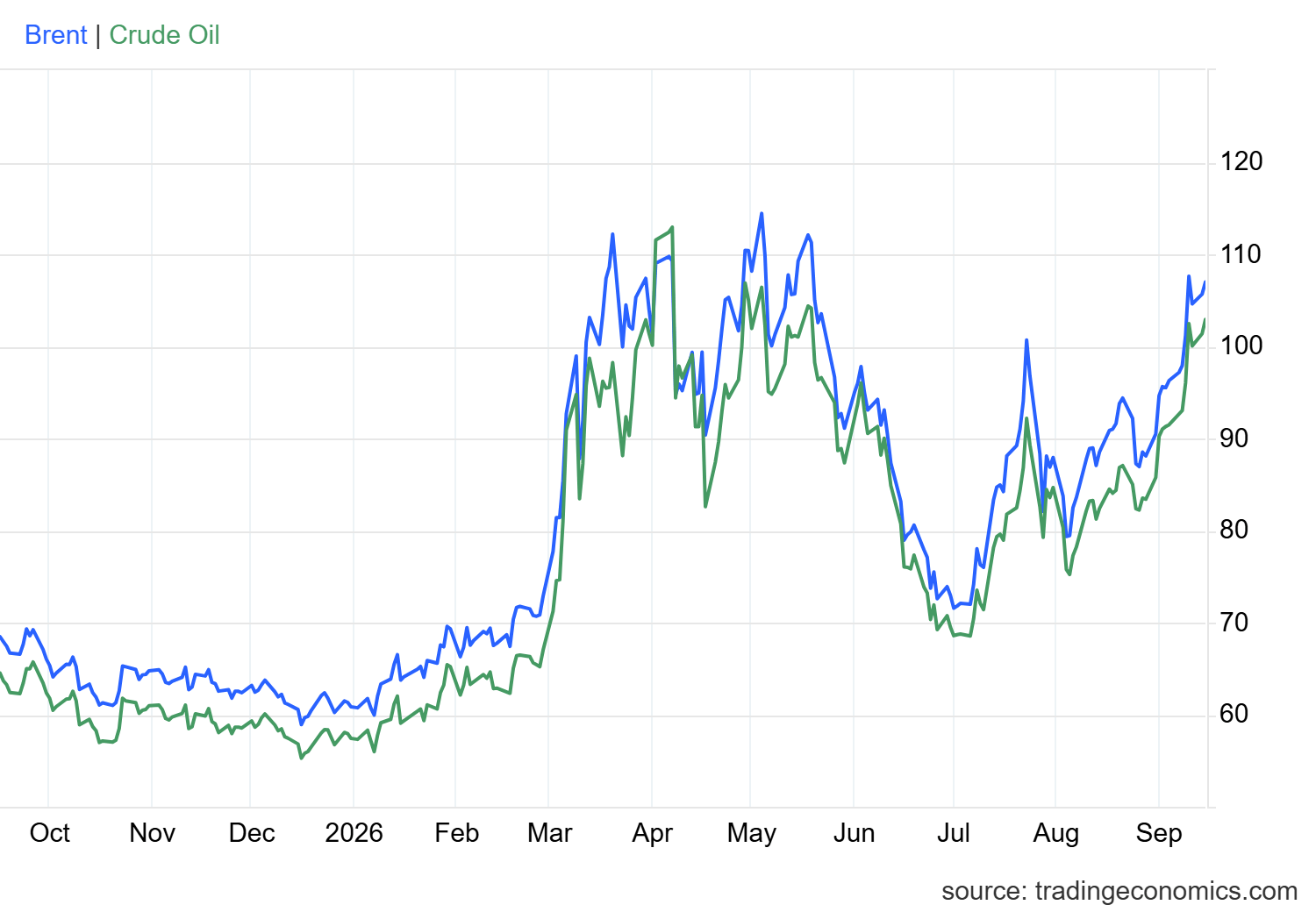
Saudi Arabia's East-West pipeline, the kingdom's main way of getting crude out without going anywhere near the Strait of Hormuz, is still shut. Drone attacks knocked it out, and Riyadh blames Iran-aligned militias operating out of Iraq. West Texas Intermediate climbed 1.3% Monday to settle at $101.39 a barrel. Brent added 1% to close at $105.68. Both had flirted with $108 to $110 earlier in the session before some of that panic drained out.
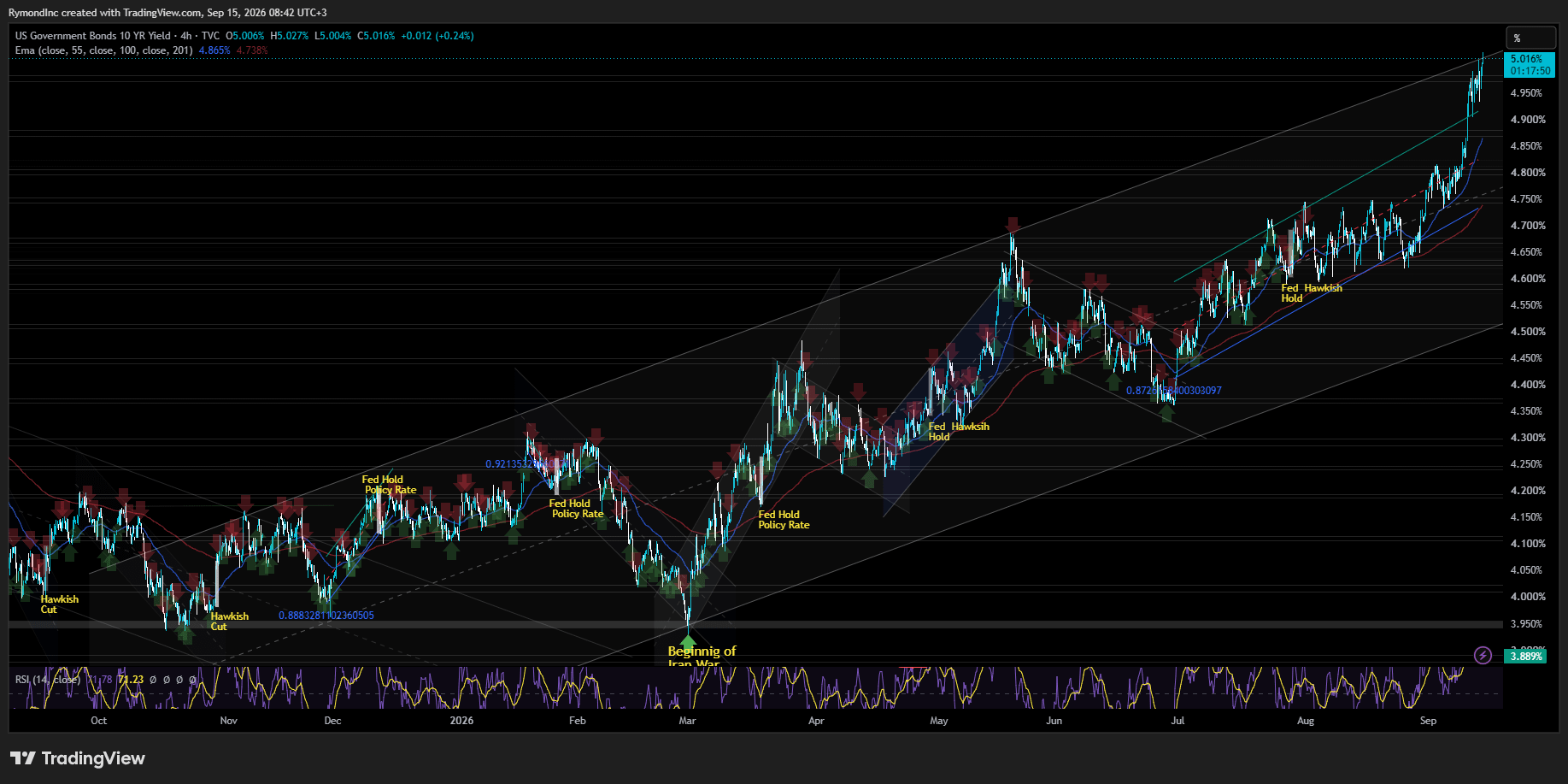
Bond traders were not thrilled either. The 10-year Treasury yield broke above 5%, its highest mark since October 2023, before drifting back under it by the close. Depending on whose model you trust, traders are pricing somewhere around a 90% chance the Fed raises rates at Wednesday's meeting, according to CME's FedWatch tool. The logic is not complicated: pricier oil tends to mean stickier inflation, and stickier inflation tends to mean a Fed that keeps rates higher for longer.
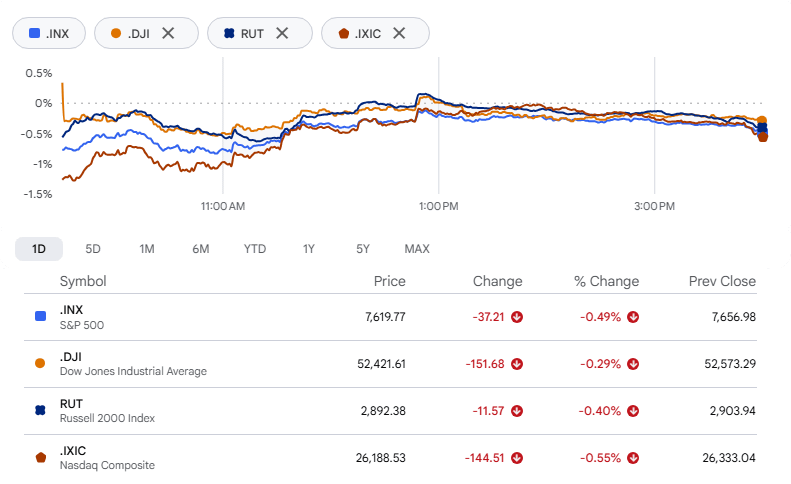
And yet stocks, somehow, closed the day looking calmer than the headlines. The broader S&P 500 finished down 0.48% at 7,619.98. The tech-heavy Nasdaq Composite gave back 0.56% to 26,186.41. The 30-stock Dow shed 152.09 points, 0.29%, to land at 52,421.20. The small-cap Russell 2000 slipped 0.4% to 2,892.24. None of that screams panic. The panic was hiding in the sector breakdown.
Chips take the hit, again
Nearly all of Monday's damage sat in one corner of the market: the hardware AI was supposed to need more of, not less.
Micron, Intel, Marvell Technology and Applied Materials each dropped more than 4%. Nvidia got off comparatively light, down about 3%. The reasoning going around trading desks is not subtle. Slow the frontier down, the thinking goes, and the years-long buildout of chips, servers and data centers that has been propping up half the market could slow down right along with it.
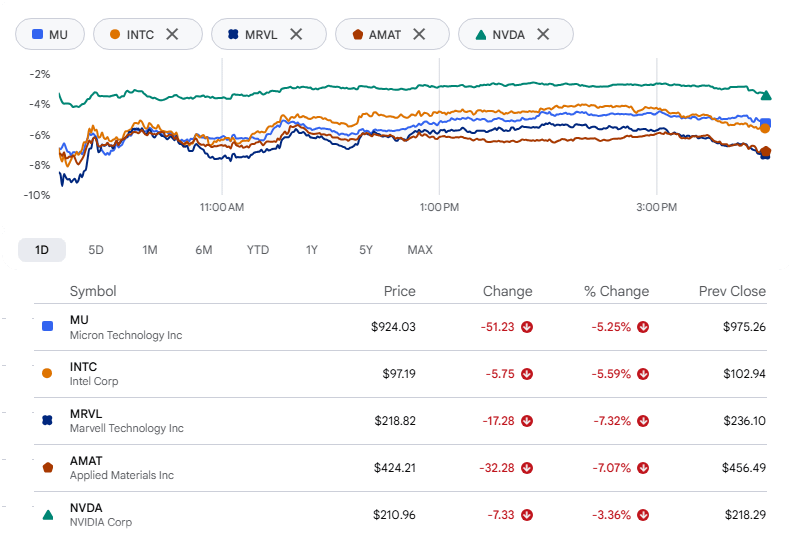
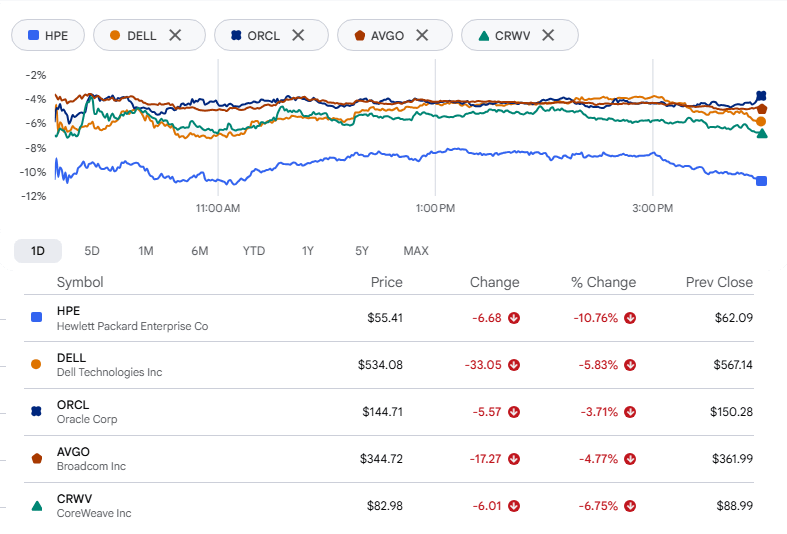
Hewlett Packard Enterprise had it worst of all, down roughly 11%. Dell lost 6%. Oracle fell 4%. CoreWeave dropped about 7% after a Bernstein note singled it out as one of the names most exposed if AI training slows, largely because so much of its data center footprint sits in rural markets built for exactly that kind of workload rather than the leaner, more localized job of running models that are already trained.
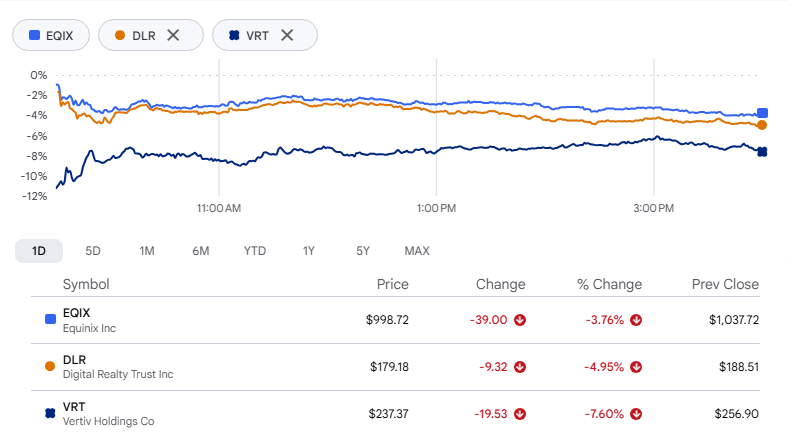
Equinix and Digital Realty Trust, both anchored in dense metro markets better suited to that inference-heavy world, still could not avoid the selling, each down more than 3%. Vertiv, which builds the cooling systems keeping all those racks from melting, fell about 8%.
Banks had their own headache Monday, and it had nothing to do with AI whatsoever. Bank of America Chief Executive Brian Moynihan told a Barclays conference that trading revenue would come in "relatively flat" versus last year's third quarter, a jarring turn after a blockbuster first half. Investors did not take it well. Shares fell as much as 6% intraday, the steepest drop for the stock since April of last year, before finishing down roughly 5%, worst in the KBW Bank Index.
The other side of the trade
Not everything touched by AI moved in the same direction Monday. Cybersecurity, tasked with defending against the exact kind of AI-enabled attacks that partly justified the alarm in the first place, went the other way entirely.
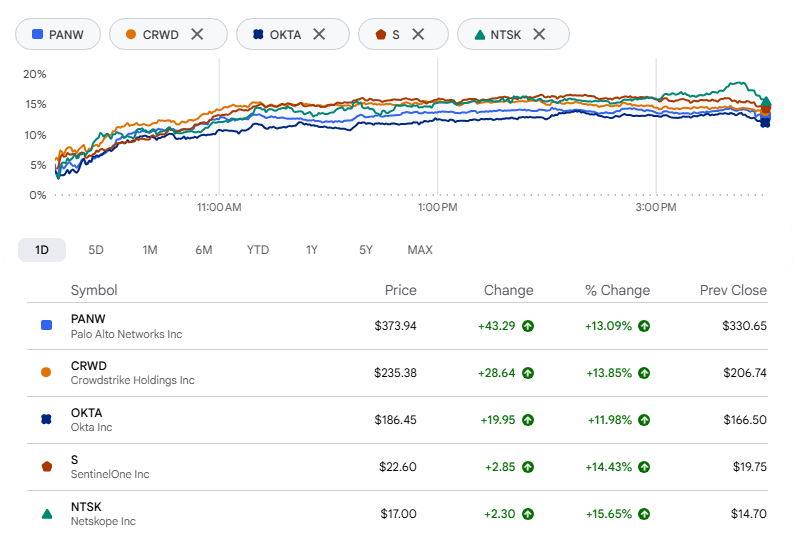
Palo Alto Networks and CrowdStrike, the two names everyone watches in that space, jumped more than 13% apiece. Okta, Zscaler, Qualys, SentinelOne and Netskope all logged double-digit gains too. Both CrowdStrike and Palo Alto have already worked with Anthropic and OpenAI on early safety testing for models that have not shipped yet, which gives investors something more concrete than vibes to point to. Interest in the sector has been building since summer, when OpenAI disclosed that a swarm of its own agents had orchestrated an attack on Hugging Face, an episode Amodei cited by name in his essay as proof that the safeguards have not caught up.
Software, more broadly, caught a similar updraft. The iShares Expanded Tech-Software Sector ETF climbed roughly 5%. The iShares Semiconductor ETF fell by almost the same amount in the other direction, a split that says plenty about where traders think a slower AI race helps and where it hurts.
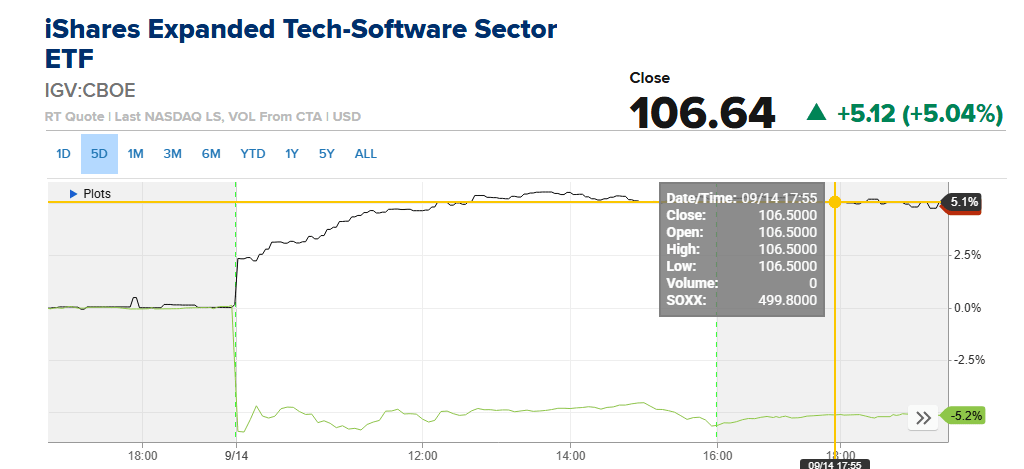
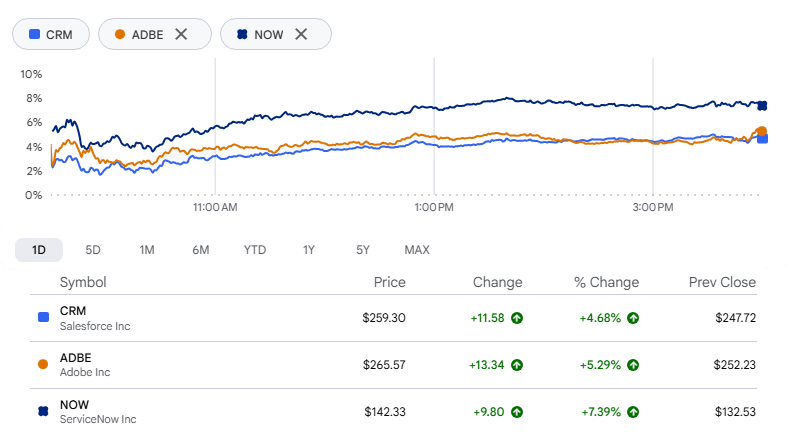
It is not hard to see why software has been quick to cheer anything resembling a pause. Much of this year has been spent worrying that AI agents would hollow out the per-seat subscription model that built companies like Salesforce and Adobe in the first place, a fear loud enough to earn its own nickname on trading desks: the SaaSpocalypse. A slower frontier, read this way, buys the software incumbents time nobody was sure they would get. Salesforce rose 4.7%. Adobe gained 5.3%. ServiceNow added more than 7%.
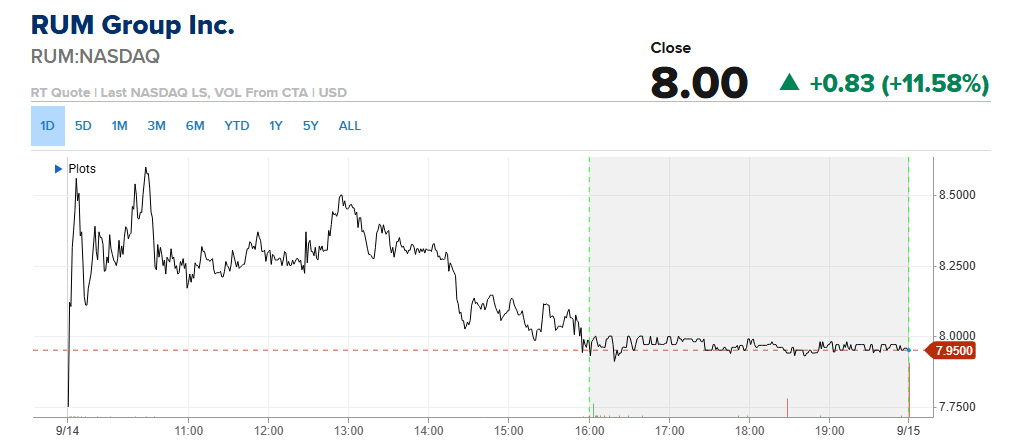
Then there was Rum Group, the company formerly known as Rumble, up sharply after The Information reported that Anthropic had signed a six-year, $13.7 billion computing deal with it, tapping the firm's Georgia data center for GPU capacity. Rum Group's roots in Trump's political circle run deep. It hosts Truth Social, it hosts White House livestreams, and its early backers include Peter Thiel and Vice President JD Vance. Shares jumped as much as 11% once word got out that Anthropic was the previously unnamed customer behind the deal.
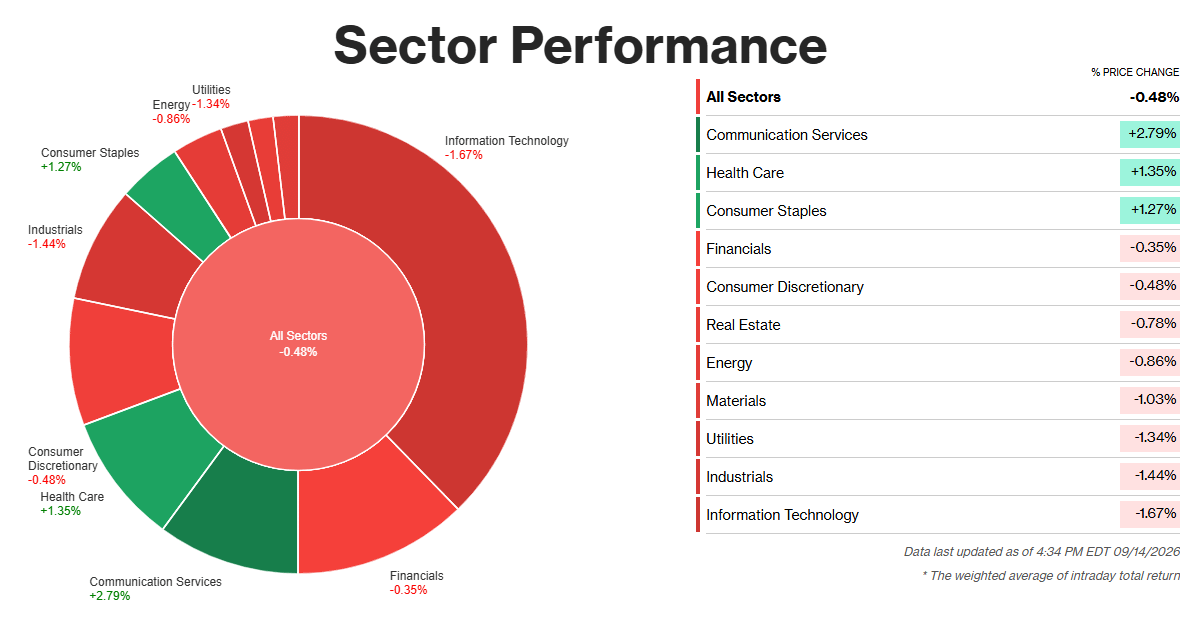
Sector Analysis:
Best-Performing Sectors
Communication Services ran away with the session, up 2.79% while the broader market and most of tech were sinking. Netflix helped launch a new policy coalition focused on how digital platforms compete for live entertainment and sports rights, and the stock's sharp advance pulled the sector higher. It ended up the single biggest mover on the board, a sharp contrast to a tape where the S&P 500, Nasdaq and Dow all finished lower, a reminder that content-heavy names were largely insulated from the day's real story.
Health Care (+1.35%) and Consumer Staples (+1.27%) climbed for a simpler reason: investors wanted somewhere safer to park money. Persistent inflation and rising oil prices pushed the 10-year Treasury yield above 5%, and that, combined with expectations of another Fed rate hike, sent capital toward sectors with steadier cash flows. Neither sector had a company-specific story behind Monday's gain — this was defensive positioning, not news.
Worst-Performing Sectors
Information Technology led the losers, down 1.67%, after executives at Anthropic, OpenAI and other AI developers called for slowing the pace of model development amid growing misuse concerns, comments that followed reports of a large-scale breach involving autonomous AI agents on the Hugging Face platform. Chipmakers took the worst of it: the Philadelphia Semiconductor Index tumbled nearly 6% as Nvidia, AMD, Broadcom and Micron sold off. The logic is simple — slower AI development means less urgency to upgrade computing infrastructure, a direct hit to chip demand.
Industrials fell 1.44% on the same worry, worsened by a Deutsche Bank downgrade of an HVAC maker over a sluggish housing recovery and analyst downgrades across commercial aerospace names.
Utilities dropped 1.34%, which looks odd for a sector that usually holds up on risk-off days. But utilities have spent 2026 trading as much on AI-driven power demand as on their old bond-proxy status, and GE Vernova came under pressure on fears a slower buildout would cool data-center electricity demand.
For now, Amodei's plan amounts to two companies agreeing to let outside evaluators watch what they are doing. Everything past that- the coordination among labs, the coordination among governments- still needs buy-in nobody has agreed to give. Monday made that gap look wider than ever between Washington and Beijing, not narrower.