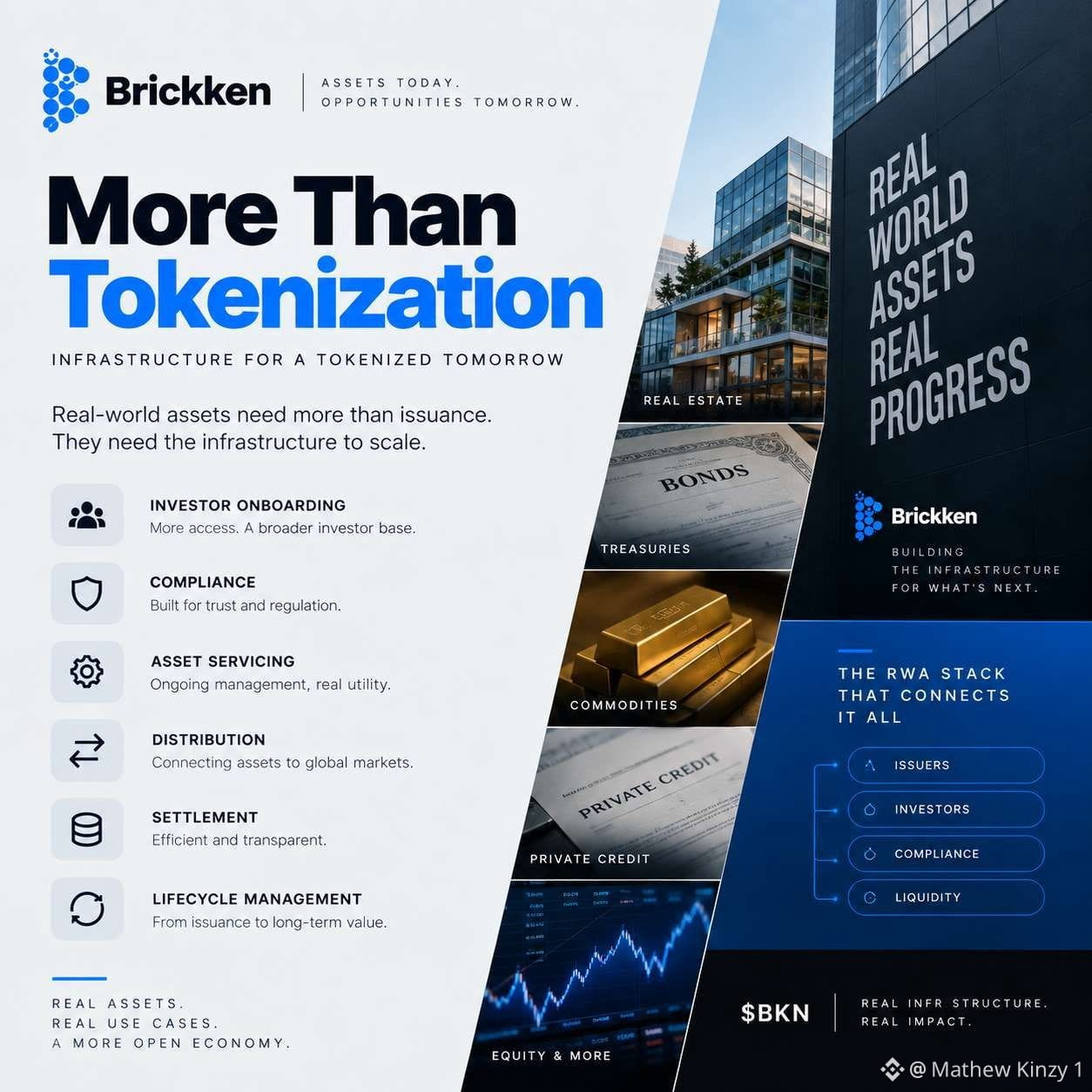
The RWA race may eventually become less about who tokenizes the most assets and more about who owns the infrastructure those assets depend on.
That distinction matters.
Putting an asset onchain is only one part of the process. Real adoption also requires investor onboarding, compliance, asset servicing, distribution, settlement and lifecycle management after issuance.
This is why I’m paying closer attention to infrastructure-focused projects such as Brickken and $BKN
The interesting question for me isn't simply how many assets can be tokenized. It's whether platforms can build systems institutions are comfortable using repeatedly as tokenized markets scale.
If RWAs eventually become a trillion-dollar onchain sector, the biggest winners might not necessarily be the individual tokenized assets.
They could be the infrastructure layers quietly connecting issuers, investors, compliance and liquidity.
Which part of the RWA stack do you think captures the most value long term: issuance, infrastructure, distribution or liquidity?
#RWA #Tokenization #Macro Insights#
That distinction matters.
Putting an asset onchain is only one part of the process. Real adoption also requires investor onboarding, compliance, asset servicing, distribution, settlement and lifecycle management after issuance.
This is why I’m paying closer attention to infrastructure-focused projects such as Brickken and $BKN
The interesting question for me isn't simply how many assets can be tokenized. It's whether platforms can build systems institutions are comfortable using repeatedly as tokenized markets scale.
If RWAs eventually become a trillion-dollar onchain sector, the biggest winners might not necessarily be the individual tokenized assets.
They could be the infrastructure layers quietly connecting issuers, investors, compliance and liquidity.
Which part of the RWA stack do you think captures the most value long term: issuance, infrastructure, distribution or liquidity?
#RWA #Tokenization #Macro Insights#