
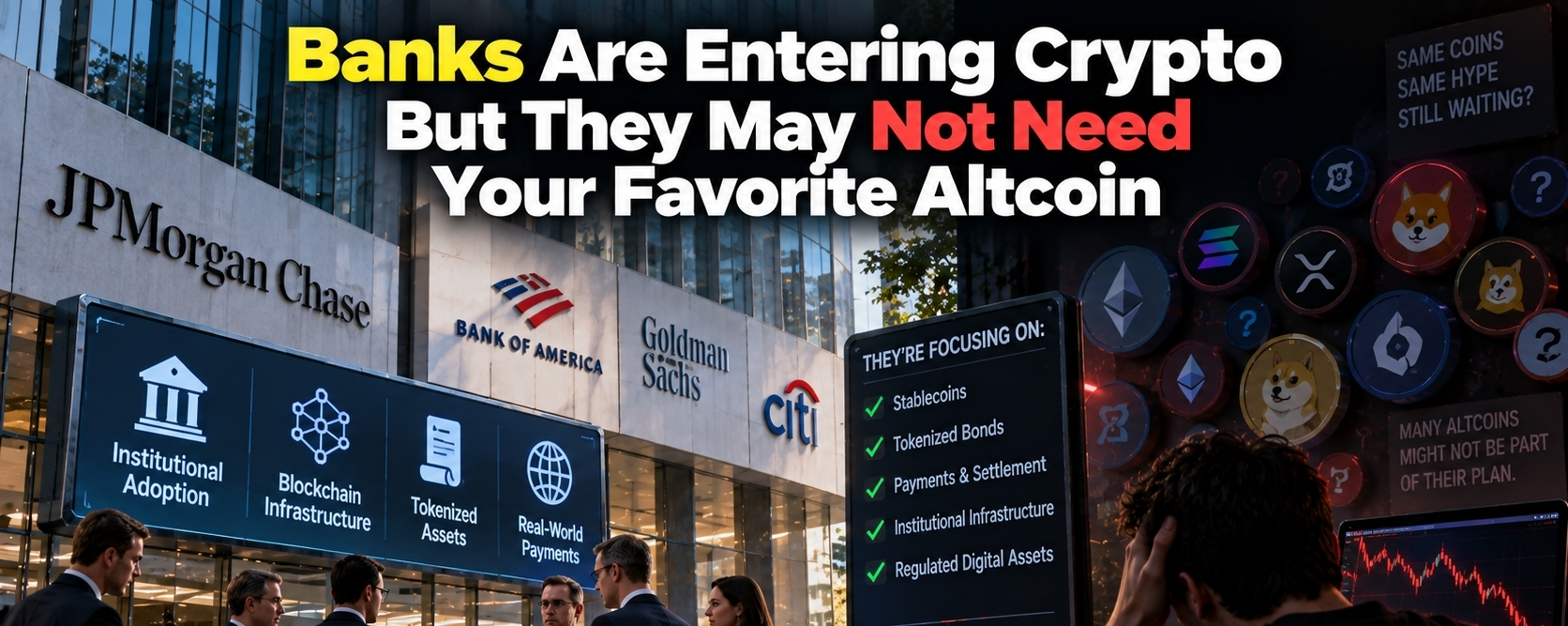


For years, crypto investors waited for banks to enter the industry.
Now traditional finance is moving closer to blockchain through digital-asset custody, stablecoins, tokenization, settlement infrastructure and institutional crypto products.
At first glance, this sounds extremely bullish for the entire crypto market.
But there is an uncomfortable question worth asking:
What if banks adopt blockchain technology without needing most existing altcoins?
Blockchain adoption and token adoption are not always the same thing.
Banks Don't Necessarily Need Thousands of Tokens
The crypto market contains thousands of different tokens.
Each project has its own narrative, ecosystem and community. Many investors assume that wider blockchain adoption will eventually increase the value of these assets.
But banks aren't entering crypto because they want exposure to every token.
They are interested in specific problems blockchain technology might solve.
That could include faster settlement, tokenized assets, cross-border payments, digital custody and programmable financial infrastructure.
If a bank can use those technologies without buying a particular altcoin, increased adoption may not automatically create demand for that token.
Blockchain and Crypto Tokens Are Different
This distinction is extremely important.
A blockchain is infrastructure.
A token is an asset operating within or connected to that infrastructure.
Sometimes the token is essential to how the network works. It might be needed to pay transaction fees, secure the network or participate in governance.
But in other cases, institutions may interact with blockchain-based systems while having very little reason to hold the associated speculative assets.
So when someone says, “Banks are adopting blockchain,” the next question should be:
Which blockchain, and what assets do they actually need to use it?
Tokenization Could Be Huge
One area attracting significant attention is tokenization.
Traditional assets such as stocks, bonds, funds and real estate interests can potentially be represented digitally on blockchain-based infrastructure.
This could make certain financial processes faster, more programmable and potentially available across wider trading windows.
Imagine financial assets moving between investors using blockchain rails instead of relying entirely on older settlement systems.
That could be a major technological shift.
But it doesn't automatically mean every crypto token benefits.
The tokenized asset itself may be the product investors want.
Stablecoins May Be More Useful to Banks
Stablecoins are another important part of the story.
Unlike highly volatile cryptocurrencies, stablecoins are designed to maintain a relatively stable value, often linked to currencies such as the U.S. dollar.
That makes them potentially useful for payments, settlement and moving value across blockchain networks.
For financial institutions, predictable value can be more practical than holding a token capable of moving 20% in a short period.
This creates an interesting possibility.
Some of the biggest winners from financial blockchain adoption might not be speculative altcoins at all.
They could be stablecoin infrastructure, settlement networks, custody providers and tokenization platforms.
Bitcoin Is a Different Conversation
Bitcoin occupies a somewhat different position.
Institutions can view Bitcoin as an investable digital asset rather than simply infrastructure required to operate a financial application.
That creates direct investment demand.
An institution buying Bitcoin exposure is fundamentally different from a bank experimenting with blockchain settlement technology.
In one case, capital is directly seeking exposure to the asset.
In the other, the institution may only care about the underlying technology.
Traders should understand that difference.
Ethereum Raises an Interesting Question
Smart-contract networks create a more complicated situation.
If financial institutions build applications or settle transactions on a public blockchain, the network's native asset may play an important role in paying fees and securing the system.
Greater network activity can therefore increase usage of the underlying infrastructure.
But even then, investors need to ask whether growing usage translates into enough economic demand for the token to justify its valuation.
Network adoption and token value can be connected without moving perfectly together.
Private Blockchains Could Compete
Banks also have another option.
They don't necessarily need to use fully public blockchain networks.
Financial institutions can develop or participate in permissioned systems where access is controlled.
These networks may use blockchain-inspired technology while operating very differently from open crypto ecosystems.
If a bank can receive the efficiency benefits it wants through a private or permissioned network, it may have little reason to interact with thousands of public tokens.
This is one reason “blockchain adoption” shouldn't automatically be interpreted as “altcoin adoption.”
A Project Can Succeed While Its Token Struggles
This sounds strange, but it's possible.
Imagine a blockchain application gains millions of users.
Transactions increase.
Companies integrate its technology.
The product becomes successful.
But suppose the token isn't required for most activities, or its supply grows faster than demand.
The technology could succeed while the token performs poorly.
Investors therefore need to understand exactly how value flows through a crypto ecosystem.
A useful product doesn't automatically create a valuable token.
Ask Where the Value Goes
This may become one of the most important questions in crypto investing.
When a blockchain network grows, who captures the economic value?
Does the native token benefit?
Do validators benefit?
Do application developers capture the revenue?
Do stablecoin issuers benefit?
Do traditional financial institutions capture most of the value?
Or does the end user simply receive cheaper and faster financial services?
Adoption matters, but value capture matters too.
Wall Street Could Use Crypto Differently
Crypto-native traders often think about blockchain through tokens.
Traditional finance may think about it through infrastructure.
Banks don't necessarily need another speculative asset.
They may want faster settlement.
They may want programmable payments.
They may want assets that can move more efficiently between financial institutions.
They may want better digital custody infrastructure.
Blockchain could provide some of those capabilities without requiring institutions to become altcoin traders.
This Doesn't Mean Altcoins Have No Future
None of this means altcoins are useless.
Some networks could become important infrastructure for decentralized finance, payments, gaming, tokenization, data, identity or entirely new applications.
Native tokens can also play essential roles in securing decentralized networks.
The point is simply that investors should avoid assuming institutional blockchain adoption automatically benefits every crypto asset.
The connection needs to be demonstrated.
The Question Every Investor Should Ask
When a project announces a partnership with a bank or financial institution, traders often react immediately.
But instead of stopping at the headline, ask deeper questions.
Is the institution actually using the public network?
Does using the product require the token?
Will increased activity create meaningful token demand?
Is the institution buying the asset or simply using technology built around it?
Those questions can completely change how important an announcement really is.
The Bigger Shift
Crypto spent years trying to convince traditional finance that blockchain mattered.
Now traditional finance is increasingly exploring the technology.
But Wall Street may not adopt crypto exactly the way crypto investors imagined.
Banks could take the parts they find useful tokenization, settlement, stablecoins, custody and programmable infrastructure while ignoring many speculative tokens entirely.
That wouldn't necessarily mean crypto failed.
It could mean the technology succeeded in a different way.
Final Thoughts
“Banks are entering crypto” sounds like one giant bullish headline.
Reality is more complicated.
Institutional adoption can be extremely important for the industry while benefiting different parts of the market very differently.
Bitcoin could attract investment demand.
Stablecoins could power payments.
Certain blockchains could provide settlement infrastructure.
Tokenized assets could bring traditional markets on-chain.
And thousands of other tokens might receive little benefit at all.
So the next time you hear that a major bank is adopting blockchain, don't immediately ask:
“Which altcoin will pump?”
Ask the more important question:
“What exactly does the bank need the token for?”
That distinction could become increasingly important as crypto and traditional finance move closer together.