

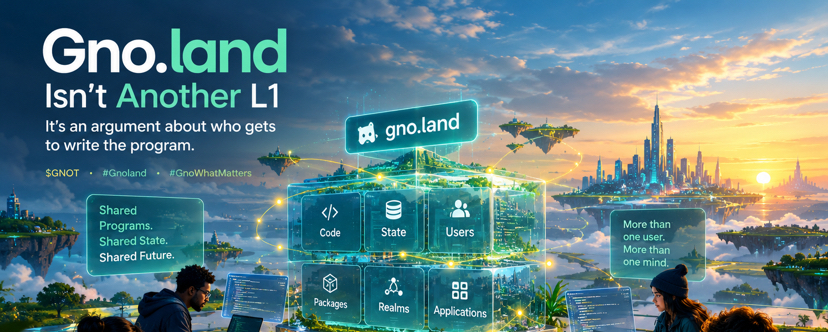

Gno.land Is Not Another L1. It Is an Argument About Who Gets to Write the Program.
“Gno is the first general purpose multi user programming language.”
That sentence sounds almost understated.
It is not.
Most blockchain infrastructure was designed around a surprisingly narrow mental model: a developer writes a program, deploys it, and other people interact with it.
The “other people” are treated as users of the application.
Gno.land starts somewhere more radical:
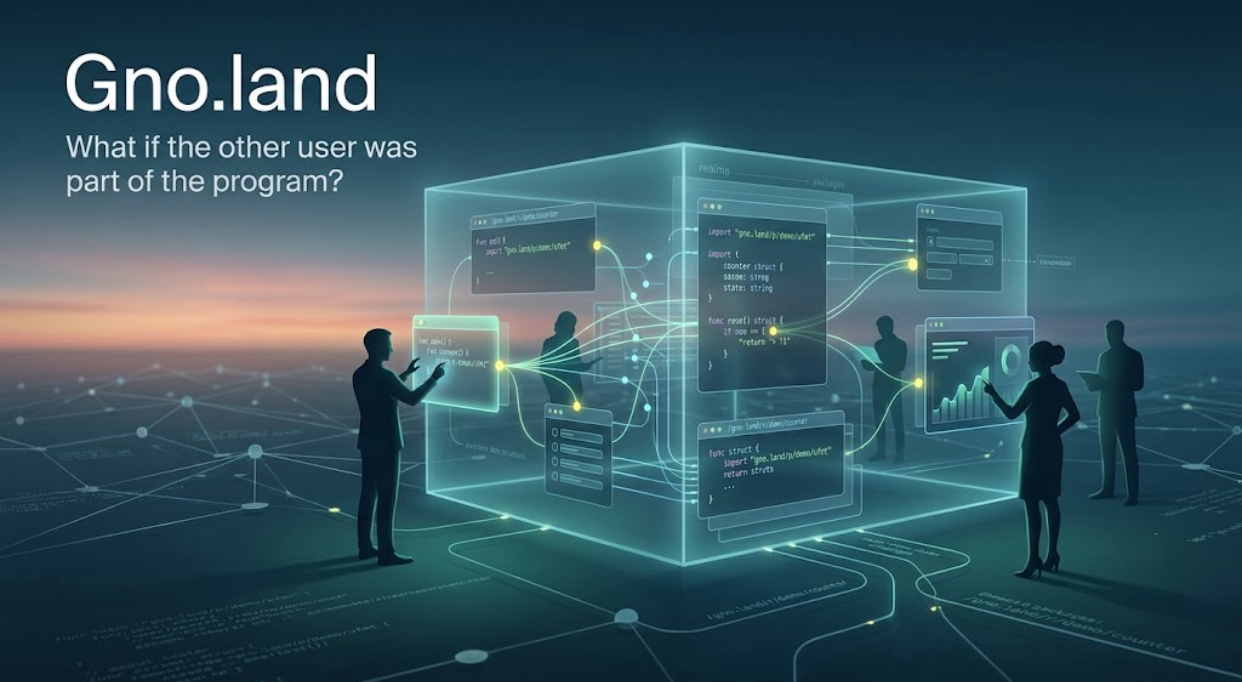
What if other people are not merely users of the program, but part of the programming model itself?
That is the question underneath Gno, the GnoVM, Gno.land, and ultimately $GNOT.
And it is why reducing Gno.land to “Go on a blockchain” misses the point entirely.
The blockchain industry has spent years solving the wrong abstraction
Smart contract platforms have become extraordinarily good at making decentralized computation possible.
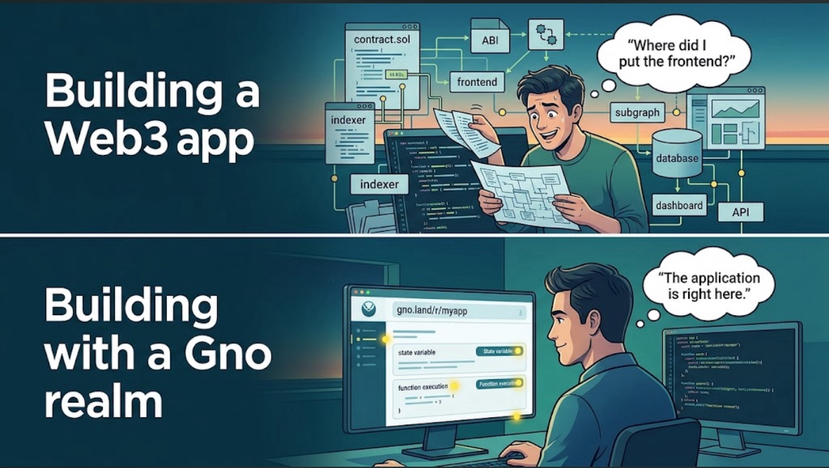
But the developer experience remains fragmented.
Code lives in one place.
State is represented somewhere else.
Interfaces are generated through ABIs.
Frontends sit outside the protocol.
Indexers reconstruct information after execution.
Developers manually reason about storage.
Auditors inspect contracts and integrations separately.
Then, when two contracts need to cooperate, the system relies on interfaces, conventions, governance assumptions and increasingly elaborate security practices.
The industry has normalized this architecture.
Gno challenges the premise.
Its proposition is deceptively simple:
If multiple people are going to interact with persistent software, then multi user interaction should be visible at the language and runtime level.
That changes the question from:
“How do we put existing applications on a blockchain?”
to:
“What should a programming environment look like when its programs are persistent, public and simultaneously used by strangers?”
That is a much more interesting problem.
Gno is not “Go on a blockchain”
Gno is an interpreted, deterministic variation of Go designed for smart contracts. It deliberately does not reproduce all of Go; the blockchain environment requires restrictions that make execution predictable and safe.
The important innovation is therefore not the syntax.
It is the execution model.
A Gno application is organized into packages that live at explicit paths.
There are three fundamental categories:
• /p/ — pure packages that are stateless and reusable
• /r/ — realms that maintain persistent state
• /e/ — ephemeral packages used for temporary execution
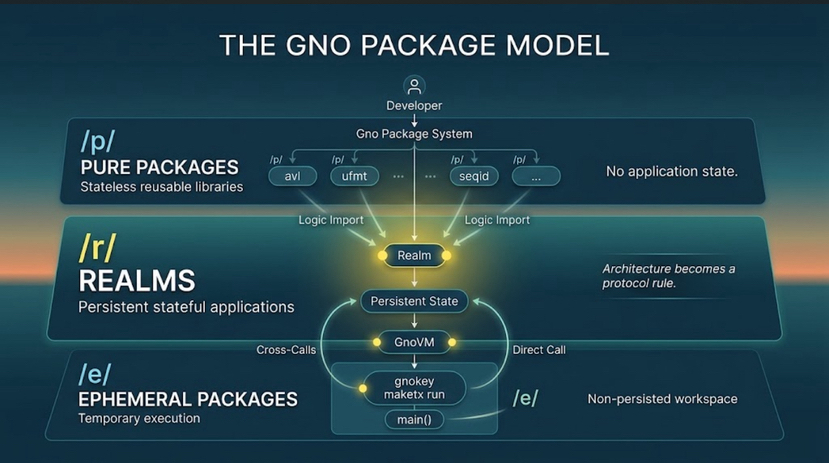
The distinction matters because it turns software architecture into a protocol rule.
Consider the difference.
A pure package cannot secretly accumulate state.
A realm explicitly owns persistent state.
An ephemeral package exists only for execution and is not stored on chain.
This is not merely naming.
It is architecture expressed through the package system.
And that is where Gno begins to become genuinely interesting.
The realm is the real primitive
A Gno realm is a stateful package identified by its package path and corresponding address.
Its state can persist between transactions.
Developers can use ordinary top-level variables, and Gno automatically persists the resulting state after execution. The developer does not have to manually reconstruct the equivalent of a storage layer for every data structure.
That sounds like a small developer experience improvement.
It is more consequential than that.
Imagine writing:
var count int
func Increment(_ realm) int {
count++
return count
}
The variable is not simply a local variable inside a conventional application.
It becomes part of the realm’s persistent state.
The code and the state are therefore much closer together.
And then Gno adds another unusual primitive:
Render().
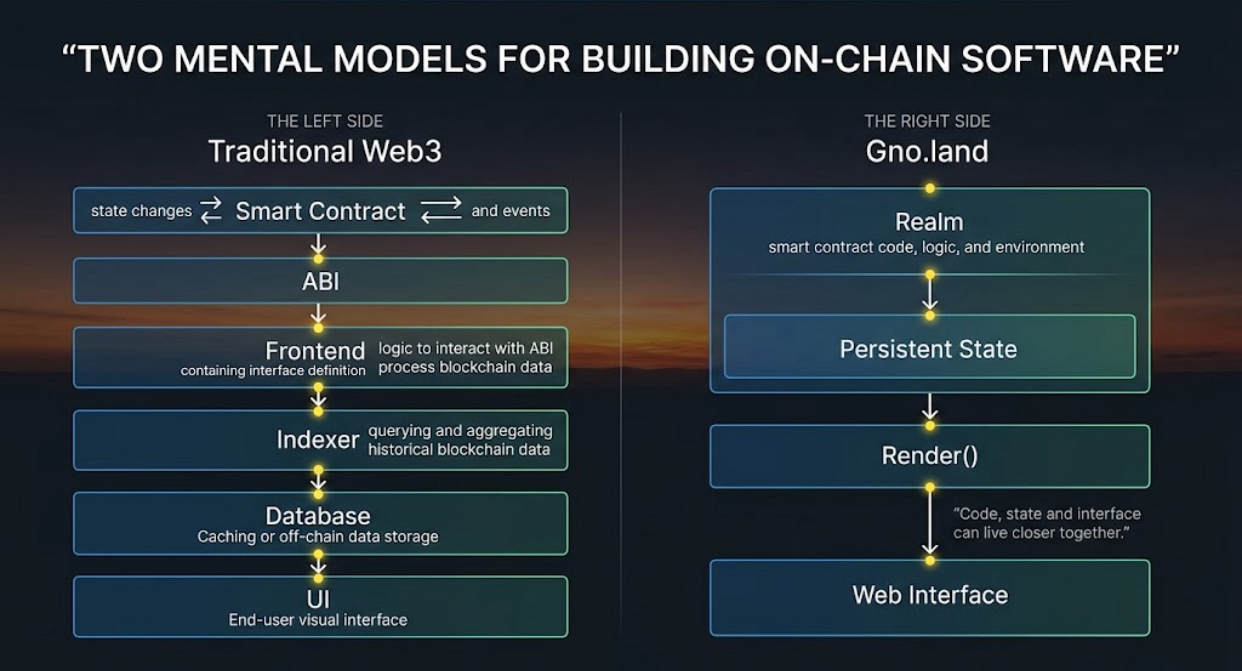
A realm can expose a rendering function that returns Markdown, which gnoweb can use to render the realm as a web page. The same realm can therefore contain application logic, persistent state and a machine readable presentation layer.
That creates a remarkably different development loop.
Instead of:
contract → ABI → frontend → indexer → database → UI
you can have something much closer to:
realm → state → Render() → page
You can still build sophisticated external frontends.
But you do not have to build an entire frontend stack before the underlying idea can exist.
That is a subtle distinction with enormous implications.
The most important word in Gno may be “crossing”
The deeper architectural idea is interrealm programming.
One realm can interact with another, but the boundary is not supposed to disappear.
Gno’s interrealm specification makes crossing explicit through language level rules and parameters.
Why does that matter?
Because composability creates a security problem.
Suppose two mutable programs interact.
Program A depends on Program B.
Program B can later change its behavior.
Now A’s assumptions can become invalid.
This is where immutable pure packages become interesting.
A /p/ package is stateless and cannot be modified after creation. It can therefore act as a stable shared dependency between stateful realms.
That gives Gno a compelling architectural thesis:
“Trust between programs should be encoded in the structure of the software, not reconstructed after deployment.”
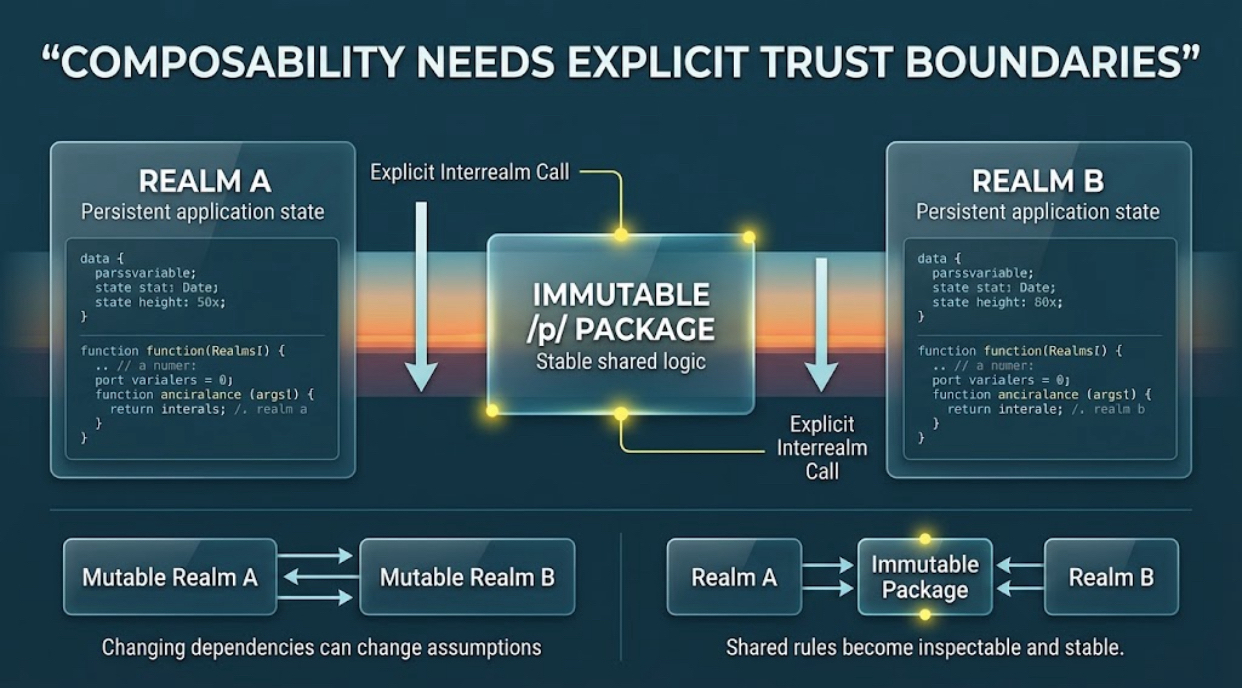
That may ultimately be more important than whether Gno can produce another impressive throughput benchmark.
Gno is building something closer to a public software commons
This is where the “GitHub of Web3” analogy becomes useful, but only if we understand what it actually means.
Gno.land organizes code around package paths.
You can browse those packages.
You can inspect their source.
You can reuse pure packages.
You can interact with realms.
And gnoweb provides a unified interface for exploring both applications and their underlying code.
The result is a blockchain environment where software is not necessarily presented as an opaque contract address behind a separate website.
The path itself becomes part of the application.
That opens an interesting design space.
A forum can be a realm.
A knowledge base can be a realm.
A governance application can be a realm.
A community registry can be a realm.
A documentation system can be a realm.
And the rules governing these systems can themselves be public, inspectable code.
Gno’s own Boards application illustrates this direction: an on chain forum where posts, discussions, permissions and moderation logic can live within the Gno ecosystem.
This is why Gno’s early applications should not be dismissed simply because they do not resemble the latest DeFi casino.
They reveal what the machine is optimized to make possible.
The overlooked category: readable blockchains
Crypto has spent years optimizing for machines.
Execution.
Settlement.
Throughput.
Finality.
Availability.
But there is another dimension of decentralization that receives far less attention:
readability.
Can a normal developer understand what a system does?
Can another developer reuse its logic?
Can users inspect the relationship between code, state and interface?
Can communities build applications where the rules are visible instead of hidden behind layers of infrastructure?
Gno.land is effectively betting that the answer should be yes.
Its design philosophy emphasizes transparent and auditable code, with realms functioning as publicly inspectable software rather than opaque binaries attached to websites.
That creates a different kind of blockchain primitive.
Not simply a computer.
A public computer whose programs remain part of the public record.
And then there is $GNOT
This is where the token thesis needs to be handled carefully.
$GNOT is not interesting merely because it is the asset associated with another L1.
Its utility is tied to the underlying resource model.
According to Gno.land’s current token documentation, GNOT is used for transaction fees, smart contract execution, storage deposits and IBC/ICS interactions. Storage deposits are particularly important because persistent data creates an ongoing resource requirement.
That makes the token economically connected to the thing Gno is trying to make abundant:
persistent public computation.
If applications store state, storage has a cost.
If users execute transactions, computation has a cost.
If applications communicate across networks, interoperability has a cost.
The token therefore sits beneath the resource economy of the system.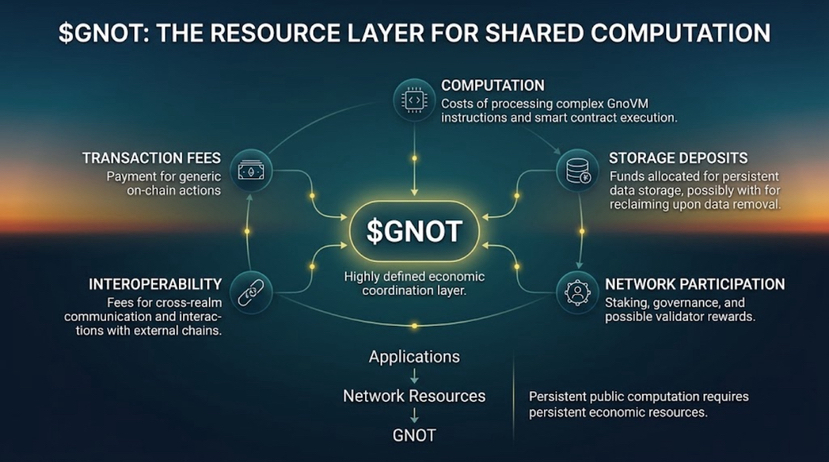
The stronger thesis is not:
“GNOT will go up because Gno is innovative.”
It is:
If Gno’s model of persistent, composable, publicly readable software gains adoption, GNOT becomes the economic layer through which that shared computational environment is paid for.
That is a much more defensible argument.
The timing matters
Gno is no longer merely an experimental idea waiting for a hypothetical future.
Gno.land announced its Beta Mainnet launch in March 2026. Its current network documentation identifies Betanet (gnoland1) as the production network, while Pearl/Test16 became the latest testnet in August 2026.
The GNOT public sale also took place in July 2026, with 38.76 million GNOT allocated through a uniform-price auction. The project’s published token distribution puts total supply at 1.333 billion GNOT.
That changes the conversation.
The question is no longer:
“Could this architecture work?”
The more serious questions are:
Can developers build applications that actually benefit from it?
Can the package and realm model create meaningful composability?
Can readable on chain software become a genuine product advantage?
Can Gno attract developers beyond the Go community?
And, most importantly:
Does the architecture produce applications people actually want to use?
Technology becomes infrastructure only when developers stop talking about the architecture and start building on top of it.
The biggest risk is also obvious
A serious analysis should not turn this into a victory lap.
Gno’s architecture is unconventional.
That is an advantage only if developers understand it.
Go familiarity lowers the barrier, but Gno is not full Go. The deterministic blockchain environment requires restrictions, and interrealm programming introduces concepts developers must learn.
There is also a much larger competitive problem.
Etherium, Solana, Cosmos and other ecosystems already have enormous developer communities, liquidity, tooling and application networks.
Gno is not competing merely against virtual machines.
It is competing against ecosystems.
And ecosystems have network effects.
A technically elegant architecture can lose to an inferior architecture with more developers, more liquidity and more users.
That is the uncomfortable part of the thesis.
Gno does not need to prove that every other chain is poorly designed.
It needs to prove that its design unlocks applications that are materially better because the architecture exists.
That is the real test.
The bet behind Gno.land
The most interesting thing about Gno is therefore not speed.
It is not the fact that it uses Go.
It is not another TPS comparison.
It is a philosophical decision about software.
Traditional applications assume that programs belong to their developers.
Blockchains assume that programs can belong to everyone.
Gno goes one step further:
What if the programming language itself acknowledged that reality?
What if persistent state were natural?
What if code could be inspected where the application lives?
What if reusable immutable logic were a first class primitive?
What if crossing between stateful programs were visible in source?
What if the interface could emerge from the same stateful object that the network executes?
That is the experiment.
And it is much bigger than “Go on a blockchain.”
“The interesting blockchain is not necessarily the one that computes faster. It may be the one that makes shared computation easier to understand.”
Final thought
Crypto has spent the last decade teaching machines how to trust strangers.
The next decade may be about teaching software how to expect strangers.
That distinction matters.
A decentralized application is not merely a program that nobody controls.
It is a program designed to survive interaction with people its author does not know.
Gno.land takes that fact seriously enough to put it inside the programming model.
If the experiment works, the most important thing Gno contributes may not be another execution environment.
It may be a different mental model for building public software.
Not:
“Here is my contract. Please interact with it.”
But:
“Here is the program. Here is its state. Here are its rules. Here is the path. Read it. Reuse it. Call it. Build alongside it.”
That is a much more ambitious proposition.
And perhaps that is what Gno What Matters actually means.
**The future of on chain software may not belong to the chain that hides the complexity best.
It may belong to the environment that makes shared complexity easiest to see.**
#Gnoland #GnoWhatMatters #GNOT
@_gnoland
Author: Muhammad Mustapha Yamusa