
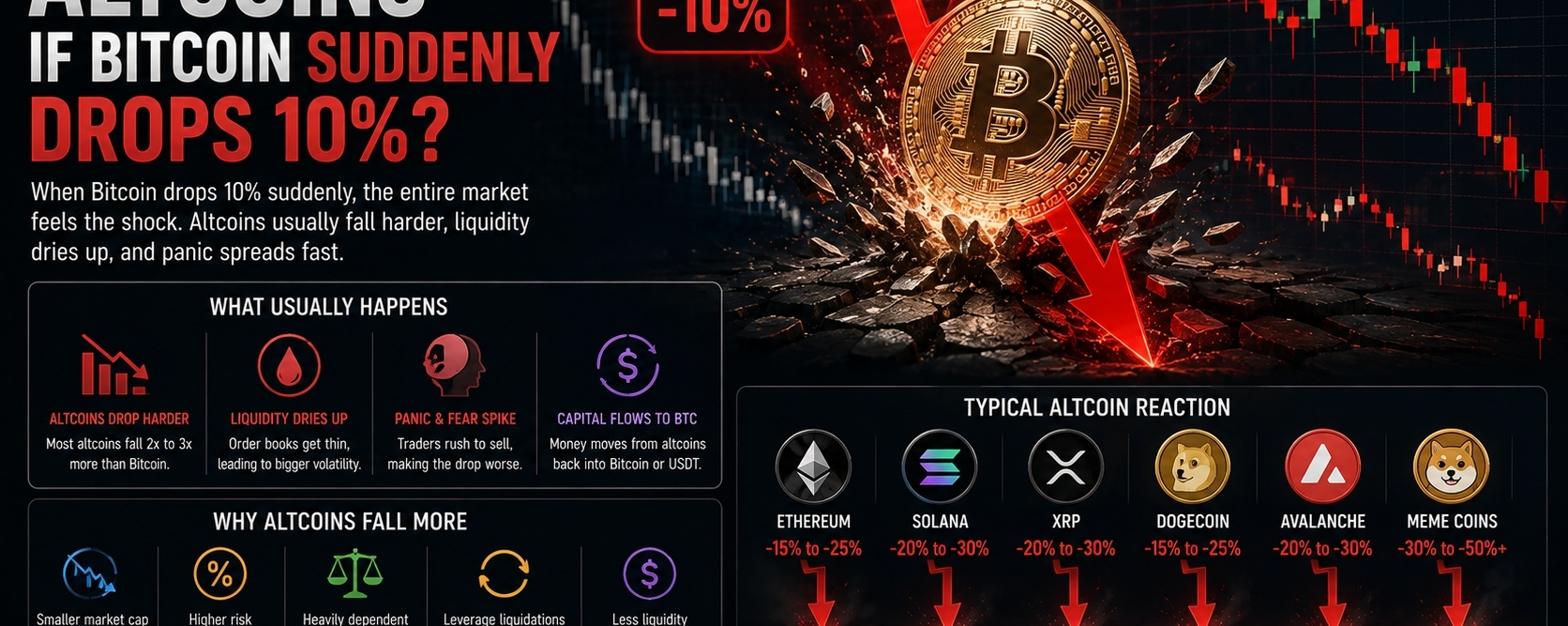


Bitcoin drops 10% in a few hours.
For BTC holders, that is already a serious move. But for altcoin traders, the damage can be much bigger.
A 10% Bitcoin decline doesn't mean every altcoin will fall exactly 10%. Some may lose 15%, 20% or even more as traders rush toward safety and leveraged positions start getting liquidated.
So why are altcoins often hit harder?
Bitcoin Still Leads the Market
Bitcoin remains the main reference point for the broader crypto market.
When $BTC is stable or trending higher, traders are generally more comfortable taking additional risk in altcoins. But when Bitcoin suddenly falls, sentiment can change almost instantly.
Instead of searching for the next altcoin pump, traders start protecting capital.
That shift in risk appetite can create additional selling pressure across the market.
Altcoins Usually Carry More Risk
Many altcoins have smaller market capitalizations and less liquidity than Bitcoin.
That means it can take less selling pressure to move their prices significantly.
If buyers disappear during a Bitcoin correction, an altcoin can move through support levels quickly because there may not be enough demand to absorb aggressive selling.
This is one reason a 10% BTC decline can turn into a much larger percentage move elsewhere.
Leverage Can Accelerate the Drop
The initial decline is only part of the story.
During bullish periods, traders often build leveraged long positions across Bitcoin and altcoins. If prices suddenly fall, some of those positions begin hitting liquidation levels.
Forced selling can then push prices even lower, triggering another group of liquidations.
This chain reaction can turn an ordinary correction into a violent short-term move.
Bitcoin Dominance Becomes Important
Bitcoin dominance measures Bitcoin's share of the total crypto market.
If Bitcoin falls while altcoins fall even faster, BTC dominance can rise because altcoins are losing relatively more value.
This is an important environment for altcoin traders to recognize.
A falling Bitcoin price combined with rising BTC dominance can be particularly difficult for weaker altcoins.
Not Every Altcoin Will React the Same
Some coins can show relative strength.
A token with a major catalyst, strong demand or unusual trading activity might hold up better than the rest of the market.
Large-cap altcoins may also behave differently from smaller speculative tokens.
However, relative strength doesn't mean immunity. During a severe market-wide sell-off, correlations across crypto can increase quickly.
The Recovery Matters Too
What happens after Bitcoin's 10% drop can tell traders a lot.
If BTC quickly finds buyers, reclaims important levels and stabilizes, stronger altcoins may recover rapidly.
Sometimes they can even outperform Bitcoin during the rebound.
But if BTC produces only weak bounces before making new lows, altcoin traders may remain cautious and selling pressure can continue.
Should You Automatically Buy the Altcoin Dip?
A 20% discount can look attractive.
But a lower price alone doesn't make something a good entry.
Before buying, it can be more useful to watch whether Bitcoin has stabilized, whether the altcoin is defending support, whether volume is returning and whether the broader market structure is improving.
Trying to catch a falling market simply because something looks “cheap” can become expensive.
Bitcoin Is the Chart Altcoin Traders Can't Ignore
You might trade SOL, XRP, DOGE or a small-cap token, but Bitcoin's behavior still matters.
A strong altcoin setup can fail quickly if BTC suddenly breaks major support.
That's why experienced traders often keep Bitcoin open on another chart even when they aren't trading it directly.
Final Thought
If Bitcoin suddenly drops 10%, don't assume altcoins will simply follow with another 10% decline.
The combination of thinner liquidity, higher speculation, leverage and changing risk appetite can make altcoin moves much more aggressive.
Some will recover. Some will show impressive relative strength. Others may struggle long after Bitcoin stabilizes.
When Bitcoin sneezes, altcoins don't always catch a cold sometimes they catch the whole storm.