
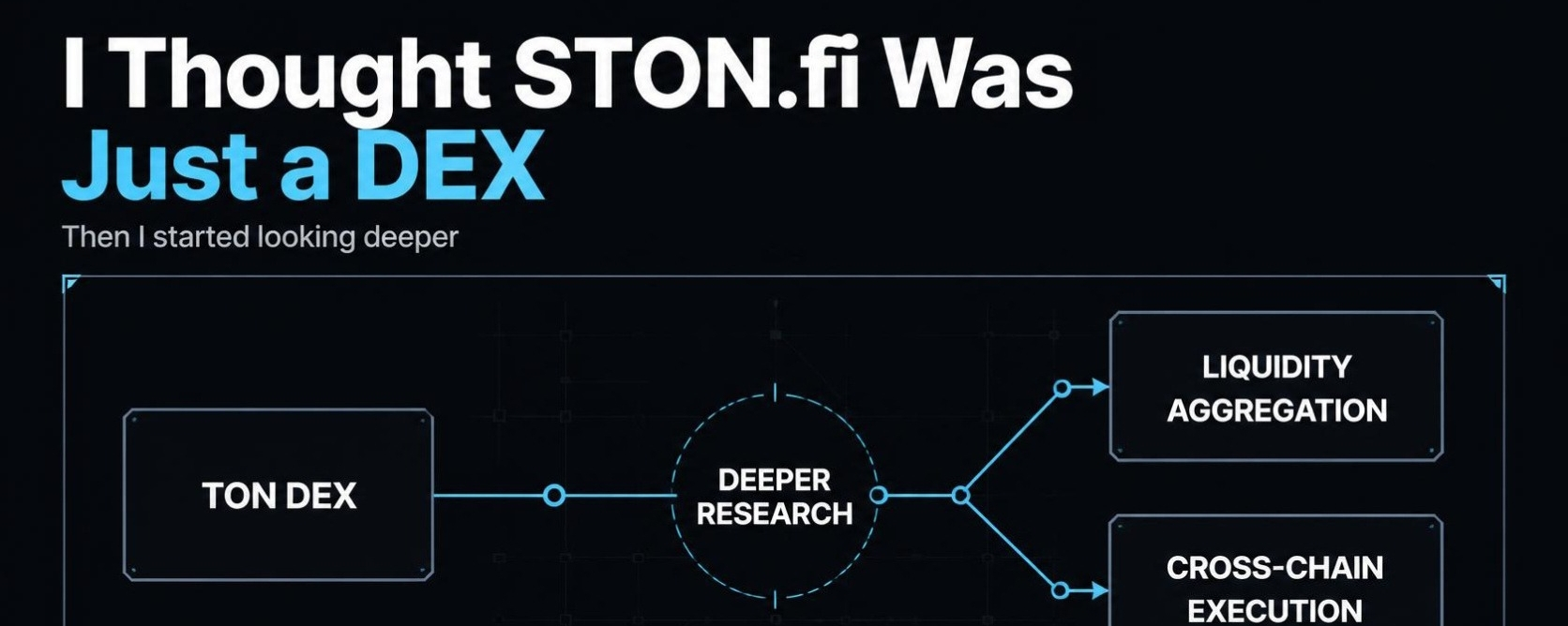

All this while, I never really paid attention to STON.fi.
A friend recently introduced me to it, so I decided to stop and actually research what they are building.
And honestly, I discovered there is much more to STON.fi than I initially thought.
So, what is STON.fi?
At its core, STON.fi is a decentralized exchange and AMM-based liquidity protocol built around the TON ecosystem.
It allows users to swap assets while maintaining control of their own wallets rather than handing custody of their assets to a centralized exchange.
But that was only the beginning of my research.
Then I started looking at liquidity
A DEX needs liquidity.
Without sufficient liquidity, traders can experience greater price impact and slippage when executing swaps.
This made me realize that the real question isn't simply:
“Can I swap tokens?”
It's:
“How efficiently can liquidity be accessed and used?”
Then I discovered Omniston
This was probably the part that caught my attention the most.
STON.fi has been developing Omniston, a liquidity aggregation and cross-chain execution layer.
The idea is interesting:
Instead of treating liquidity as something that exists inside one isolated ecosystem, infrastructure can help connect users and applications with liquidity across different sources.
That takes the conversation beyond:
“STON.fi is a DEX.”
and toward:
“What can better liquidity infrastructure do for DeFi?”
The cross-chain problem
DeFi liquidity is fragmented.
Different blockchains have different assets, applications, liquidity pools and infrastructure.
For users, that can create unnecessary complexity.
STON.fi's current direction includes cross-chain swaps across TON, TRON and EVM-compatible networks, with Omniston playing a role in its broader cross-chain infrastructure.
What interests me isn't simply adding more chains.
It's the possibility of making the underlying complexity less visible to the user.
Then there is the STON ecosystem
My research also took me into:
• $STON
• GEMSTON
• ARKENSTON
• Staking
• Governance
• Liquidity provision
• Developer infrastructure
• Omniston
• Cross-chain execution
Each piece adds another layer to understanding the ecosystem.
And developers?
This is another area I'm looking into.
STON.fi provides developer infrastructure and APIs that can allow builders to interact with its DeFi ecosystem.
That opens questions around what developers can build on top of liquidity and execution infrastructure.
Wallets, trading interfaces, analytics tools and other DeFi applications are just some examples of where this kind of infrastructure can become useful.
What I'm NOT doing
I'm not here to tell anyone:
“Buy $STON.”
That's not the point of my research.
I'm interested in understanding the technology, the ecosystem, the opportunities and the risks.
I would rather understand a project properly before forming an opinion about it.
So this is just the beginning
I started by thinking:
“STON.fi is another DEX on TON.”
After digging deeper, I'm realizing that the story is considerably broader.
Now I want to understand the details.
How does STON.fi actually work?
How does Omniston work?
How does liquidity aggregation happen?
What role does $STON play?
How does governance work?
And what could this mean for the future of cross-chain DeFi?
I'm going to keep researching and share what I learn along the way. 👀