#centralbanksbuy289tonsgoldinq2
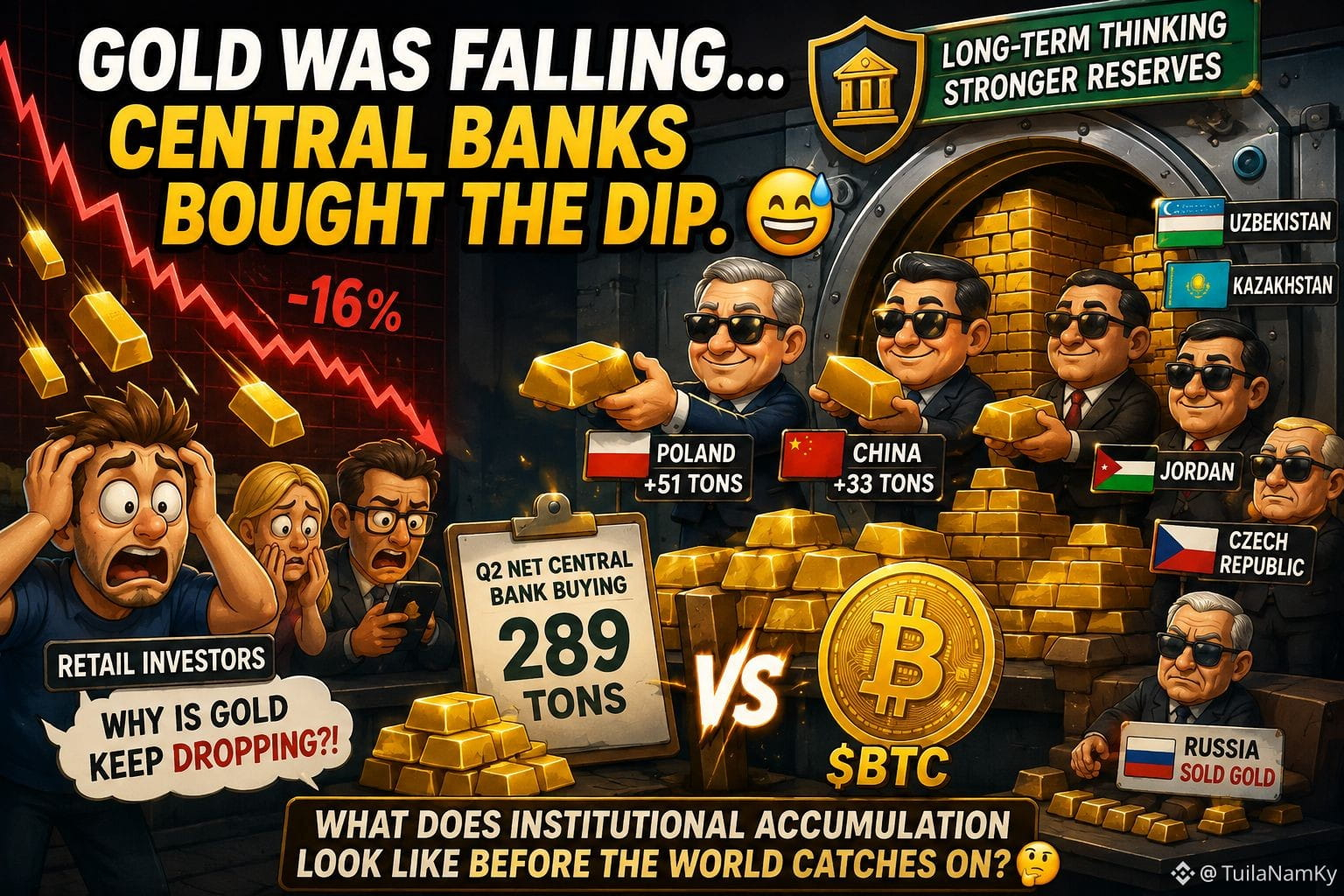
🏆 Gold was falling… and central banks bought the dip. 😅
While many investors were watching the price chart, central banks were watching something else.
📊 289 tons of gold.
That was the reported level of net central-bank buying in Q2.
And here's the interesting part:
Gold had fallen roughly 16% during the quarter — one of its sharpest quarterly declines in years.
Yet the buying continued.
🇵🇱 Poland reportedly added 51 tons.
🇨🇳 China added 33 tons.
Other buyers included Uzbekistan, Kazakhstan, Jordan, and the Czech Republic.
Meanwhile, Russia moved in the opposite direction, reportedly selling gold to support government finances.
So this wasn't simply a story of:
“Gold goes up → everyone buys.”
It was the opposite.
📉 Price weakness appeared alongside strong official-sector demand.
And that may be the more interesting signal.
Retail jewelry demand reportedly fell 17%, while central banks accumulated.
Different buyers.
Different time horizons.
Different reasons. 👀
The bigger macro story may not be tomorrow's gold price.
It may be what reserve managers are doing over the next several years.
A World Gold Council survey found that many reserve managers expect global gold holdings to increase, while a large share also expects lower USD allocations over time.
💡 Square Insight:
Central banks don't trade like crypto Twitter. 😅
They don't need a breakout candle to start buying.
Sometimes the real story appears when long-term buyers are accumulating while the chart looks weakest.
That also raises an interesting comparison for $BTC:
Gold is already being used as a reserve asset.
Bitcoin is often compared with digital gold.
But the question isn't which one wins.
The question is:
What does institutional accumulation look like before the market fully understands the trend? 👀
$BTC
#Gold #Macro #Bitcoin
🏆 Gold was falling… and central banks bought the dip. 😅
While many investors were watching the price chart, central banks were watching something else.
📊 289 tons of gold.
That was the reported level of net central-bank buying in Q2.
And here's the interesting part:
Gold had fallen roughly 16% during the quarter — one of its sharpest quarterly declines in years.
Yet the buying continued.
🇵🇱 Poland reportedly added 51 tons.
🇨🇳 China added 33 tons.
Other buyers included Uzbekistan, Kazakhstan, Jordan, and the Czech Republic.
Meanwhile, Russia moved in the opposite direction, reportedly selling gold to support government finances.
So this wasn't simply a story of:
“Gold goes up → everyone buys.”
It was the opposite.
📉 Price weakness appeared alongside strong official-sector demand.
And that may be the more interesting signal.
Retail jewelry demand reportedly fell 17%, while central banks accumulated.
Different buyers.
Different time horizons.
Different reasons. 👀
The bigger macro story may not be tomorrow's gold price.
It may be what reserve managers are doing over the next several years.
A World Gold Council survey found that many reserve managers expect global gold holdings to increase, while a large share also expects lower USD allocations over time.
💡 Square Insight:
Central banks don't trade like crypto Twitter. 😅
They don't need a breakout candle to start buying.
Sometimes the real story appears when long-term buyers are accumulating while the chart looks weakest.
That also raises an interesting comparison for $BTC:
Gold is already being used as a reserve asset.
Bitcoin is often compared with digital gold.
But the question isn't which one wins.
The question is:
What does institutional accumulation look like before the market fully understands the trend? 👀
$BTC
#Gold #Macro #Bitcoin