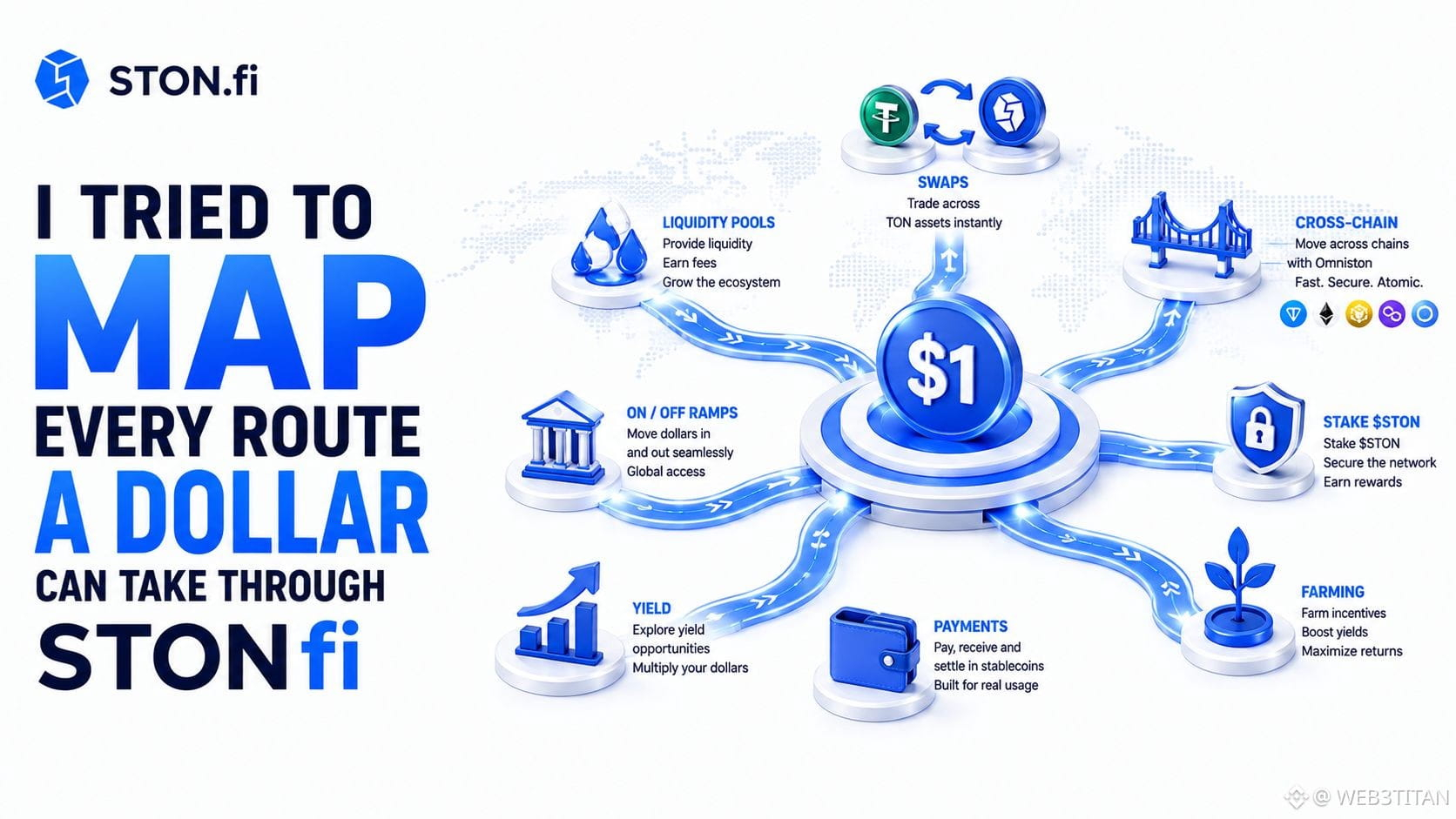
I TRIED TO MAP EVERY ROUTE A DOLLAR CAN TAKE THROUGH STONfi
I wanted to understand what actually happens when I swap a dollar through STONfi. The interesting part is that the same USDT can take different execution paths depending on the trade.
THE SIMPLE AMM ROUTE
The most familiar path is a direct AMM swap.
Your trade goes through a liquidity pool where traders swap against liquidity provided by other users.
THE MULTI-HOP ROUTE
Sometimes the best price isn't in one pool.
Instead of swapping directly, STONfi can route the trade through intermediate tokens to reach better liquidity and reduce price impact.
THE RESOLVER ROUTE
For cross-chain swaps, Omniston introduces resolvers.
Resolvers compete to execute the order by offering quotes, helping the protocol find a better execution path instead of relying on one liquidity source.
THE ESCROW AND SETTLEMENT PATH
Cross-chain swaps also need a safe settlement process.
Escrow style contracts and atomic execution help make sure the transfer follows the agreed conditions before funds are released.
ONE EXPERIENCE, MANY PATHS
What stood out to me is that users don't need to choose these routes manually.
STONfi and Omniston decide whether the swap should use an AMM pool, a multi-hop route, or resolver based execution.
MY TAKE
The biggest lesson for me is that a swap isn't always one transaction through one pool.
It's a routing system designed to find the best path, execute it safely, and deliver the final asset with as little friction as possible.
Explore - @STONfi DEX
$VET $SOL
I wanted to understand what actually happens when I swap a dollar through STONfi. The interesting part is that the same USDT can take different execution paths depending on the trade.
THE SIMPLE AMM ROUTE
The most familiar path is a direct AMM swap.
Your trade goes through a liquidity pool where traders swap against liquidity provided by other users.
THE MULTI-HOP ROUTE
Sometimes the best price isn't in one pool.
Instead of swapping directly, STONfi can route the trade through intermediate tokens to reach better liquidity and reduce price impact.
THE RESOLVER ROUTE
For cross-chain swaps, Omniston introduces resolvers.
Resolvers compete to execute the order by offering quotes, helping the protocol find a better execution path instead of relying on one liquidity source.
THE ESCROW AND SETTLEMENT PATH
Cross-chain swaps also need a safe settlement process.
Escrow style contracts and atomic execution help make sure the transfer follows the agreed conditions before funds are released.
ONE EXPERIENCE, MANY PATHS
What stood out to me is that users don't need to choose these routes manually.
STONfi and Omniston decide whether the swap should use an AMM pool, a multi-hop route, or resolver based execution.
MY TAKE
The biggest lesson for me is that a swap isn't always one transaction through one pool.
It's a routing system designed to find the best path, execute it safely, and deliver the final asset with as little friction as possible.
Explore - @STONfi DEX
$VET $SOL