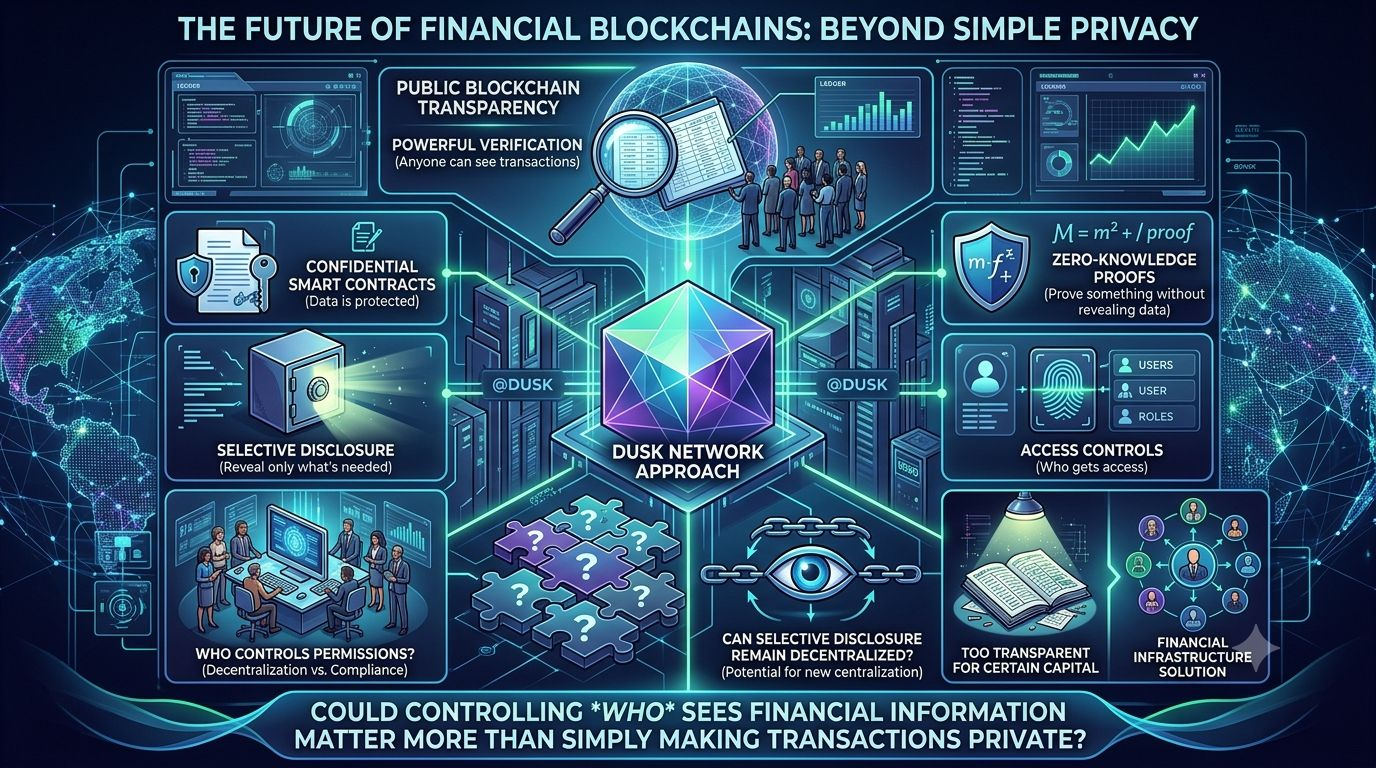
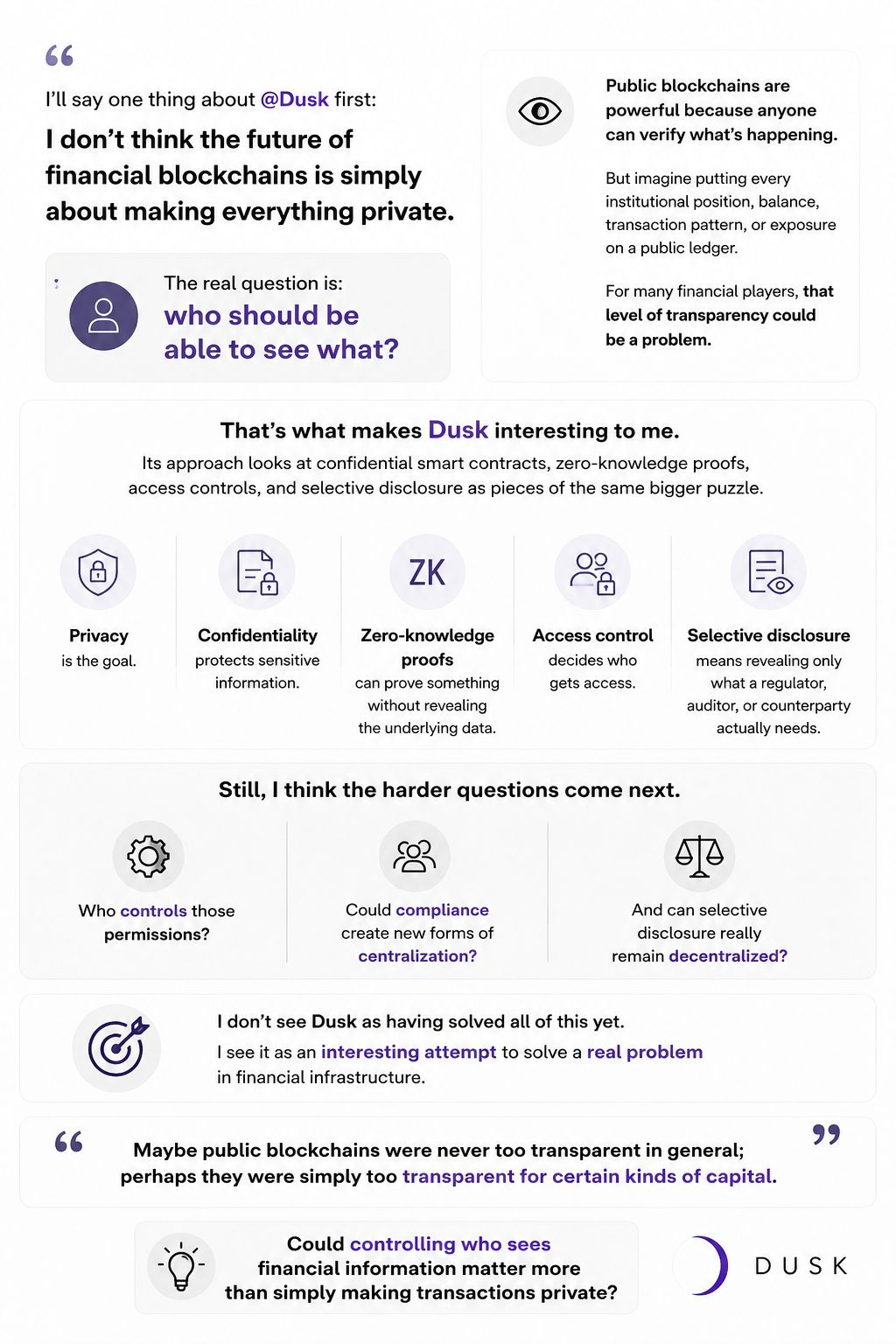
I’ll say one thing about @Dusk first: I don’t think the future of financial blockchains is simply about making everything private.
The real question is: who should be able to see what?
Public blockchains are powerful because anyone can verify what’s happening. But imagine putting every institutional position, balance, transaction pattern, or exposure on a public ledger. For many financial players, that level of transparency could be a problem.
That’s what makes Dusk interesting to me.
Its approach looks at confidential smart contracts, zero-knowledge proofs, access controls, and selective disclosure as pieces of the same bigger puzzle.
But they’re not the same thing.
Privacy is the goal. Confidentiality protects sensitive information. Zero-knowledge proofs can prove something without revealing the underlying data. Access control decides who gets access. Selective disclosure means revealing only what a regulator, auditor, or counterparty actually needs.
Still, I think the harder questions come next.
Who controls those permissions? Could compliance create new forms of centralization? And can selective disclosure really remain decentralized?
I don’t see Dusk as having solved all of this yet. I see it as an interesting attempt to solve a real problem in financial infrastructure.
Maybe public blockchains were never too transparent in general; perhaps they were simply too transparent for certain kinds of capital.
Could controlling who sees financial information matter more than simply making transactions private?
@Dusk #dusk $DUSK
$BTR
$ONG
إخلاء مسؤولية: يتضمن آراء جهات خارجية. لا تُعدّ نصيحة. يُمكن استخدام Binance AI دون أي ضمان.اطلع على الشروط والأحكام.