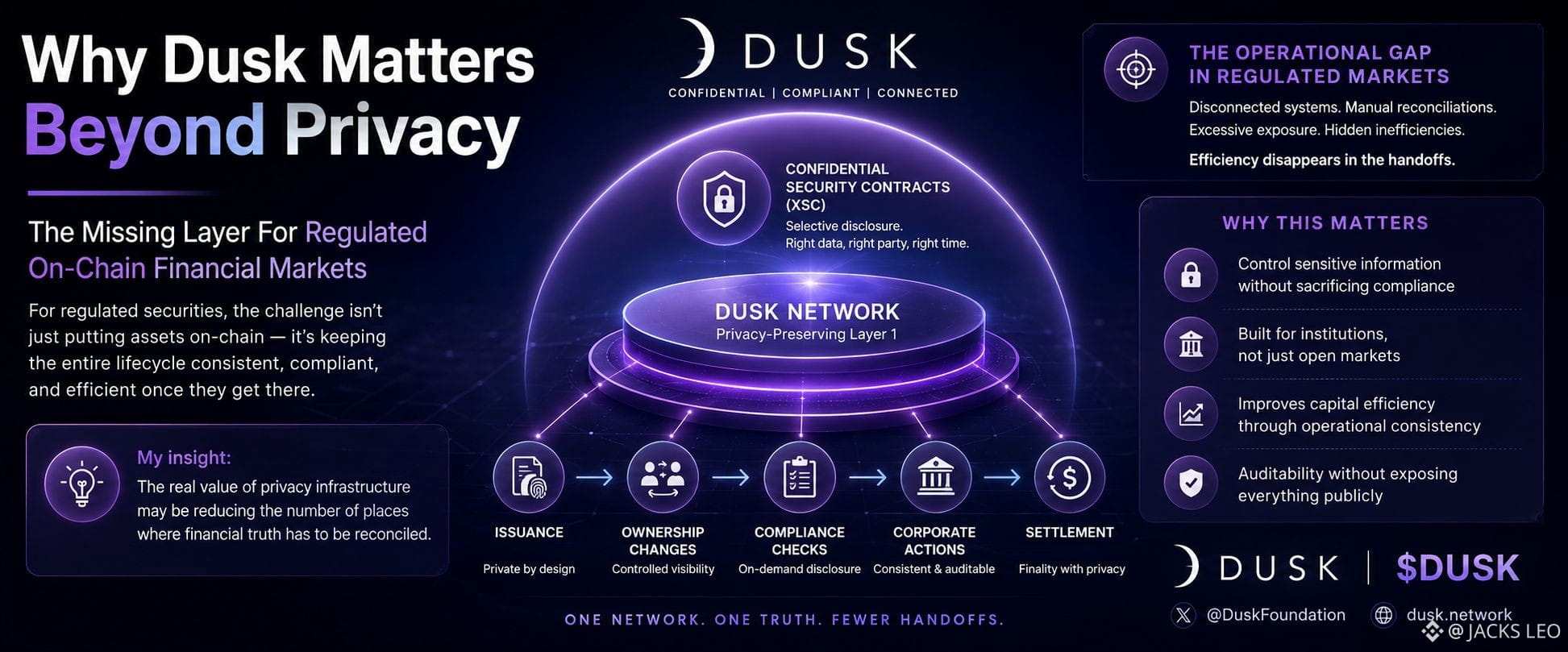
I’ve been looking at Dusk from a slightly different angle: the hard part for regulated securities may not be putting them on a blockchain, but keeping their entire lifecycle consistent once they get there.
Issuance, ownership changes, transfers, compliance checks, corporate actions and settlement all create operational handoffs. If every step requires moving between systems, the efficiency promised by on-chain markets can quietly disappear. This is where Dusk becomes interesting to me.
Its architecture can be viewed as an attempt to bring regulated financial workflows closer together, while still allowing sensitive information to remain controlled rather than exposing everything publicly. That matters because institutions rarely need “maximum transparency.” They need the right information visible to the right party at the right time.
My takeaway: the real value of privacy infrastructure may be reducing the number of places where financial truth has to be reconciled.
The open question is whether Dusk can attract enough real financial activity to prove that this infrastructure creates meaningful operational and capital-efficiency gains, rather than simply offering better technology.
I’m watching adoption and real transaction workflows more than short-term DUSK price action.
@Dusk $DUSK #dusk
Issuance, ownership changes, transfers, compliance checks, corporate actions and settlement all create operational handoffs. If every step requires moving between systems, the efficiency promised by on-chain markets can quietly disappear. This is where Dusk becomes interesting to me.
Its architecture can be viewed as an attempt to bring regulated financial workflows closer together, while still allowing sensitive information to remain controlled rather than exposing everything publicly. That matters because institutions rarely need “maximum transparency.” They need the right information visible to the right party at the right time.
My takeaway: the real value of privacy infrastructure may be reducing the number of places where financial truth has to be reconciled.
The open question is whether Dusk can attract enough real financial activity to prove that this infrastructure creates meaningful operational and capital-efficiency gains, rather than simply offering better technology.
I’m watching adoption and real transaction workflows more than short-term DUSK price action.
@Dusk $DUSK #dusk