#dusk $DUSK @Dusk
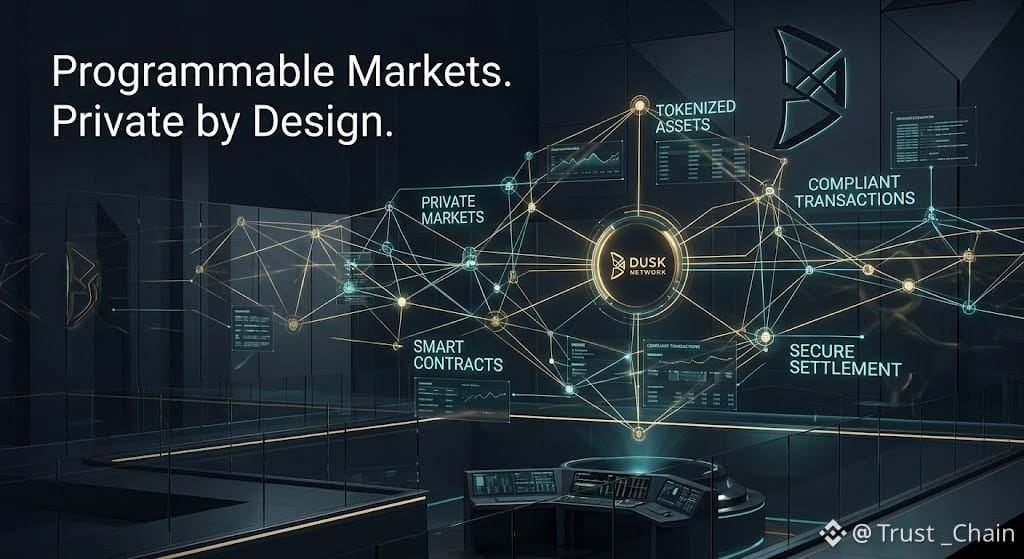
DUSK is starting to look less like an RWA narrative — and more like market infrastructure. 👀
Looking beyond the headlines, the thesis is becoming more interesting than simply “a private blockchain for institutions.”
The key is workflow compression.
Traditional private markets involve issuers, investors, administrators, venues, custodians, payment providers and legal infrastructure — often with each party managing pieces of the same ownership lifecycle.
Dusk’s approach is to make that lifecycle programmable:
Eligibility → Issuance → Ownership → Transfer → Payment → Settlement
Tokenization isn’t simply putting an asset onchain.
It’s about making the rules surrounding that asset programmable.
And importantly:
Tokenization does NOT automatically create liquidity.
Real liquidity still needs eligible investors, demand, pricing, venues, custody and payment infrastructure.
That’s why the NPEX direction is interesting — connecting blockchain infrastructure to an existing regulated market instead of building another speculative market in isolation.
The architecture supports that thesis:
DuskDS → settlement & data availability
DuskVM → native execution & ZK
DuskEVM → Solidity/EVM applications
Hedger → confidential EVM workflows
Citadel → identity & selective disclosure
Dusk Trade → tokenized-asset market infrastructure
The goal isn’t to make everything private.
It’s to make the right information visible to the right participant at the right time.
That’s a much more practical privacy model for regulated finance.
The bigger $DUSK thesis?
Not replacing traditional finance — making regulated financial workflows programmable.
Now the real test is execution: sustained issuance, trading and settlement activity.
That’s what I’m watching. 👀
#dusk @Dusk $DUSK
DUSK is starting to look less like an RWA narrative — and more like market infrastructure. 👀
Looking beyond the headlines, the thesis is becoming more interesting than simply “a private blockchain for institutions.”
The key is workflow compression.
Traditional private markets involve issuers, investors, administrators, venues, custodians, payment providers and legal infrastructure — often with each party managing pieces of the same ownership lifecycle.
Dusk’s approach is to make that lifecycle programmable:
Eligibility → Issuance → Ownership → Transfer → Payment → Settlement
Tokenization isn’t simply putting an asset onchain.
It’s about making the rules surrounding that asset programmable.
And importantly:
Tokenization does NOT automatically create liquidity.
Real liquidity still needs eligible investors, demand, pricing, venues, custody and payment infrastructure.
That’s why the NPEX direction is interesting — connecting blockchain infrastructure to an existing regulated market instead of building another speculative market in isolation.
The architecture supports that thesis:
DuskDS → settlement & data availability
DuskVM → native execution & ZK
DuskEVM → Solidity/EVM applications
Hedger → confidential EVM workflows
Citadel → identity & selective disclosure
Dusk Trade → tokenized-asset market infrastructure
The goal isn’t to make everything private.
It’s to make the right information visible to the right participant at the right time.
That’s a much more practical privacy model for regulated finance.
The bigger $DUSK thesis?
Not replacing traditional finance — making regulated financial workflows programmable.
Now the real test is execution: sustained issuance, trading and settlement activity.
That’s what I’m watching. 👀
#dusk @Dusk $DUSK