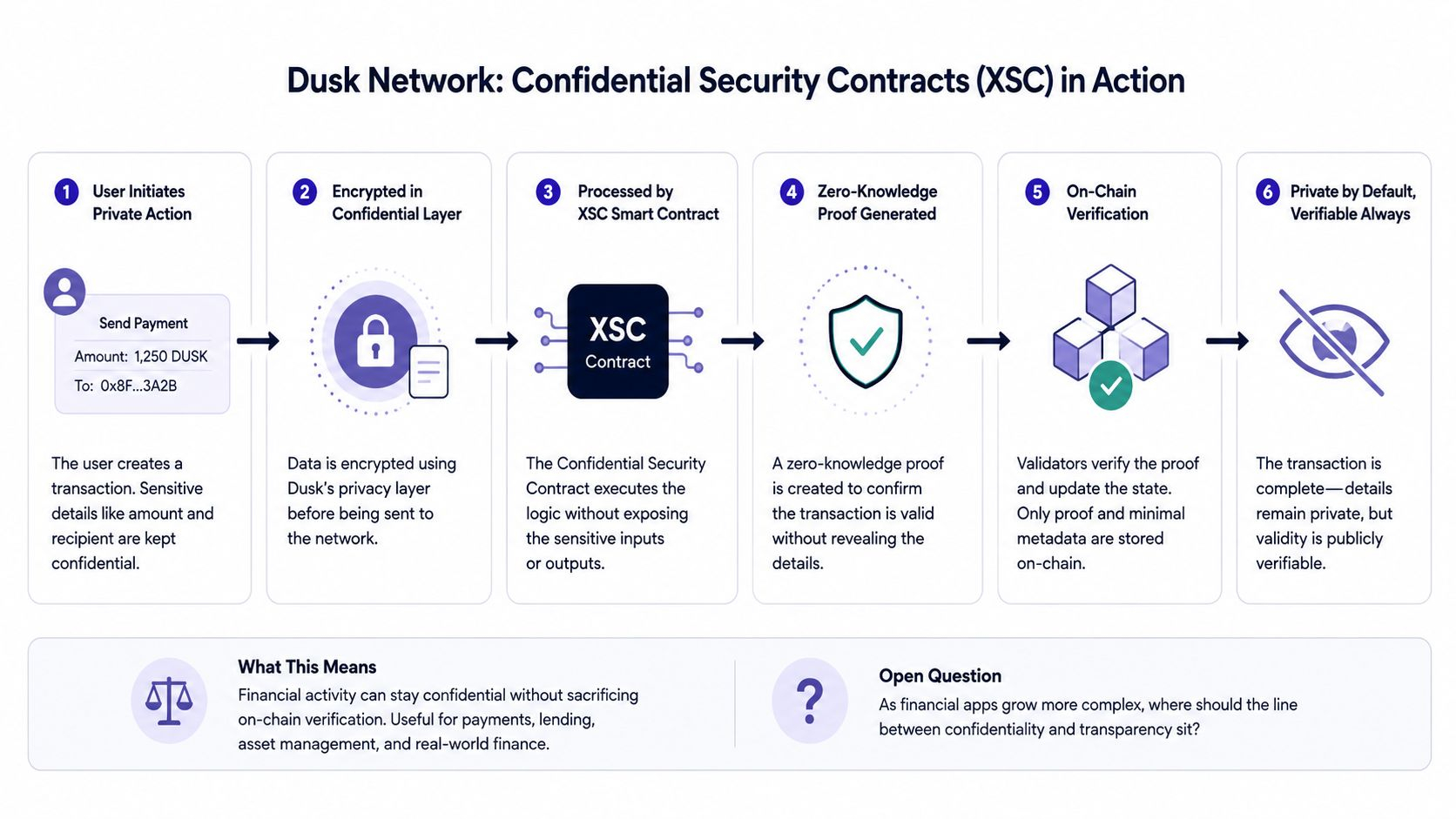

I was looking at Dusk Network again, and one detail kept pulling my attention back: its Confidential Security Contract (XSC) approach. At first, I saw it as another attempt to make blockchain transactions private, but the more I thought about it, the more I noticed the difference in what Dusk is actually trying to preserve.
In most DeFi apps, transparency is almost treated as the default. Wallet activity, balances, and transaction details can become visible on-chain, even when that information may not be something a financial user wants everyone to see. Dusk takes a different approach by building confidentiality into the way contracts operate rather than treating privacy as an extra layer added later.
That sounds useful, but I think the important question is how this behaves when real financial applications become more complicated. Privacy can make a system more practical, but it can also introduce trade-offs around verification, integration, and how users understand what is happening underneath.
What I find interesting is that Dusk isn't simply asking whether blockchains can hide information. It's asking how much financial activity can remain private while still being verifiable and usable on-chain.
I’m still watching that balance closely. In a real financial application, where should the line between confidentiality and transparency actually sit?
@Dusk $DUSK #dusk
In most DeFi apps, transparency is almost treated as the default. Wallet activity, balances, and transaction details can become visible on-chain, even when that information may not be something a financial user wants everyone to see. Dusk takes a different approach by building confidentiality into the way contracts operate rather than treating privacy as an extra layer added later.
That sounds useful, but I think the important question is how this behaves when real financial applications become more complicated. Privacy can make a system more practical, but it can also introduce trade-offs around verification, integration, and how users understand what is happening underneath.
What I find interesting is that Dusk isn't simply asking whether blockchains can hide information. It's asking how much financial activity can remain private while still being verifiable and usable on-chain.
I’m still watching that balance closely. In a real financial application, where should the line between confidentiality and transparency actually sit?
@Dusk $DUSK #dusk